

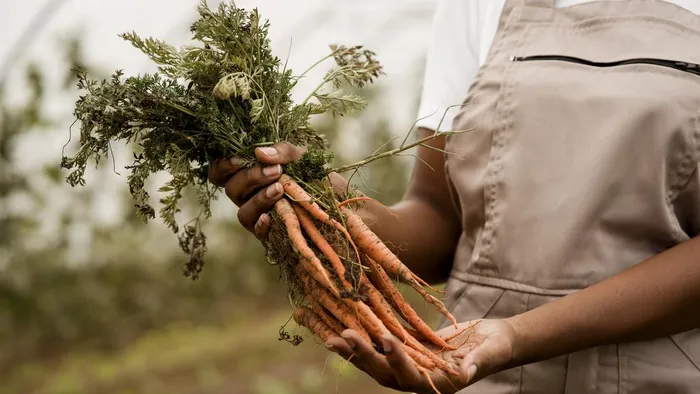
A healthy agricultural industry is vital to economic development, employment and food security.
Image: Freepik
South Africa’s farms aren’t just fields and early mornings – they are engines of income, jobs and food for millions of families, new data from Statistics South Africa shows.
The latest Agricultural Survey reveals horticulture – citrus, vegetables and other high-value crops – is leading the charge in sales, outpacing traditional field crops, livestock and animal products.
Maize, cattle and fruit remain strong earners, keeping the sector balanced and profitable.
“A healthy agricultural industry is vital to economic development, employment and food security,” Statistics South Africa said in its note on the survey, which is based on 2024 data.
Agriculture is a key push driver for economic growth, Investec chief economist Annabel Bishop recently stated. “The ample field crop harvests this year have bolstered agriculture production substantially,” she said.
The International Monetary Fund notes that following two quarters of strong activity, overall growth in South Africa is projected to reach 1.3 to 1.4 percent in 2025‑26, driven by continued robust private consumption.
While exports remain hampered by tariffs and ongoing global trade policy uncertainty, strong commodity prices are supporting export receipts in the near term. There are, however, risks to the downside.
The US tariffs on South African agricultural exports could devastate rural employment and hit economic growth, the South African Reserve Bank (SARB) has warned.
In its October 2025 Monetary Policy Review, the bank said that although agriculture makes up only 4.2% of South Africa’s exports to the US, the sector is “fully exposed” to the 30% tariff now in effect. Citrus, sugar and wine are among the hardest-hit products.
“The loss of jobs and incomes could decimate some rural communities,” the report said, noting employment could drop by as many as 40,000 jobs compared with the baseline scenario.
Other estimates put potential job losses at about 22,000 across the economy; enough to push the total number of unemployed close to nine million. SARB’s models suggest the tariffs could knock 0.4 percentage points off South Africa’s economic growth in 2026.
US tariffs on South African exports to that country took effect on August 7, 2025, after South Africa failed to strike a new trade deal with Washington. These taxes mainly affect the automotive and farming sectors.

Small, medium and micro producers now generate more than a third of total commercial farming income.
Image: Statistics South Africa
Smaller farms are rewriting the rules. Small, medium and micro producers now generate more than a third of total commercial farming income and employ roughly half of the agricultural workforce.
These farms are often far from big processing hubs, supporting rural communities and local markets.
Statistics South Africa notes that one of the priorities listed in the final communiqué from the Business 20 (B20) South Africa forum is the inclusion of small and medium-sized enterprises in global value chains.
This includes supporting small-scale agricultural producers and smallholder farmers.
Commercial agriculture created 25,614 jobs between 2023 and 2024, a 3.1% increase. Almost six in ten employees in the agricultural industry were men.
This matters not just for farm owners, but for rural economies where jobs are scarce, and every income counts.
Regionally, the Western Cape stands out as the powerhouse of sales, employment and wages.
IOL BUSINESS