


War-torn South Sudan is predicted to have the fastest growing economy this year at 24.3%.
Image: Wikimedia Commons
As South Africa’s moribund economy continues to limp along, war-torn South Sudan has been listed as the world’s fastest-growing economy in 2025, according to data storytelling platform Voronoi.
However, there’s a caveat. Voronoi’s extrapolation appears to be completely inaccurate.
IOL probed the recent blog post and determined that Voronoi referenced the International Monetary Fund’s (IMF’s) Latest World Economic Outlook publication.
It extrapolated the data to predict that South Sudan’s growth will land at 24.3% this year.
However, the actual World Economic Outlook does not distinguish between South Sudan and Sudan. Moreover, a close look at the figures shows that Sudan had a negative 24.3% growth in 2024.
The same percentage as the one Voronoi has – just totally reversed.
And, if you Google “what country is expected to have the fastest growing economy 2025,” the Voronoi data comes up.
Sudan’s gross domestic product (GDP) is projected to grow by 9.5% in 2025, according to the IMF’s World Economic Outlook.
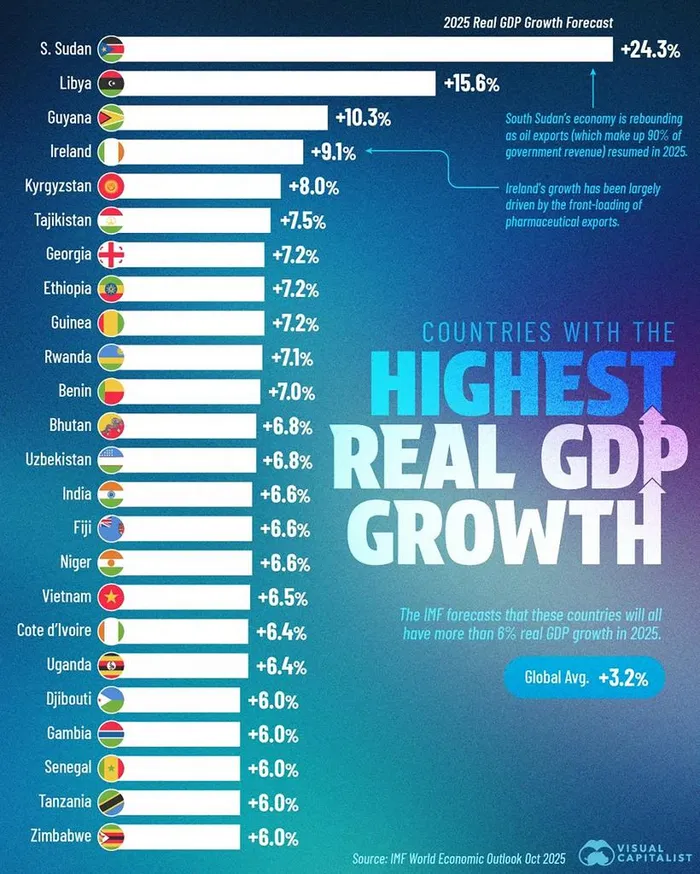
Voronoi’s extrapolation of IMF data.
Image: Voronoi
Voronoi is a mobile platform for data storytelling, created by the team behind Visual Capitalist, which itself analyses data.
FocusEconomics.com stated that South Sudan is expected to grow at 17.8% next year. "But while the projection looks impressive, it is the result of a highly favourable base of comparison; the economy shrank 26% in 2024 due to spillovers from the war in neighbouring Sudan," it said.
The IMF projects global growth at about 3.2%, highlighting how unusual South Sudan’s rebound would be in a global context.
In the IMF report, it noted that its projections reflect assumptions that the ongoing conflict in Sudan will end by the end of 2025 and that reconstruction will commence shortly after that.
It also stated that “data for 2011 exclude[s] South Sudan after July 9; data for 2012 and onward pertain to the current Sudan”.
South Sudan is East Africa’s youngest nation, gaining independence from Sudan in 2011.
It is known for its diverse wildlife and the vast Sudd swamp, but decades of civil war, political instability, and poverty have left its economy fragile, heavily reliant on oil and agriculture, with Juba as its capital.
The World Bank reports that South Sudan’s secession triggered economic shocks for both countries.

Figures from International Monetary Fund’s Latest World Economic Outlook publication.
Image: International Monetary Fund
Sudan lost oil revenues that had accounted for half of government revenue and 95% of exports, slowing growth and contributing to double-digit inflation. Rising fuel costs and economic hardship triggered protests in 2013.
Both Sudan and South Sudan continue to be affected by conflict. Human Rights Watch and Amnesty International reported that fighting between rival forces in Sudan has caused widespread civilian harm.
This includes war crimes, extrajudicial killings, and displacement in Darfur and other regions, with millions of people forced from their homes. Internal wars in South Sudan have similarly disrupted production and displaced populations.
By contrast, South Africa’s gross domestic product growth (GDP) is set to come in at less than 1.5% based on various estimates, including from economists, the IMF, and Minister of Finance Enoch Godongwana, among others. Actual figures are yet to be released.
IOL BUSINESS