

Food inflation continues to run ahead of the average at 4.4%.
Image: Pexels
South Africa’s inflation rate in 2025 hit its lowest level in more than two decades, easing price pressures on households, Statistics South Africa said.
Overall, Statistics South Africa data shows that, while some individual items remain costly, the slower overall inflation rate means that, on average, household spending did not increase as sharply as in previous years.
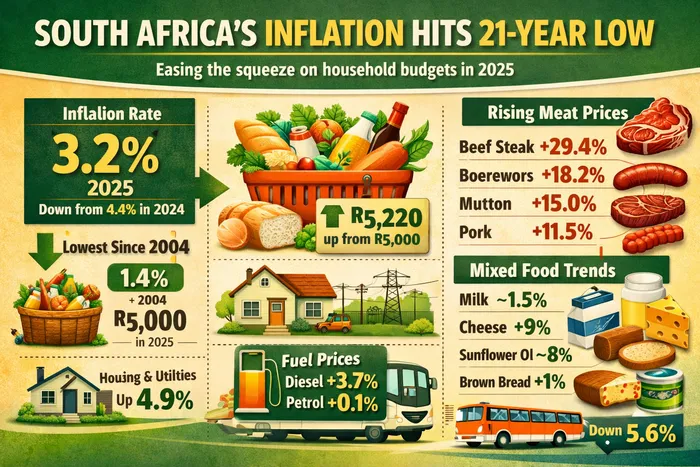
The average consumer price index for the year was 3.2%, down from 4.4% in 2024, the lowest annual rate since 2004, when inflation averaged 1.4%.
Even though prices rose, the pace was slower than in recent years, helping households stretch their budgets further.
Food and non‑alcoholic beverages recorded steady inflation of 4.4%, but meat prices accelerated sharply over the year.
Using 2024 as a baseline, a basic food basket costing R5,000 per month in 2024 would have risen to roughly R5,220 per month in 2025. Meat prices were the biggest contributor, with beef steak, boerewors, and mutton all rising faster than average food inflation.
Beef steak rose 29.4%, sausages 19.4%, boerewors 18.2%, mutton 15.0%, and pork 11.5%. Cereal products also rose, including brown bread (1.0%), white bread (1.7%) and spaghetti (3.1%), while maize meal slowed to 9.5%.
The good news is that dairy remained largely in deflation, with fresh full-cream milk down 1.5%, but cheddar cheese prices rose 9.0%.
Inflation at a glance.
Image: ChatGPT
Oil and fats slowed to 4.6%, with sunflower oil softening and olive oil 8.0% cheaper than a year ago. Non-alcoholic beverages rose 4.2%, up from 3.7% in November.
Housing and utilities rose 4.9% year‑on‑year, and actual rentals are up 3.7% annually, including townhouses 4.6%, flats 4.2%, and houses 3.3%.
For households paying around R9,000 in rent in 2024, this translates to about R9,440 per month in 2025.
Electricity, water, and refuse collection also saw moderate increases, reflecting the overall category’s inflation.
However, domestic workers’ wages increased at a slower pace than in 2024.
Other essentials, such as public transport, education, and communication services, experienced smaller price changes, meaning some everyday costs remained largely stable.
Fuel prices rose modestly, with diesel up 3.7% and petrol 0.1%, while long-distance bus fares fell 5.6% year-on-year despite a December spike of 38.6% due to seasonal travel.
IOL BUSINESS