


South Africa's unemployment crisis is being rebuilt each year from the bottom up.
Image: Freepik
South Africa's unemployment problem is often framed as a failure of policy or economic growth.
But Stats in Brief 2025, published by Statistics South Africa, shows that the pressure on the labour market begins much earlier – and is being driven by the steady expansion of the legally employable population.
When population growth is read alongside employment and unemployment data, a clear picture emerges: more people are reaching working age every year than the economy is able to absorb.
And the first point of strain is already visible in the country's youngest legal workers.
A demographic pipeline under pressure
According to Statistics South Africa’s mid-year estimates, South Africa's population reached about 63.1 million in 2025, growing at just over 1% a year. That growth is not evenly distributed across age groups.
The majority of South Africans are now aged 15 and older, and the fastest pressure point is at the very bottom of that range.
The 15–19 age cohort alone accounts for roughly 5.5 million people, making it one of the single largest five-year age bands in the country.
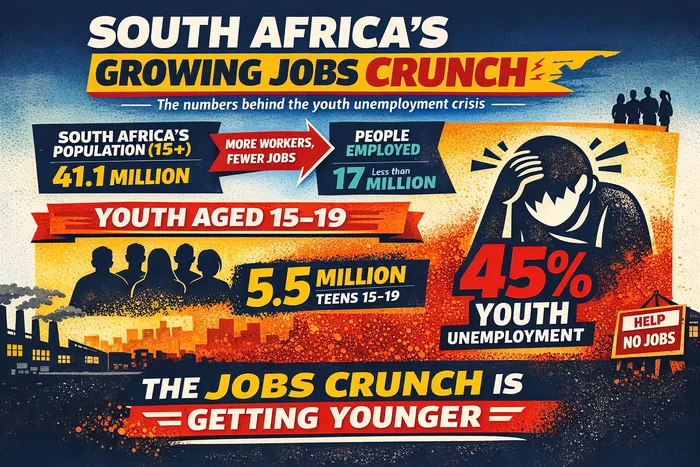
Youth unemployment in numbers.
Image: ChatGPT
Every year, a new slice of this group becomes legally eligible to work, study further, or enter vocational training.
From a labour-market perspective, this is a wide and growing pipeline that feeds everything else.
As this youth cohort ages into their early twenties, they join an already large working-age population (15–64) that now exceeds 40 million people.
The employment gap
In theory, this should be a demographic advantage: a large, youthful labour force capable of driving growth. In practice, the employment data tells a different story.
Statistics South Africa's labour force figures show that fewer than 17 million people are employed.
Even allowing for those still in education or not seeking work, the gap between the number of people legally able to work and those actually in jobs is substantial – and widening.
Where youth unemployment begins
This is where the youth cohort becomes central to understanding unemployment.
Unemployment is highest among younger age groups, particularly those entering the labour market for the first time.
The 15–19 group sits at the boundary of this problem. Many are still in school, but those who are not – or who are trying to enter training or informal work – face extremely limited opportunities.
As they move into the 20–24 age bracket, the pressure intensifies. Stats in Brief shows that these are among the most populous age groups in the country, but also among those with the weakest employment outcomes.
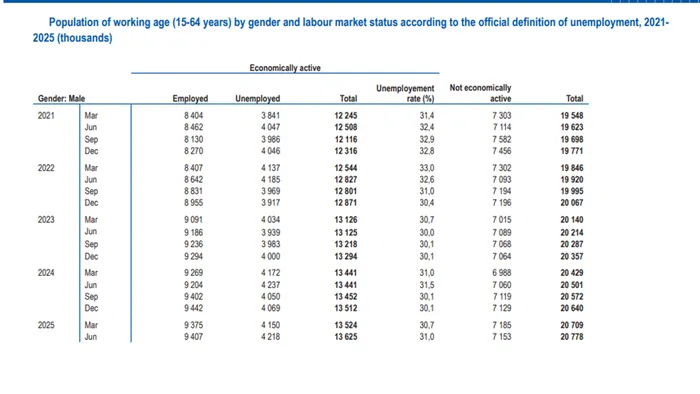
Population of working age (15-64 years) by gender and labour market status according to the official definition of unemployment, 2021-2025 (thousands).
Image: Statistics South Africa
Not all adults aged 15 and older are economically active. Many have stopped looking for work altogether.
For young people, especially, repeated failure to find work early on can lead to long-term disengagement.
This matters because unemployment figures understate the scale of the problem – the demographic expansion continues regardless of whether people give up looking.
The result is a backlog of young adults who are legally employable, willing to work, but unable to find jobs.
A cumulative crisis
Crucially, this is not a one-off shock. It happens every year.
A new cohort turns 15 annually. If job creation is weak, that cohort does not replace those who have found work – it adds to those who have not. Unemployment becomes cumulative.
Each year starts with more people needing jobs than the year before.
Read together, the population and labour data in Stats in Brief 2025 point to a structural imbalance. South Africa's population is growing mainly in legally employable age groups, starting with a very large 15–19 cohort.
Employment growth, meanwhile, is too slow to absorb even a fraction of that expansion.
The consequence is a labour market under permanent strain – not because people are entering illegally or prematurely, but because the legal working-age population is expanding faster than the economy can respond.
That is the deeper story in the data: South Africa's unemployment crisis is being rebuilt each year from the bottom up, beginning with the youngest legal workers and following them into adulthood.
IOL BUSINESS