


Economists are hopeful VAT won't go up this year.
Image: Pexels | Nataliya Vaitkevich
As South Africa heads into Budget day, Value-Added Tax (VAT) is again in the spotlight — not necessarily because it is expected to change, but because of how deeply it touches both government revenue and household finances.
VAT remains one of the state’s most reliable sources of income, yet also one of its most politically sensitive levers.
This indirect tax levied at 15.5% on most goods and services in South Africa, collected by the South African Revenue Service, applies to most transactions.
However, certain goods are taxed at 0%, including 19 basic food items, along with fuel, paraffin and exports.
Other categories fall outside the VAT system altogether. Residential rental accommodation, selected educational services and non-fee-based financial services are among those treated as exempt.
That structure, while technical, has become central to broader fiscal debates.
Last year’s National Budget demonstrated just how combustible VAT policy can be. A proposal to lift the rate by two percentage points triggered political infighting within the government of national unity, followed by legal challenges from opposition parties.
Just before court rulings were due, government backed down.
Finance Minister Enoch Godongwana confirmed VAT would remain at 15% from 1 May 2025, abandoning the planned increase after consultations with coalition partners and parliamentary committees.
The reversal avoided an immediate cost-of-living shock for consumers but left National Treasury facing an estimated R75 billion revenue shortfall over the medium term.
It also forced Treasury to present the Budget three times before it was finally adopted in May – the first such delay in democratic South Africa’s history.
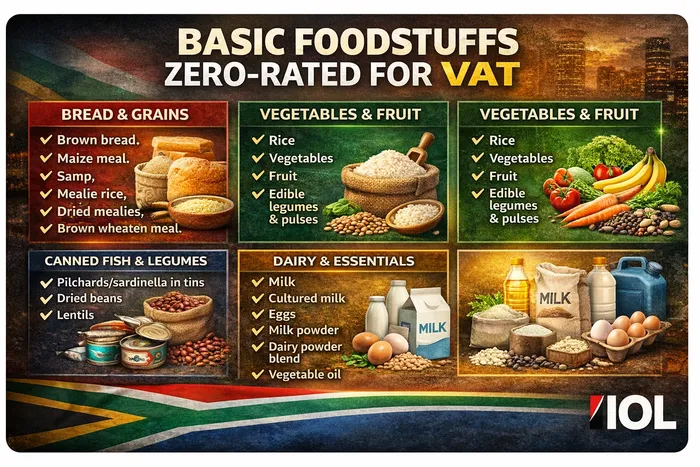
19 food items are exempt from VAT.
Image: ChatGPT
Against that backdrop, analysts say Treasury is unlikely to risk reopening the VAT battle.
Chief economist at Citadel, Maarten Ackerman does not anticipate major tax changes. “Given last year’s political challenges around VAT, it is highly unlikely that the government will revisit a VAT hike,” he explains.
Ania Strydom, payroll compliance research manager at Deel Local Payroll, said National Treasury understands VAT increases remain unpalatable, “particularly in a coalition-driven environment”.
However, calls to expand the list of zero-rated goods may resurface as households grapple with rising living costs, she added.
Though not necessarily transformative, for consumers stability would be welcome.
Tando Ngibe, senior manager at Budget Insurance, said if VAT and personal income tax remain unchanged, households should assess what that means for their finances. Consumers need to “pay close attention” to the presentation, he says.
Meanwhile, Shaheed Patel, consultant, tax & exchange control and Dehal Jivan, candidate attorney at CMS South Africa have already noted that National Treasury had previously noted a revenue "overrun" partially driven by VAT, which earned it R11.3 billion.
Kristof Kruger, senior fixed income trader at Prescient Securities, pointed to the fact that we could see smaller indirect adjustments, such as tweaks to VAT exemptions.
The Organisation Undoing Tax Abuse cautions government not to raise VAT, saying “last year’s decision not to proceed with a broad-based 2% VAT increase demonstrated that credible alternatives to regressive taxation exist”.
Even without a VAT hike, consumers are unlikely to escape price pressures.
Ester Ochse, product head at First National Bank Integrated Advice, warned that indirect taxes and inflation can still lift the cost of everyday goods
Increases in duties on alcohol and sugary drinks, along with levies on items such as plastic bags, may appear small individually but accumulate over time, stretching household budgets, she said.
Globally, governments are wrestling with similar trade-offs.
Lelethu Poswa, fund management at Anchor Capital points out that, in Japan, Prime Minister Sanae Takaichi is proposing a temporary two-year removal of VAT on food.
VAT there is 10%, with a reduced 8% rate for food, beverages (excluding alcohol/dining in), and newspaper subscriptions. This rate has remained stable since October 2019 to fund an aging population.
IOL BUSINESS