


South Africans are just not happy.
Image: Freepik
Global data shows a clear relationship between income and life satisfaction, with countries that have higher GDP per capita consistently ranking among the happiest in the world.
Countries at the top of the World Happiness Report rankings, including Finland, Denmark and Iceland, record scores above 7, supported by higher income levels.
South Africa, by contrast, ranks 101st with a score of around 5, placing it in the lower half of the global rankings.
The World Happiness Report combines well-being data from over 140 countries with high-quality analysis by world-leading researchers from a range of academic disciplines.
The annual report is published by the University of Oxford’s Wellbeing Research Centre in partnership with Gallup, the UN Sustainable Development Solutions Network, and our Editorial Board.
“By making the essential insights from wellbeing science accessible to all, we give everyone the knowledge to create more happiness for themselves and others,” the association says.
Statistics South Africa’s report Subjective Poverty in South Africa: Findings from the Income & Expenditure Survey, 2022/2023 notably found that “individuals’ reported levels of happiness are consistently associated with how they evaluate their financial circumstances.”
Fewer South Africans now describe themselves as poor than they did eight years ago, but many still say their income does not cover the cost of everyday living.
Statistics South Africa examined what economists call subjective poverty – how individuals perceive their own financial well-being and whether they believe they can meet what they consider to be a basic, acceptable standard of living.
The World Happiness Report’s dataset shows that countries with higher GDP per capita are generally grouped at the top of the rankings, while lower-income countries tend to rank further down.
GDP per capita is one of the main factors used to explain differences in life evaluation scores.
At the same time, happiness scores are based on a range of factors, including social support, healthy life expectancy, freedom, generosity and perceptions of corruption.
World Happiness Report data shows that South Africa’s position has changed over time.
The country recorded its most significant improvement around 2016, when its ranking climbed compared with earlier years.
More recently, the data shows a decline, with one of the steepest drops occurring in 2024.
This movement has contributed to South Africa’s current position at 101.
The data indicates that the country’s ranking reflects a series of gains and losses rather than a consistent trend.
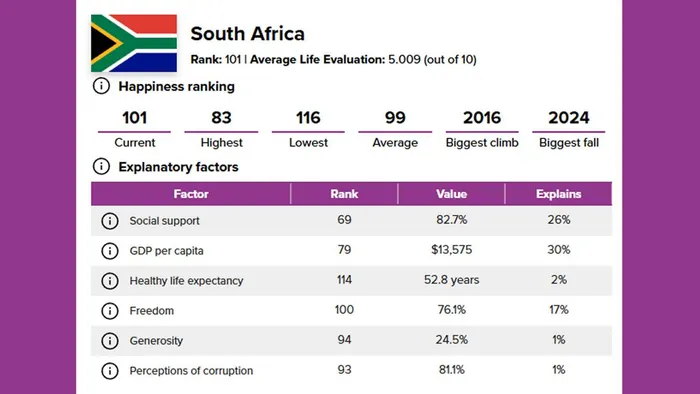
South Africa's position in the World Happiness Report.
Image: World Happiness Report
South Africa’s ranking places it below several countries in the global table.
This suggests that income alone is not determining its position in the rankings.
The data shows that while GDP per capita remains a key factor, other components also contribute to overall life evaluation scores. South Africa’s economic performance provides additional context.
Statistics South Africa reported that the economy expanded by 0.4% in the fourth quarter of 2025, lifting full-year growth to 1.1% – the strongest annual performance since 2022.
National Treasury expects growth to reach 1.6% in 2026, up from an estimated 1.4% in 2025. However, economists have flagged risks to the outlook given the ongoing war in the Middle East.
Maarten Ackerman, chief economist at Citadel, said the overall growth picture remained fragile despite the modest improvement in 2025.
“There are huge question marks around the length of the Middle East conflict, which could potentially have a downward impact on global and SA growth,” PSG chief economist Johann Els has said.
Inflation pressures are expected to increase, with a sharp fuel price rise projected for April.
“These increases will be the highest ever implemented in a single month in South Africa and will likely derail the fragile economic recovery envisaged for South Africa in 2026,” independent economist Elize Kruger has said.
The World Happiness Report data shows that GDP per capita is one of several factors used to explain differences in life evaluation scores.
Other factors include social support, healthy life expectancy, freedom, generosity and perceptions of corruption.
These factors contribute to how individuals assess their quality of life.
The data shows that while income remains closely linked to happiness globally, rankings vary across countries and over time.
South Africa’s position at 101 reflects that variation.
IOL BUSINESS