

A food shocker is in the pipeline as diesel goes up.
Image: Pezels
When the South African Reserve Bank models inflation risks, it starts with oil prices and the rand.
But for South African households, the real impact is far more immediate – and far more tangible – at the supermarket till.
Governor Lesetja Kganyago said the central bank had modelled two scenarios tied to sustained higher oil prices. In the first, oil averages close to $100 a barrel, and the rand weakens by around 5%, pushing inflation above 4% and requiring an additional interest rate increase this year.
In a more severe scenario, where oil remains above $100 for over a year, and the rand weakens by about 10%, inflation exceeds 5%, and several rate hikes would be required before it returns to target by 2028.
In both cases, growth is weaker initially before there is some catch-up later, Kganyago said. That is the macroeconomic framing. The reality for households sits much closer to home – and it runs through diesel.
A potential increase of around R11 per litre in diesel from 1 April represents a structural cost shock, not a marginal adjustment.
South Africa’s supply chain is heavily road-based, with roughly 80% of goods transported by truck. That system is overwhelmingly diesel-powered, with millions of commercial vehicles moving goods across the country daily.
Transport alone can account for up to 10% to 15% of the final price of food, depending on distance and product type.
A jump from roughly R25/litre to R36/litre implies a 44% increase in diesel costs.
Even partial pass-through has a measurable impact. Some crude mathematics based just on headline inflation expectations across this piece, with the anticipated fuel price hike, shows that:
That is before factoring in a weaker rand, which raises the cost of imported inputs like fertiliser and fuel itself.
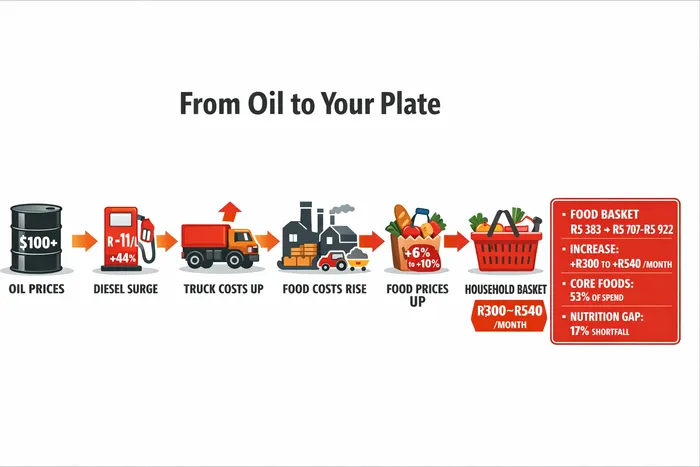
The flow through effects of higher fuel costs.
Image: ChatGPT
Data from the Pietermaritzburg Economic Justice & Dignity Group’s Household Affordability Index shows the average household food basket cost R5,383.81 in February 2026.
That figure has been relatively stable, rising just R70.59, or 1.3%, year-on-year.
A diesel-driven shock changes that trajectory sharply.
Applying a 6%–10% increase:
A single cost shock could add between R300 and R540 a month to food spending. That is several multiples of the recent annual increase.
The composition of the basket matters as much as its size. According to the same index, core staple foods account for roughly 53% of total household food expenditure.
These include maize meal, rice, bread and cooking oil – items that households cannot substitute away from. When their prices rise, households do not reduce consumption. Instead, they cut back on:
This is how inflation translates into deteriorating nutrition rather than just higher spending.
Even before any fuel shock, affordability is stretched. The group’s data shows that a basic nutritious food basket for a family of seven costs R6,459.83.
This is R1,076 higher than what households typically spend on food, implying a 17% shortfall in adequate nutrition.
A diesel-driven increase of R300 to R500 does not simply raise costs – it widens an already significant gap between what households buy and what they need.
The Reserve Bank’s projections place inflation above 4% in a mild scenario and above 5% in a severe one. But headline inflation is an average across the economy.
For low-income households:
This means their experienced inflation rate can exceed the headline number by a meaningful margin.
In effect, the burden of an oil shock is unevenly distributed and concentrated on essentials.
IOL BUSINESS