

The Middle East war is set to harm South Africa's economy.
Image: ChatGPT
South Africa’s economic outlook is being reshaped far beyond its borders, as the Middle East conflict moved through oil markets, pushes up fuel and fertiliser costs, and begins feeding into inflation, household spending and ultimately growth.
At the macro level, the divergence is already visible.
The South African Reserve Bank (SARB) has held its growth forecast steady at about 1.4%, while the Organisation for Economic Co-operation and Development has revised its outlook lower to closer to 1.1%, citing the impact of higher global energy costs and inflation pressures.
That gap reflects a deeper uncertainty: how far and how fast the current shock will move through the economy.
The most immediate impact is being felt at the pump. Petrol prices rose about 15%, translating to increases of around R3 a litre, while diesel surged roughly 40%, adding about R7 per unit.
Fuel is not a contained cost. It is embedded across supply chains, from moving goods to powering operations, which results in fuel hikes quickly moving into broader prices.
“For consumers, fuel price increases are not necessarily at an end if the war intensifies over April, negatively affecting fuel prices further. Risks have risen, and the fuel price increase… if not quickly reversed in May will weaken gross domestic product,” Investec chief economist Annabel Bishop said.
As fuel costs rise, households absorb the first hit through higher transport and food costs, reducing disposable income and weakening consumption, which accounts for roughly 60% of gross domestic product.
The second-round effect is now building in the food system.
Higher diesel prices, rising fertiliser costs and disrupted shipping routes are pushing up input costs across agriculture, with South Africa heavily reliant on imported fertiliser and fuel.
UN Trade and Development has pointed to sharp increases in fertiliser prices, with urea rising by as much as 29% in recent weeks amid supply disruptions linked to geopolitical tensions.
At the same time, fertiliser remains one of the largest cost components in farming.
“Fertiliser can account for up to 50% of input costs in grain production,” says Sanele Nkosi, head of agriculture at BDO South Africa.
That cost pressure will filter through to consumers.
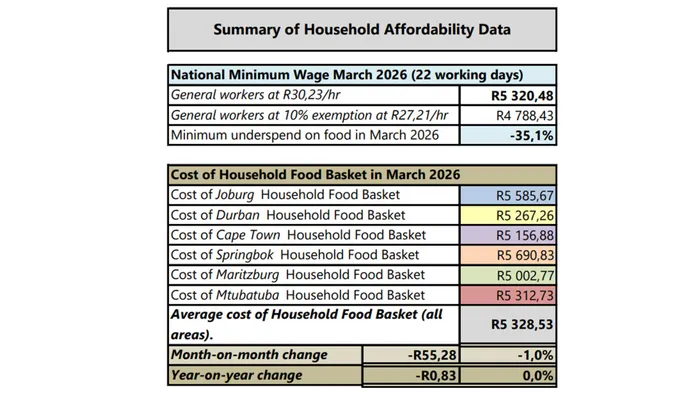
South Africans earning minimum wage underspend on food by 35%.
Image: Pietermaritzburg Economic Justice and Dignity Group.
The Pietermaritzburg Economic Justice and Dignity Group’s March Household Affordability Index shows the average cost of a basic food basket at R5,328.53, broadly unchanged year-on-year.
Yet affordability remains severely constrained. A general worker earning the national minimum wage of R5,320.48 still falls short, leaving households underspending on food by 35.1%.
Why inflation may rise without immediate shortages
Despite rising costs, food shortages are not expected in the near term.
Wandile Sihlobo has cautioned that higher fertiliser prices do not translate immediately into higher food prices, as current supply reflects planting decisions made months earlier.
“Farmers can’t pass costs directly to consumers. They unfortunately can only manage them by reducing plantings. But this is not the case. The food products we have on shelves and will have for months were planted months ago. We have plenty of supplies in South Africa.”
However, that buffer is temporary.
If higher input costs persist, planting decisions may shift, potentially affecting future supply and pricing.
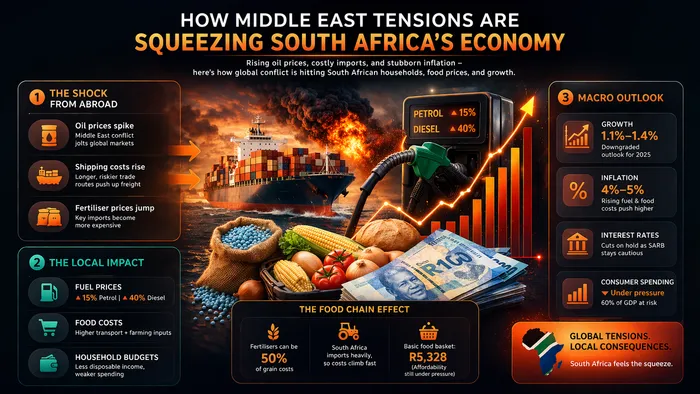
How the Middle East war is affecting South Africa's economy.
Image: ChatGPT
Rising fuel and food costs complicate the inflation outlook and narrow policy options.
Forecasts earlier this year ahead of the war suggested inflation could remain contained more or less within SARB’s range; current conditions point to risks of inflation moving above 4%, and potentially higher if oil prices remain elevated.
Vishal Rama, portfolio manager at Prescient Investment Management, said higher fuel prices “remain a material upside risk to inflation,” despite the temporary tax reduction.
“Higher transport and food costs are likely to reduce household disposable income and weigh on consumer spending,” said Rama.
That limits the ability of the South African Reserve Bank to cut interest rates and raises the possibility that borrowing costs may remain higher for longer. Higher rates, in turn, weigh on investment and credit demand, adding another drag on growth.
In its latest interest rate statement, SARB governor Lesetja Kganyago said the central bank now expects inflation to reach around 4% in the second quarter, with fuel inflation exceeding 18%.
Kganyago warned that a prolonged conflict could push inflation as high as 5% this year, potentially requiring further interest rate hikes to bring it back to the 3% target.
Yet, PSG senior economist Johann Els has said without government’s intervention to cushion the blow of the fuel price hike, inflation would have risen sharply. He said, had the full under-recovery been passed through to consumers, inflation would have reached 4.2% in April. With the levy cut, he now expects 3.6%.
Frank Blackmore, lead economist at KPMG South Africa, noted “Instead of adding approximately 1% points to the consumer price index for April, it will add something closer to 0.6% points to inflation, which gets us just over the 4% inflation, even for April, which is a lot better than things could have been”.
Fuel prices will be felt at the till point.
Image: Freepik
Taken together, the shock is now moving through all major components of the economy.
Consumption is under pressure from rising living costs. Agriculture and food production face higher input costs and potential output constraints. Export sectors are dealing with rising freight costs and logistical uncertainty.
The result is a growth outlook that is increasingly exposed to external forces.
While baseline forecasts still point to growth of around 1.1% to 1.4%, the balance of risks is shifting lower.
What begins as an oil shock is now feeding through fuel, food and household budgets, tightening financial conditions and weighing on demand.
IOL BUSINESS