

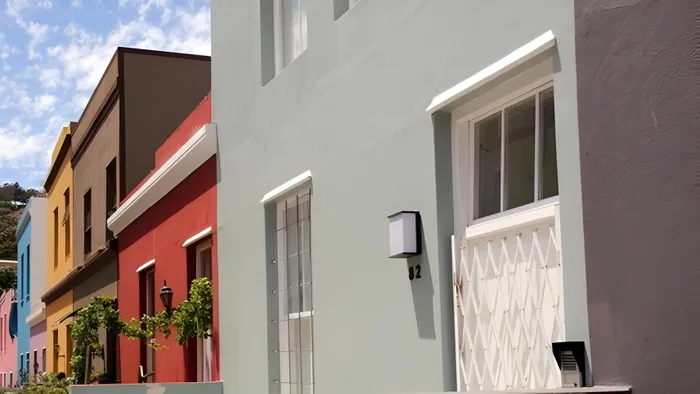
Homes in Cape Town's Bo-Kaap. Home prices in the Western Cape are rising faster than the national average.
Image: Nicola Mawson | IOL
South Africa’s residential property market is gaining momentum, but the gains are increasingly out of step with what households earn.
House price inflation accelerated to 7.1% in November 2025, up from 6.8% in October, with prices rising 0.6% month-on-month, according to Statistics South Africa.
Property owners benefit from rising asset values, particularly in coastal regions, while renters face steadily increasing monthly costs driven by the same underlying forces – demand concentration, limited supply, and higher property prices.
Yet, home prices are rising faster than rents, and both are rising faster than income growth, creating a widening affordability gap. According to the February 2026 PayInc Net Salary Index, average nominal net salaries in South Africa remained stable at R21,550.
Fuelling the increase in housing prices is higher-value regions and property types. The Western Cape recorded inflation of 9.5%, while freehold homes – typically stand-alone houses – rose 8.1% year-on-year, outpacing sectional title properties at 6.6%.
Properties sold for the first time increased by just 1.3%, compared with 7.1% growth for resold homes, indicating that price growth is being driven primarily by the existing housing market, where demand remains stronger.
What this means in practice is that the cost of entering the housing market is rising faster than incomes.
Assuming a monthly income of around R30,000, a R1 million home costs more than 33 times a single month’s income – equivalent to nearly three years of income, before interest and deposits are considered. This highlights how large the purchase is relative to household earnings, even before day-to-day living costs are factored in.
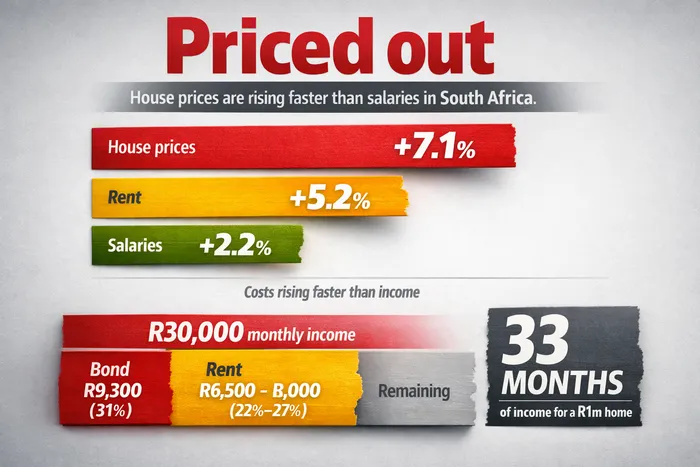
The housing market in numbers.
Image: ChatGPT
A typical bond repayment of around R9,300 on a R1 million home would consume roughly 31% of monthly income, already at the upper limit of what banks consider affordable.
By comparison, renting the same property at R6,500 to R8,000 would take up between 22% and 27% of income, making it significantly more manageable.
Lease agreements often allow for annual increases of between 6% and 10%, but actual rental growth is closer to 5% year – slower than house price inflation – suggesting resistance from tenants.
Geography is also amplifying the trend. The Western Cape’s 9.5% house price inflation is well above the national average, reinforcing its position as both the fastest-growing and most expensive market.
In contrast, Gauteng’s growth of 4.6% reflects a more constrained environment, closer to income realities.
The result is a housing market pulling in two directions.
Asset values are accelerating, particularly in high-demand regions, while affordability is tightening for both buyers and renters.
Freehold properties saw stronger gains of 8.1% compared with 6.6% for sectional title units, suggesting continued demand for larger, stand-alone homes.
Provincially, smaller markets showed sharper increases, with Limpopo up 16.8% and the Northern Cape rising 15.9%, although from a lower base.
IOL BUSINESS