


Unionised sectors will pressurise employers for higher annual salary increases to mitigate the negative impact of higher transport costs on workers’ purchasing power.
Image: Freepik
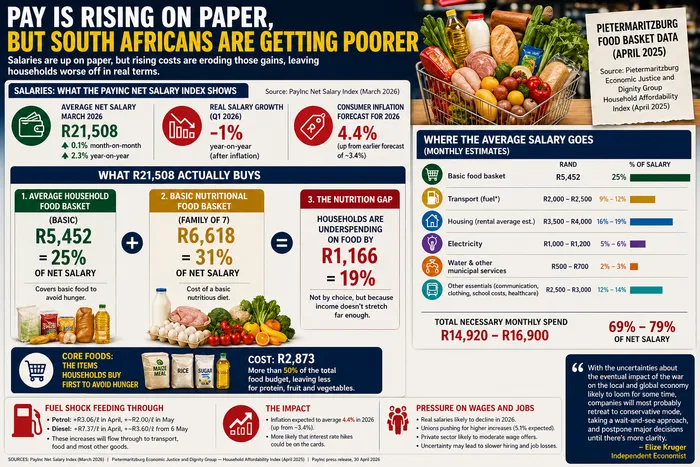
South Africans may be earning slightly more, but rising costs are eroding those gains, leaving households worse off in real terms.
The average net salary edged up to R21,508 in March 2026, a marginal 0.1% increase month-on-month and 2.3% higher than a year ago. However, once inflation is taken into account, net salaries declined by about 1% in real terms over the first quarter of the year, according to the PayInc Net Salary Index.
The PayInc Net Salary Index tracks the average nominal net salaries of about 2.1 million South African earners. Remaining above year-ago levels, the data points to a stabilisation in net salaries over the first quarter of 2026.
However, economic uncertainty linked to the war in the Middle East is expected to weigh on the outlook for the remainder of the year, says PayInc. The gap between nominal and real income is beginning to show up in everyday expenses.
According to the Pietermaritzburg Economic Justice and Dignity Group, the average household food basket cost R5,452 in April. That means roughly a quarter of the average take-home salary is already spent on basic food.
And that is not enough to meet proper nutritional needs. The group found that a basic nutritional food basket for a family of seven costs R6,618, pushing the share of income required for food closer to one-third.
The data highlights a widening gap between what households can afford and what they need to spend.
Families are underspending on food by about 19%, as they prioritise cheaper staples over more nutritious options.
Core foods, the items households buy first to avoid hunger, cost R2,873 and make up more than half of the food budget, limiting the ability to buy protein, fruit and vegetables.
At the same time, rising fuel costs are expected to push prices higher across the economy.
Petrol prices increased by R3.06 per litre in April and are expected to rise by a further R2.00 in May, while diesel has surged by R7.37 and could increase by another R3.60 from 6 May, PayInc said.
These increases are likely to filter through into transport, food and other essential goods in the coming months. “This remains a notable shock to the economy and the probability that it could trigger a widespread upward adjustment in prices across the economy remains very high, but also dependent on how long fuel prices remain at these levels,” said independent economist Elize Kruger.
Although government has introduced a temporary fuel levy relief measure from April to June, economists say the broader inflation impact is still building. Consumer inflation is now expected to average around 4.4% in 2026, up from earlier forecasts of about 3.4%, increasing the likelihood of interest rate hikes according to PayInc.
Other economists have also pegged inflation moving higher, although closer to a more conservative 4% - which remains within the South African Reserve Bank’s target range. However, markets have been pricing in at least one mid-year interest rate hike of 25 basis points.
Inflation is seen rising towards 4.4% this year according to PayInc.
Image: ChatGPT
The anticipated worsening inflation scenario will hit salary earners’ purchasing power, likely resulting in negative net salary growth in real terms in 2026, said PayInc.
The employment space is expected to be impacted in different ways. Unionised sectors will pressurise employers for higher annual salary increases to mitigate the negative impact of higher transport costs on workers’ purchasing power, PayInc noted.
The entity said that the private sector, which is more responsive to the economic environment, could respond by moderating wage offers to maintain employment and keep the doors open in a difficult economic environment.
In its latest Bureau of Economic Research Inflation Expectations Survey, analysts and businesspeople forecast nominal salary growth of 4.1% and 4.7%, respectively for 2026, whereas trade union officials are predicting 5.1%.
“With the uncertainties about the eventual impact of the war on the local and global economy likely to loom for some time, the South African economy enters a period where companies will most probably retreat to conservative mode, taking a wait-and-see approach, and postpone major decisions until there’s more clarity,” said Kruger.
Kruger added, “This could have a negative impact on employment prospects and earnings expectations in the remainder of 2026”.
IOL BUSINESS