

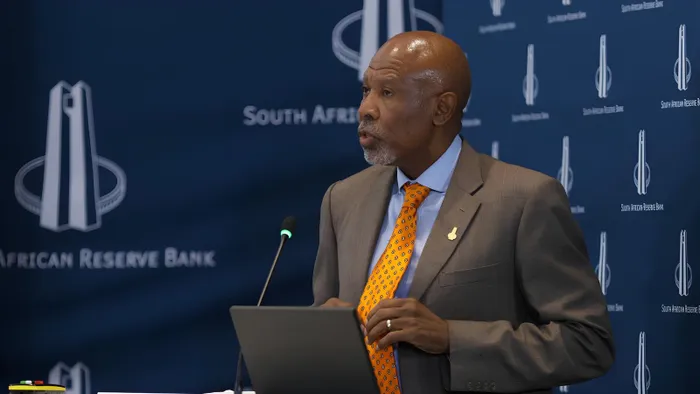
Lesetja Kganyago, governor of the South African Reserve Bank, will address the nation later today.
Image: SARB
South Africans are being squeezed from almost every direction at once as economists expect the South African Reserve Bank (SARB) to raise interest rates today.
This comes as consumers are already battling shrinking salaries, rising living costs and mounting debt. South Africa’s headline inflation rate climbed to 4% in April – a 19-month high – while PayInc said May inflation was forecast to rise further to around 4.6%.
Most economists and market commentators now expect the SARB to raise rates by 25 basis points this week, which would lift the prime lending rate from 10.25% to 10.50%.
Data released ahead of this afternoon’s Monetary Policy Committee interest rate decision paints an increasingly bleak picture for households, with higher earners now spending more than their monthly salaries servicing debt, while the buying power of wages has fallen to its lowest level in two years.
At the same time, food, fuel and electricity costs continue to rise faster than incomes, unemployment remains above 32%, and younger South Africans are entering debt counselling earlier as financial pressure deepens.
The latest DebtBusters Debt Index for the first quarter of 2026 found that consumers earning more than R50,000 a month now require 101% of their take-home pay to service debt every month, while their debt-to-income ratio has climbed to 303% – the highest of any income group.
DebtBusters executive head Benay Sager told IOL that many consumers in this income bracket were effectively falling behind on debt repayments so they could still afford essentials such as food and water.
Sager also said successive interest rate cuts and access to retirement savings through the two-pot system had provided temporary financial relief to many households.
However, Sager warned that inflationary pressures linked to the Middle East conflict and rising oil prices were once again increasing financial strain on consumers. “What remains consistent is that debt burdens are elevated, and income growth is not keeping pace with rising costs,” he said.
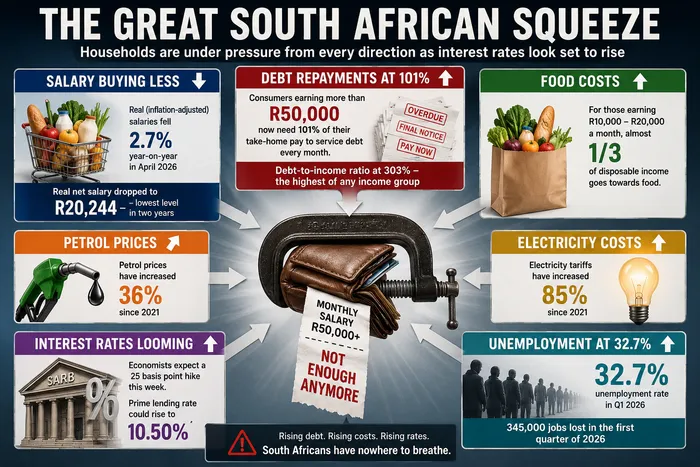
How South Africans are battling in numbers.
Image: ChatGPT
The report found South Africans were increasingly relying on unsecured lending to survive, with a record 96% of debt counselling applicants now holding a personal loan, while 61% had a payday or one-month loan.
The average number of credit agreements per applicant has climbed to 8.5 per person – the highest level since 2017 – suggesting growing dependence on multiple lenders.
DebtBusters also found that unsecured debt among consumers earning more than R50,000 a month had surged by 99% since 2021, far outpacing inflation and salary growth.
Lower-income households, meanwhile, were facing a different form of pressure.DebtBusters said debt levels among lower-income consumers had fallen by a quarter, but largely because many were losing access to credit rather than becoming financially healthier.
For consumers earning between R10,000 and R20,000 a month, almost a third of disposable income now goes towards food alone.
Separate data from the latest PayInc Net Salary Index also showed that South Africans’ salaries were increasingly failing to keep up with inflation. PayInc found that the average nominal net salary declined to R21,228 in April 2026 – 0.6% lower than March and 0.5% lower than a year earlier.
After accounting for inflation, real salaries – which reflect what consumers can actually buy with their earnings – fell by 1.2% month-on-month and 2.7% compared with April 2025, dropping to R20,244, the lowest real salary level recorded in two years.
“The sharp deterioration in the economic outlook following the Middle East war outbreak is already filtering through to the labour market,” independent economist Elize Kruger said.
“The combination of slowing salary growth and rising inflation is creating a difficult environment for salary earners,” Kruger said. “Households are being squeezed from multiple directions at the same time, with higher fuel prices, rising living costs and the growing possibility of higher interest rates.”
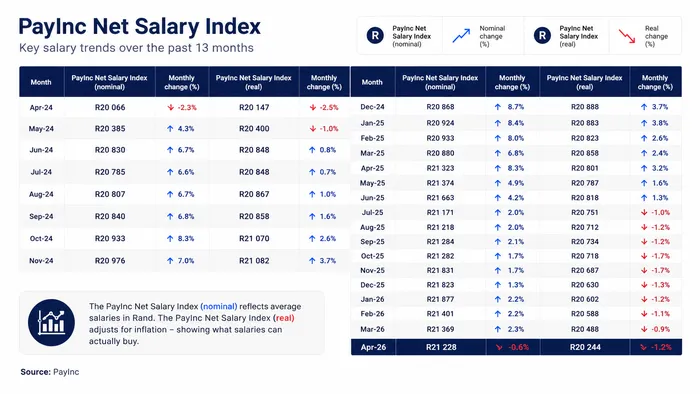
Salaries are declining in real terms.
Image: PayInc
Lara Hodes, Investec chief economist, said SARB was likely to act pre-emptively to stop inflation risks linked to rising oil prices from becoming entrenched in the economy.
“The SARB is likely to hike rates by 25bp to 7% this week, acting pre-emptively to prevent any second-round effects from becoming embedded in inflation,” Hodes said. This is the policy rate that the bank uses and is several percentage points lower than prime.
Lerato Ntuli from Anchor Capital said inflation risks remained “skewed to the upside”, warning that prolonged conflict in the Middle East could keep global oil prices elevated and continue feeding through into domestic fuel and transport costs.
Yet, Harry Scherzer from Future Forex said a higher-for-longer interest rate environment could help support the rand and reduce imported inflation risks linked to fuel and energy prices.
Kristof Kruger from Prescient Securities said markets had already largely priced in a 25-basis point increase, with investors now focused on whether the Reserve Bank indicates more tightening could follow should inflation and oil prices remain elevated.
However, Kruger said the SARB was “not signalling the end of the cycle”.
Samuel Seeff from Seeff Property Group, however, urged the Reserve Bank not to raise rates, arguing that the recent inflation spike was being driven largely by external pressures rather than excessive consumer demand.
“The higher inflation is largely imported. It is not the fault of consumers overspending in the economy,” Seeff said. He warned that another rate hike could place further pressure on households already struggling with debt costs and rising living expenses.
The labour market is also showing increasing signs of strain.
According to the Quarterly Labour Force Survey, 345,000 jobs were lost in the first quarter of 2026, while South Africa’s unemployment rate rose to 32.7% from 31.4% in the previous quarter.
“The labour market has already started 2026 on the back foot,” Kruger said.
Kruger added: “With uncertainty around the global and local economic outlook expected to persist for some time, many businesses are likely to adopt a wait-and-see approach… This could negatively impact investment decisions, workforce expansion and earnings expectations for the remainder of 2026.”
IOL BUSINESS