


Tourism is now a key drive of jobs and GDP according to Statistics South Africa.
Image: Taryn Elliott | Pexels
Tourism has quietly become one of South Africa’s largest employers, now supporting more jobs than sectors such as mining and agriculture – but the recovery is being driven largely by local travellers rather than international visitors.
New data from Statistics South Africa’s Tourism Satellite Account shows the sector has rebounded strongly in terms of employment and economic activity, even as inbound tourism spending remains below pre-pandemic levels.
Tourism employment more than doubled from 2020 to 2024. Reaching almost a million people in 2024. In 2020, when the COVID-19 pandemic brought travel to a standstill, the sector only accounted for 456,311 in 2020.
According to Trading Economics, as of the fourth quarter of 2025, about 17.1 million people are employed in South Africa. The formal sector dominates, accounting for 72% of jobs, followed by the informal sector (21.4%).
While employment reached a high of 17 million in late 2024, the market fluctuates, with 2026 projections suggesting a rise to around 17.4 million, the website said.
This means tourism now accounts for 5.7% of total employment in South Africa, up from 4.8% in 2019. In practical terms, about one in every 18 workers in the country is employed in tourism.
“The tourism sector now rivals several other industries in terms of workforce size,” says Statistics South Africa.
The scale of this recovery places tourism alongside, and in some cases ahead of, traditional industries. Statistics South Africa noted that the sector now employs more people than agriculture, mining and utilities.
Tourism has also strengthened its contribution to the broader economy.
Statistics South Africa data shows the sector contributed R361.7 billion to gross domestic product (GDP) in 2024, equivalent to 4.9% of total economic output, up from 3.7%, in 2019. This follows a sharp decline during the pandemic, when tourism’s contribution fell to 2.1% of GDP in 2020.
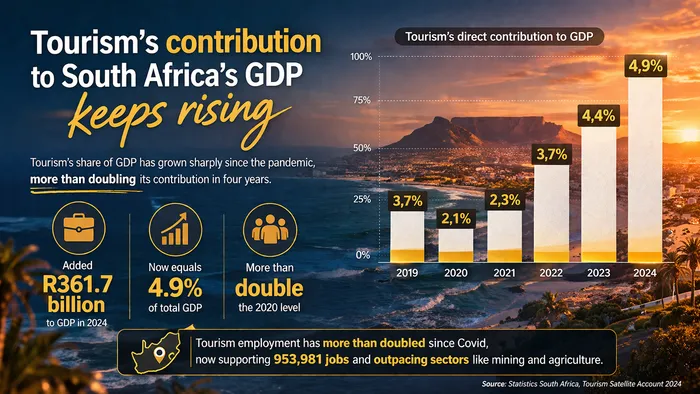
South African tourism according to Statistics South Africa data.
Image: Chat GPT | Statistics South Africa data
While employment and economic contributions has rebounded sharply, the composition of tourism demand has shifted.
Domestic tourism is now the dominant force in the sector. Of the R779.2 billion spent on tourism in South Africa in 2024, 85% came from local travellers, with inbound visitors accounting for just 15%.
Statistics South Africa said domestic tourism expenditure has shown a notable recovery since the pandemic, while inbound spending remains below pre-Covid levels.
Non-resident visitors spent R121.5 billion in 2019, compared with R113.9 billion in 2024, highlighting the slower return of international travel to South Africa.
This divergence means that while the sector has recovered in size, it has not yet returned to its previous structure.
Spending patterns also differ between local and international travellers.
Statistics South Africa data shows inbound visitors spent R17 of every R100 on road passenger transport in 2024, followed by tourism-connected products such as retail goods.
Domestic travellers, meanwhile, spent R29 of every R100 on non-specific products, reflecting broader consumption patterns across goods and services.
The Tourism Satellite Account classifies tourism-related spending into three categories: tourism-characteristic products, such as accommodation and air transport; tourism-connected products, including retail goods like food and fuel; and non-specific products, which are not directly linked to tourism but are still consumed by travellers.
IOL BUSINESS