

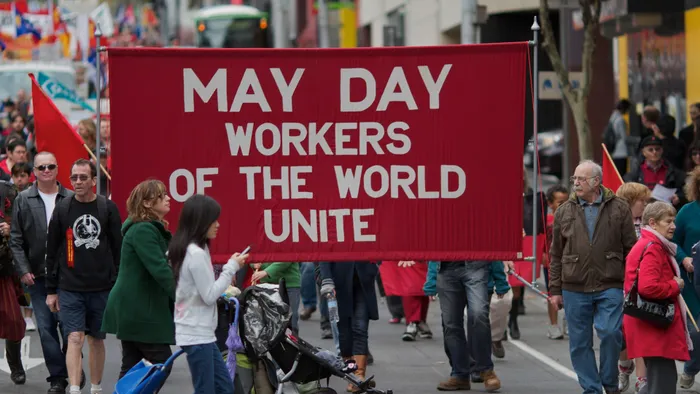
Workers from across the globe commemorate May Day.
Image: Wikipedia
More than a century after workers fought for fair conditions, a growing share of young South Africans are still fighting to enter the labour market.
Workers’ Day, celebrated on May 1, has its roots in the global labour movement of the late 19th century, when workers began fighting for shorter working hours, including the now-standard eight-hour working day, as well as safer conditions. At the time, it was common for labourers to work 10 to 16 hours a day under harsh conditions.
The day, otherwise known as May Day, traces back to protests in the United States in 1886, when thousands of workers went on strike demanding shorter working hours.
The demonstrations culminated in the Haymarket Affair in Chicago, where violence broke out during a rally, leaving several people dead and cementing the event as a defining moment in labour history.
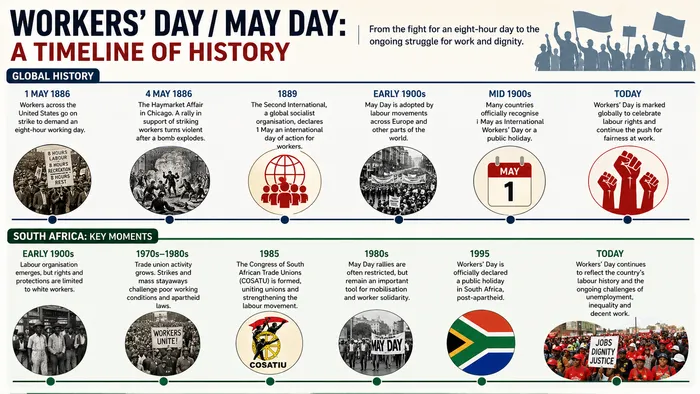
A graphical timeline of Workers' Day.
Image: ChatGPT
In the years that followed, labour movements across Europe, Latin America and parts of Asia adopted 1 May as a day to recognise workers’ rights and push for better conditions.
Over time, it became widely known as May Day or International Workers’ Day, with many countries declaring it a public holiday.
Many countries eventually recognised it as a public holiday, though its meaning evolved. In some places, it remained a day of protest while in others, it became a formal celebration of labour rights.
Despite its origins in the US, the country does not officially celebrate May Day as Labour Day, instead marking it in September.
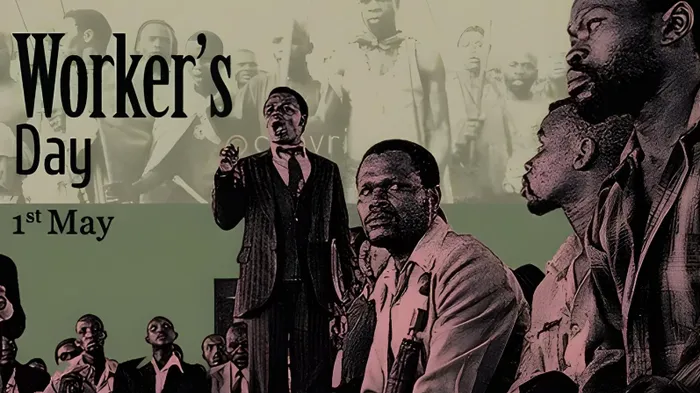
Workers' Day graphic from sahistory.org.
Image: SA History.org
In South Africa, the day carries a more political history.
Trade unions played a central role in opposing apartheid, using strikes and mass stayaways to challenge both workplace conditions and the broader political system.
Labour activism intensified in the 1970s and 1980s, with workers organising across industries despite restrictions on union activity.
In last year’s speech to commemorate the day, Congress of South African Trade Unions (COSATU) president, Zingiswa Losi, said, “May Day was born out of struggle – the fight for an 8-hour working day, the right to organise, the right to live with dignity.
"It is a day rooted in blood spilled by workers in Chicago in 1886 and carried forward in every worker rebellion across the world.”
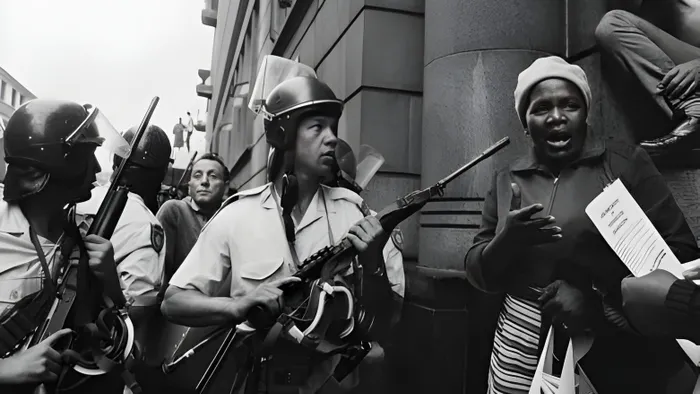
Riot police attempt to block the way of workers leaving a May Day meeting at Khotso House.
Image: SA History.org
The formation of COSATU in 1985 marked a turning point, consolidating worker power and aligning labour movements with the broader anti-apartheid struggle. “May Day has a special meaning. It was banned by apartheid because the regime knew when workers unite, the chains of oppression tremble,” Losi said.
May Day rallies during this period were often restricted or met with resistance, but they remained an important platform for mobilisation. Workers’ Day was officially recognised as a public holiday in South Africa in 1995, following the country’s transition to democracy.
“We salute the giants of 1973 – the brave men and women who, against brutal odds, launched the Durban strikes and revived the power of the trade union movement against the might of the apartheid regime,” said Losi.
Losi added that “municipal and factory workers ignited a fire, giving birth to a new era in demand of a living wage and the right to form trade unions. It was about reclaiming our humanity.”

Congress of South African Trade Unions (COSATU) president, Zingiswa Losi.
Image: NEHAWU
This year, however, Workers’ Day will be commemorated amid high unemployment, especially among the youth. According to Statistics South Africa, the official unemployment rate stood at 31.4% in the fourth quarter of 2025, the lowest reading since the third quarter of 2020.
However, with just over 17 million people employed during the last quarter of last year, fewer than half of working-age South Africans had jobs.
The challenge is even more pronounced among younger South Africans. According to Statistics South Africa, about 34.0% of people aged 15 to 24 were not in employment, education or training in the fourth quarter of 2025.
That translates into millions of young people who are not earning, not studying, and not building skills. “Some young people have been disengaged from the labour market, and they are also not building on their skills base through education and training – they are not in employment, education or training,” said Statistics South Africa.
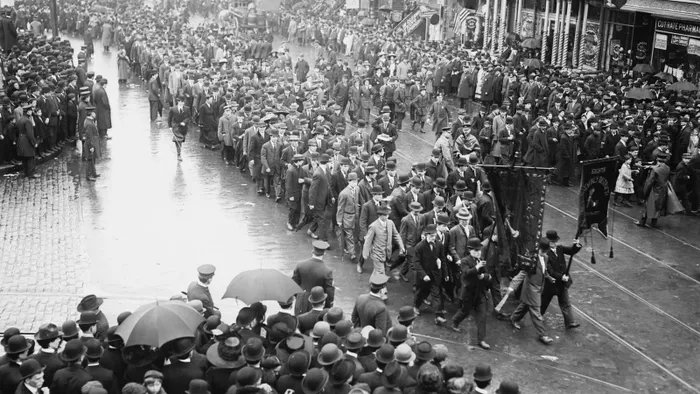
New York City held a Workers' Day parade on 1 May 1909.
Image: Library of Congress, Washington, D.C.
Statistics South Africa noted that individuals without matric recorded an unemployment rate of 37.6%, while graduates had a rate of 10.3% compared with the previous quarter.
“Unemployment rates for those with matric or lower educational qualifications exceeded the national rate, whereas individuals with other tertiary qualifications and graduates had rates below the national unemployment rate,” it said.
Pointing further to education, the agency said “year-on-year comparisons indicated that the unemployment rate decreased among those with matric and below but increased among graduates and those with other tertiary education levels”.
Trading Economics predicts that the rate will sneak back up again when the May print is released, showing an unemployment rate of 32.3%. In the third quarter of 2021, the figure hit 35.3%.
IOL BUSINESS