

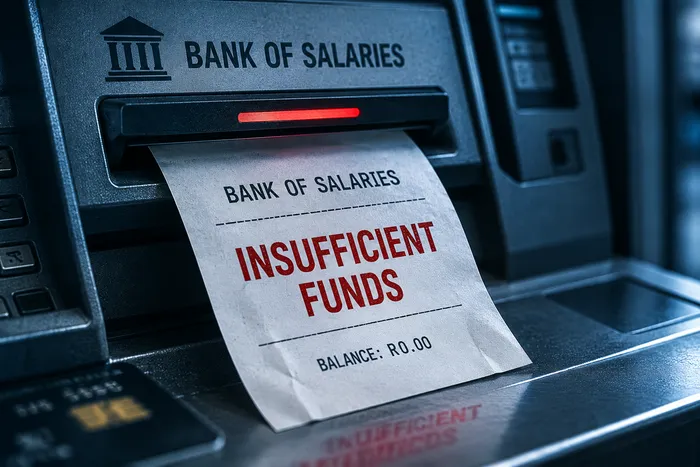
South African salary earners are once again seeing the buying power of their pay cheques shrink as inflation accelerates.
Image: ChatGPT
South African salary earners are once again seeing the buying power of their pay cheques shrink as inflation accelerates, economic uncertainty deepens, and fears grow that interest rates could rise again.
The latest PayInc Net Salary Index found that the average nominal net salary declined to R21,228 in April 2026, 0.6% lower than March and 0.5% lower than a year ago.
“The decline marks a notable shift following two years of relatively strong salary growth in 2024 and 2025, where earnings broadly kept pace with inflation,” said PayInc in a statement.
But after accounting for inflation, the picture becomes far worse.
Real salaries, which adjust for inflation and reflect what consumers can actually buy with their earnings, fell by 1.2% month-on-month and 2.7% compared with April 2025. Now down to R20,244, this is the lowest real salary level recorded in two years.
The report warns that the economic outlook has deteriorated sharply following the outbreak of conflict in the Middle East, with rising fuel prices and broader inflationary pressure now feeding through into the South African economy and labour market.
“The sharp deterioration in the economic outlook following the Middle East war outbreak is already filtering through to the labour market,” independent economist Elize Kruger said.
South Africa’s headline inflation rate climbed to 4% in April, a 19-month high. PayInc said May inflation is forecast to rise further to around 4.6%.
The worsening inflation outlook has largely been driven by fuel price spikes in April and May, reversing expectations earlier this year that inflation would remain subdued.
“The combination of slowing salary growth and rising inflation is creating a difficult environment for salary earners,” Kruger said. “Households are being squeezed from multiple directions at the same time, with higher fuel prices, rising living costs and the growing possibility of higher interest rates.”
The findings come just days before the South African Reserve Bank’s Monetary Policy Committee is set to announce its latest interest rate decision. Most economists and market commentators expect the rate to be hiked 25-basis points.
PayInc warned that with inflation forecasts for 2026 and 2027 remaining above the Reserve Bank’s newly adopted 3% target, the possibility of another interest rate hike has increased.
Should rates rise further, consumers could face even greater pressure through higher borrowing costs, further eroding disposable income, said PayInc.
PayInc noted that, at the same time, South Africa’s economy is expected to grow by just 1.1% in 2026, limiting prospects for stronger wage growth and job creation.
As a result, the labour market is already showing signs of strain.
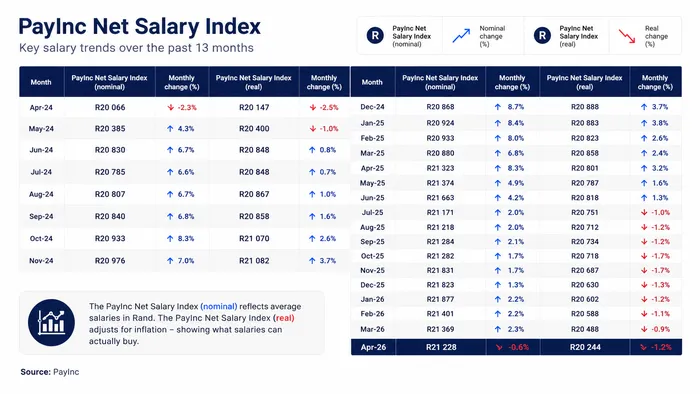
Salary gains and losses over the past 13 months.
Image: ChatGPT with PayInc data
According to the Quarterly Labour Force Survey, 345,000 jobs were lost in the first quarter of 2026, with losses recorded across the formal, informal and household sectors.
South Africa’s unemployment rate also rose to 32.7% in the first quarter, up from 31.4% in the previous quarter. “The labour market has already started 2026 on the back foot,” said Kruger.
While some employers are still granting above-inflation salary increases, businesses are increasingly cutting discretionary benefits such as guaranteed bonuses, work-from-home concessions and fully paid parental leave in an effort to contain staffing costs, said PayInc.
According to the latest Remchannel Salary and Wage Movements Survey, PayInc said South African employers that participated in the survey reported average salary increases of 5.4% over the past year.
However, many companies are simultaneously restructuring or reducing non-statutory benefits such as guaranteed bonuses, work-from-home concessions and fully paid parental leave.
“With uncertainty around the global and local economic outlook expected to persist for some time, many businesses are likely to adopt a wait-and-see approach,” Kruger said. “This could negatively impact investment decisions, workforce expansion and earnings expectations for the remainder of 2026.”
IOL BUSINESS