

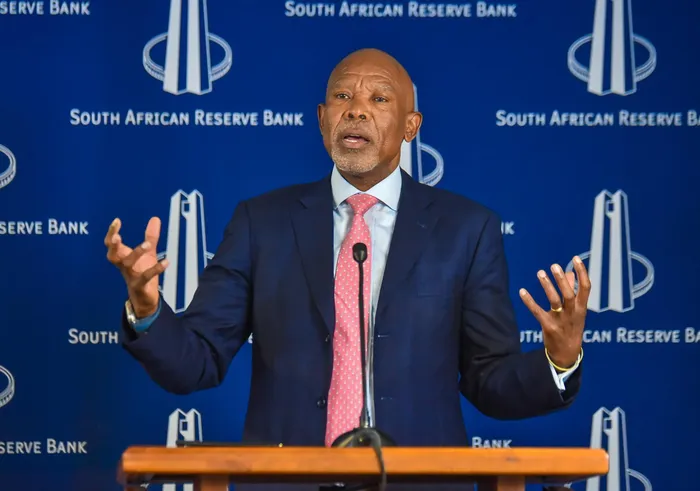
Lesetja Kganyago, Governor of the South African Reserve Bank.
Image: SARB | Facebook
The South African Reserve Bank's decision to hold interest rates is not a surprise, given the global environment.
Delivering the Monetary Policy Committee's March 2026 interest rate decision, Lesetja Kganyago, Governor of the South African Reserve Bank(SARB), said that the committee decided to keep the policy rate unchanged, at 6.75%.
“The decision was unanimous,” Kganyago said.
It would be wrong to read it as a setback for property or for the broader economy, says Stefan Botha, the director at Rainmaker Marketing.
“This is the Reserve Bank being measured at a time when the world is genuinely uncertain, and that is what you want from a credible central bank. If you think back to just two or three weeks ago, the expectation was firmly for a cut, and the fact that the Middle East conflict shifted that calculus so quickly tells you how significant the external disruption has been,”
The agency maintains that the trajectory of the easing cycle has not changed, with the 150 basis points of cumulative relief delivered since September 2024 still being very much in play and still working its way through the system.
For existing homeowners, Botha says the practical impact is neutral in the sense that bond repayments remain exactly where they have been since November, and on a R2 million bond over 20 years, you are still benefiting from roughly R2 000 per month in savings compared to where you were at the peak of the cycle.
That relief is real, and it hasn't gone anywhere, he says.
For developers and property businesses, he says operating at 10.25% prime is a workable environment and a fundamentally different market to the 11.75% we were dealing with 18 months ago.
He adds that what does shift in a tighter global environment is the margin for error, and the operators who are relying on data, who understand their buyer profiles at a granular level, and who are marketing with precision, are the ones who will continue to perform.
It's not about where rates are today but where they will be in 12 to 18 months.
For investors, the director says, looking at the medium to longer term, the thesis has not changed. The question should not be where rates are today but where they will be in 12 to 18 months, and the consensus, even accounting for the current disruption, is that they will be lower, he says.
Conversation around a cut at the May or July meeting to come back very quickly.
With the next MPC meeting being in May, Rainmaker says between now and then, the market will be watching how the Middle East situation develops and what impact the April fuel price increase has on inflation.
“If the conflict stabilises and oil prices normalise, I expect the conversation around a cut at the May or July meeting to come back very quickly, because the domestic fundamentals have not deteriorated; they have simply been overshadowed temporarily by an external shock.”
For the property sector as a whole, Botha says the message is straightforward. He says the structural demand drivers in South African property are real, they are long-term, and they are not dependent on any single interest rate decision.
What this environment does require is sharp execution, precision in pricing, in understanding your buyer, and in making every rand of marketing spend work as hard as possible, he says.
The agency suggests an additional, noteworthy dimension: South Africa's geographic distance from global conflict zones, which are currently causing significant disruption.
This distance, combined with economic improvements over the last 18 months—such as removal from the FATF grey list, credit upgrades, and contained inflation - creates a genuine prospect. International capital, seeking stable, well-governed destinations away from volatility, could begin to favour South Africa.
“We are already seeing interest from buyers who might previously have looked at markets in the Middle East and are now considering places like Cape Town and the KZN coast as serious alternatives.
"That is a story that I think will develop significantly over the coming months and one that positions South African property in a far more positive light than the immediate oil price headlines might suggest.”
The trajectory for rates remains positive, and the fundamentals are sound, so this is a period that calls for patience and good decision-making rather than any kind of panic response, Botha says.
Homeowners may feel some reassurance following the Reserve Bank’s decision to keep the prime lending rate unchanged, despite ongoing tensions in the Middle East and the potential impact on fuel prices and inflation, says
Stephan Potgieter, CEO of BetterHome Group Mortgage Origination and BetterBond, says while this does not bring immediate financial relief, it does offer some predictability as household costs continue to rise and electricity tariffs increase next month.
“Although the economy has shown encouraging signs of momentum this year, with GDP growth projected at around 1.6%, the impact of prolonged geopolitical tensions remains uncertain. In this context, we continue to encourage homeowners to budget prudently and, where possible, to pay more towards their monthly bond repayments.
"Holding the rate steady suggests a cautious stance by the Reserve Bank, and should inflation risks intensify, borrowing costs could still increase in the months ahead.”
Encouragingly, Potgieter says the property market remains resilient. He says BetterBond’s home loan applications increased by 3.0% year-on-year in the first two months of 2026, alongside improving approval ratios.
“While keeping the prime lending rate steady may not provide the relief homeowners had hoped for this month, it will support ongoing stability in the market, even amid persistent global uncertainty.”
Independent Media Property