

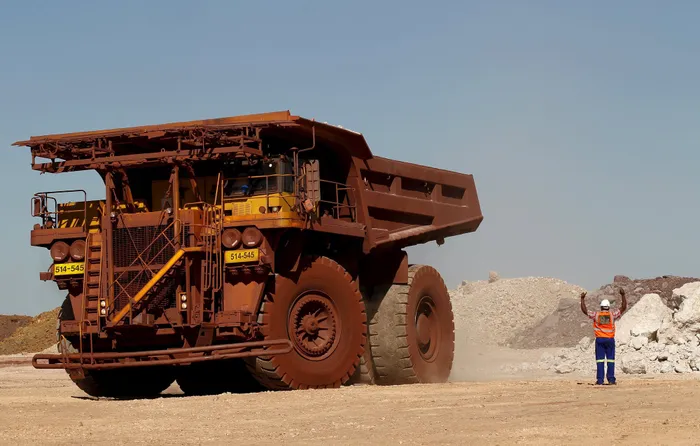
Data from Statistics South Africa (Stats SA) on Thursday showed that mining production expanded by 5.8% year-on-year in October, accelerating from a revised 1.4% increase in September.
Image: Reuters
South Africa’s key productive sectors began the fourth quarter of 2025 on firmer ground, with both mining and manufacturing reporting growth in October as demand conditions continued to support output.
However, analysts warn that underlying momentum remains fragile amid policy uncertainty, rising costs and weakening forward-looking indicators.
Data from Statistics South Africa (Stats SA) on Thursday showed that mining production expanded by 5.8% year-on-year in October, accelerating from a revised 1.4% increase in September.
This marks the sixth consecutive month of growth and the sector’s fastest annual performance since February 2024.
Jean-Pierre Terblanche, principal service statistician at StatsSA, said the main positive contributors were iron ore, platinum group metals, manganese ore, and chromium ore.
“Iron ore was the most significant positive contribution in October, expanding by 24.8%. Nickel, manganese ore, chromium ore and platinum group metals also posted positive results. The industry produced less diamonds, copper, gold and coal,” Terblanche said.
On a month-on-month basis, season-adjusted mining production increased by 2.1% in October, following a rise of 2.6% in September.
Despite the encouraging numbers, the mining industry continues to grapple with persistent headwinds, including policy uncertainty, logistical constraints and rising input costs that threaten its global competitiveness.
Last week, the Minerals Council warned that an upward trend in intermediate input costs for South African miners is emerging, even though overall input costs remain historically subdued.
The Minerals Council said the emerging trend of rising mining input costs is being driven by “higher prices for intermediate mining inputs, including iron ore—which is performing stronger” than a year ago.
“These increases are putting pressure on costs where these and other minerals are used in intermediate processes. Additionally, there has been a notable rise in sawmilling and wood costs, electricity and water tariffs, and significant increases in road transportation costs,” said the Minerals Council.
These factors, it explained, were collectively driving the upward trend in mining input costs that has been recorded over the past three months.
Meanwhile, manufacturing output increased 0.2% year-on-year in October, moderating from a revised 1% rise in September but avoiding the widely expected 1.7% contraction.
Stats SA said eight of the 10 manufacturing divisions posted positive annual growth, while two categories, wood, paper, publishing and printing, and glass and non-metallic mineral products, registered declines.
Nicolai Claassen, director of industry statistics at Stats SA, said output growth slowed significantly for motor vehicles, parts and accessories and other transport equipment; food and beverages and furniture and other manufacturing.
“Food and beverages and electrical machinery were the most significant upward contributors. Food and beverages was 1.9% and electrical machinery 6.5% stronger. Together, both divisions added 0.7 of a percentage point to overall growth,” Claassen said.
“Two divisions weighed on overall performance. Glass and non-metallic mineral products was down 5.8% and word paper and publishing was 6.9% weaker in October.”
On a month-on-month basis, seasonally adjusted manufacturing production rose by 1% in October, following increases of 0.3% in September and 0.4% in August.
The November seasonally adjusted Purchasing Managers’ Index (PMI) signalled that conditions deteriorated during the month, dragged down by a slump in new orders and business activity.
However, the index measuring business expectations six months ahead rose back above the neutral 50 mark to 50.8, suggesting some cautious optimism for the manufacturing sector heading into 2026, despite uncertain global conditions.