

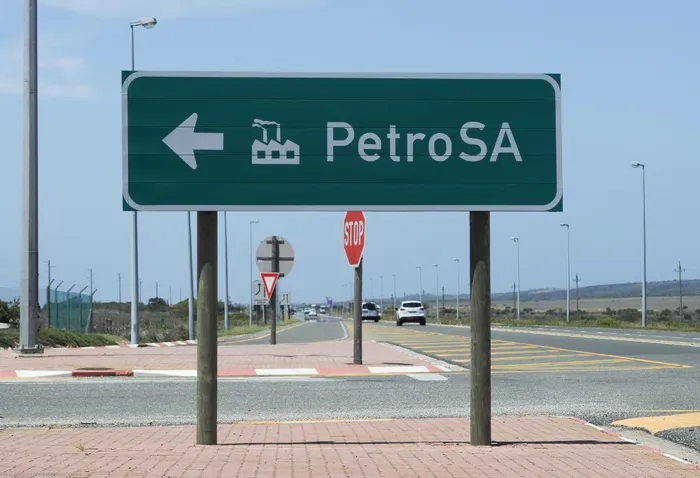
The confirmation follows disclosures by PetroSA executives to Parliament in December, during the entity’s latest financial briefing, that Sars had moved to attach the refinery over unresolved arrears related to customs duties incurred during fuel imports.
Image: File
Banele Ginindza
The Department of Mineral and Petroleum Resources has confirmed that discussions are under way between embattled state-owned oil company PetroSA and the South African Revenue Service (Sars) over the possible attachment of PetroSA’s Gas-to-Liquid (GTL) refinery in Mossel Bay to settle a R4.5 billion tax debt owed to the state.
The confirmation follows disclosures by PetroSA executives to Parliament in December, during the entity’s latest financial briefing, that Sars had moved to attach the refinery over unresolved arrears related to customs duties incurred during fuel imports.
The department on Friday said PetroSA has officially notified it of the outstanding debt to Sars but t stressed that it was observing developments at arm’s length.
"At this stage, the department does not intend to intervene directly as the issue is being handled by PetroSA’s leadership with support from the CEF Group (Central Energy Fund) in accordance with their governance and operational responsibilities," it said in response via email.
"The department will continue to monitor the situation and remain engaged with both PetroSA and the CEF Group."
Meanwhile, Sars declined to comment, citing Chapter 6 of the Tax Administration Act of 2011, which prohibits the disclosure of confidential taxpayer information.
PetroSA spokesperson Nonny Mashika also said the entity would not comment publicly on the matter.
Appearing before Parliament late last year, PetroSA chief financial officer Nombulelo Tyandela confirmed that the company was in discussions with Sars about a payment plan for the overdue debt, which she said was partly linked to a disputed deal with fuel supplier Nako Energy.
She acknowledged that Sars had indicated its intention to hold the GTL asset as discussions continued.
"So we were aware of their intention. We are still in that period of engaging and making sure we go back to Sars," she said.
"And we said in the meeting that we had with them, we'll be able to take this matter to the board on the payment plan so that we can be able to engage as the chairperson of the board have also indicated that we need to regroup and find solutions on this matter."
PetroSA’s business is currently sustained by importing finished fuel, storing it at Mossel Bay or alternative facilities, and distributing it to customers in Mossel Bay, Cape Town and limited inland markets.
But Tyandela said sales volumes are below targets and revenue remains weak.
"As we rely on imports and selling, the revenue needs to support the upstream base and the GTL plant that is not operational. About 70% of operation costs to care and maintain assets are operational at the moment to ensure the bottom line stays positive," she said.
Despite ending March 2025 with R1.6bn in cash and equivalents at group level and R1.3bn at company level, Tyandela said the financial position was “not exciting” because creditor payments were falling behind and current liabilities remain unresolved.
The entity also faces a R3bn shortfall in its rehabilitation fund, which PetroSA is required to maintain at around R10bn. The fund has grown from R1.5bn to R3bn through money-market investments earning 8% interest, but remains far below requirements.
Mikateko Mahlaule, chairperson of the Portfolio Committee on Mineral and Petroleum Resources, appealed to the Department of Mineral and Petroleum Resources to intervene in the ongoing matter between PetroSA and the Sars to create an enabling environment for the company to focus on its mandate.
PetroSA’s financial position has deteriorated sharply as current liabilities sit at R9.4bn at company level, R9.7bn at group level.
"By October 2025, current liabilities were exceeding assets. We are unable to honour liabilities as they fall due. Apart from Sars, we owe product suppliers. We depend on traders instead of refiners," Tyandela said.
BUSINESS REPORT