

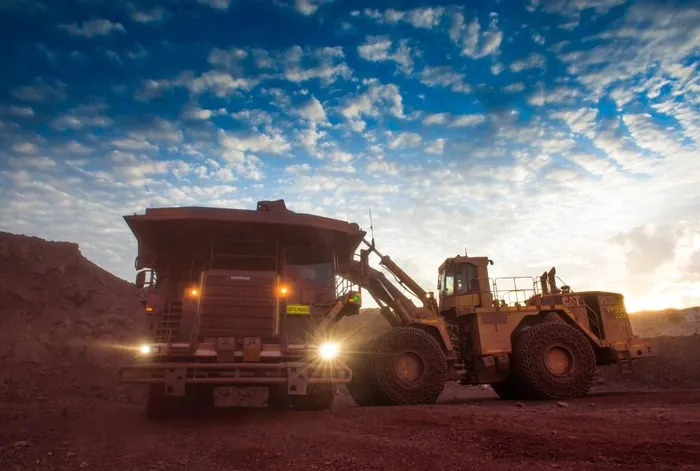
Ore railed by Kumba to the Saldanha Bay port increased by 2% to 8.6 million tons during the quarter under review, despite two derailments following the 10-day annual rail and port maintenance shutdown in October.
Image: Supplied
Tawanda Karombo
Continued improvements to Transnet’s rail and port efficiencies helped Kumba Iron Ore meet guidance and benefit from an upturn in commodity prices, underpinning a December quarter described by parent company Anglo American as stronger.
Anglo American retained Kumba after disposing of Valterra and other assets last year.
Duncan Wanblad, CEO of Anglo American, said on Thursday that Kumba Iron Ore and Minas-Rio “continue to perform strongly” during the fourth quarter to 31 December 2025.
The group’s broader production picture was mixed. Copper output fell 14% year on year to 169 500 tons during the quarter, while nickel production rose 3% to 10 300 tons.
Rough diamond production at De Beers, however, declined sharply by 35% to 3.8 million carats, largely due to maintenance shutdowns at the Jwaneng and Orapa operations in Botswana.
Anglo American said it was “undertaking an impairment review of De Beers' carrying value, assessing the impact of diamond market conditions, which could potentially lead to an impairment” when it reports full-year financials.
In South Africa, Kumba Iron Ore was propped up by improved efficiencies under Transnet.
Mpumi Zikalala, CEO of Kumba Iron Ore, said the company’s collaboration with Transnet through the Ore Users’ Forum allowed it to benefit from a stable iron ore price environment.
Ore railed by Kumba to the Saldanha Bay port increased by 2% to 8.6 million tons during the quarter under review, despite two derailments following the 10-day annual rail and port maintenance shutdown in October.
For the period, shipments for Kumba were constrained by 26 days of single loading due to the planned refurbishment of a stacker reclaimer, as well as high wind speeds at the port.
Sales volumes for the period, as a result, decreased by 5% to 8.7 million tons. However, for the 2025 full-year, sales volumes increased by 2% to 37 million tons, supported by improved operational stability.
Total finished stock for Kumba flat-lined at 7.5 million tons for the year, with 5.7 million tons of on-mine stock and more optimal port stock levels of 1.8 million tons.
Kumba benefited from stronger iron ore prices solidified by resilient Chinese pig iron production, on the back of strong export demand and stable supply from the major iron ore producers.
Lump premium iron ore prices averaged US$0.14 per dry metric ton for the year, despite pressure from high inventory levels and weak steel mill margins.
Subsequently, Kumba achieved an average realised free on board (FOB) export price of $95 per wet metric ton (wmt), “outperforming the benchmark FOB iron ore price of $85/wmt by 12%” for the year.
As a result, basic earnings in Kumba Iron Ore for 2025 are expected to be between R42.83 and R47.39 per share. This reflects a change ranging from a decline of 7% to an increase of 3% from the comparative period.
“Reported basic earnings and earnings per share for the comparative period include the reversal of an impairment on the asset value of the Kolomela cash generating unit that was recognised in 2022,” the company said.
“The impairment reversal was due to a revision in the forecast production volume profile of Kolomela as part of the company's business reconfiguration plan to optimise value.”
In the prior year, Kumba Iron Ore recorded basic earnings and earnings per share of R14 699 million and R45.81 respectively.
In the fourth quarter of 2025, the Sishen mine uplifted production by 15% to 6.6 million tons although Kolomela's output fell by 5% to 2 million tons.
For this year, Kumba said its guidance “is subject to Transnet's logistics performance” with production expectations unchanged at between 31 and 33 million tons, and lower than 2025 to reflect the tie-in of the Ultra-High Dense Medium Separation project planned for the second half of this year.
Sales guidance for 2026 of between 35 - 37 million tons also include the planned drawdown of finished stock, with production guidance for 2027 and 2028 set at between 35 and 37 million tons.
BUSINESS REPORT