

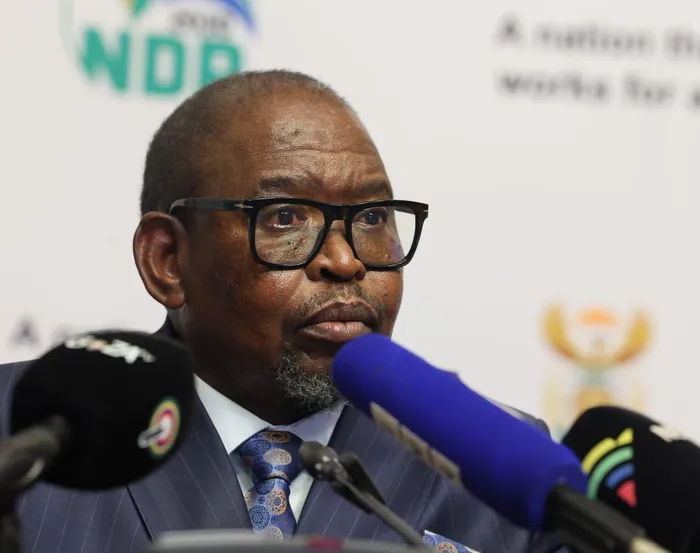
Finance Minister Enoch Godongwana speaking during a closed media briefing ahead of tabling the 2026 National Budget Review on Wednesday.
Image: GCIS
Finance Minister Enoch Godongwana has given his clearest indication yet that National Treasury may step in directly to address the deepening water supply crisis in the City of Johannesburg, warning that national government “cannot be a spectator” as the metro’s infrastructure deteriorates.
Speaking during a closed media briefing ahead of tabling the 2026 National Budget Review on Wednesday, Godongwana described Johannesburg’s situation in blunt terms.
“The City of Johannesburg is a problem. No doubt about that. And certainly, the national government cannot be a spectator,” he said.
His remarks come amid mounting pressure over persistent water outages, crumbling sanitation networks and growing public frustration in South Africa’s economic hub.
Johannesburg’s water and sanitation systems are widely regarded as being at breaking point, largely due to ageing infrastructure, years of under-investment and a financial model that has struggled to sustain reliable service delivery.
Godongwana made it clear that some form of national intervention is increasingly likely.
“At some point, the national government is going to go to Johannesburg. What form that will take is a matter of detail. But going to Johannesburg we have no option but to go,” he said.
While he stopped short of outlining specific measures, the minister suggested that discussions are already underway between city management and Treasury officials. He emphasised that the issue is not whether government will act, but how.
“They themselves at the level of management are talking to our team,” he said, adding that national authorities must find a way of “getting closer to the Johannesburg situation.”
The minister’s comments suggest that Treasury is weighing both financial and legal mechanisms to stabilise the metro’s water and sanitation systems. However, Godongwana cautioned that any intervention would need to be carefully structured and backed by appropriate legal instruments.
“The problem in an environment like that is that you need some legal instruments. If you’re going to go there as a friend and so on, it may not be a good idea,” he said, hinting that a more formal or structured intervention could be required.
Under South Africa’s constitutional framework, national and provincial governments have limited but significant powers to intervene in municipalities in cases of financial distress or failure to fulfil executive obligations. Such interventions can range from technical support and conditional funding arrangements to more direct oversight or administration.
Meanwhile, Deputy Finance Minister David Masondo said the 2026 Budget signals a fundamental shift in the effort to fix local government.
"Government is now moving from oversight to active structural intervention. The reforms underway include shifting to a utility model for water and electricity with these services to run like businesses accountable to government and the public," Masondo said.
Johannesburg’s challenges have been compounded by rapid urbanisation, population growth and constrained municipal finances. Revenue collection weaknesses, mounting debt and infrastructure backlogs have placed increasing strain on the city’s ability to maintain and upgrade critical systems.
Water shortages in particular have become more frequent, affecting households, businesses and key economic sectors. With Johannesburg contributing a substantial share of national GDP, prolonged infrastructure failures pose broader economic risks.
Budget 2026
Image: Logo
Treasury has already announced a decisive shift in the government’s approach to struggling municipalities, signalling a move from oversight to active structural intervention to address deepening governance, financial and service delivery failures at the local level.
Godongwana’s comments align with his broader fiscal message in the 2026 Budget, which emphasises stabilising public finances, improving spending efficiency and strengthening governance at subnational level. Treasury has repeatedly signalled that infrastructure investment and maintenance are critical to unlocking growth and restoring public confidence.
On Tuesday, Gauteng Premier Panyaza Lesufi blamed infrastructure failures, leaks and high-demand peaks for the water shortage crisis in Gauteng, and announced a R760 million infrastructure upgrade in the City of Johannesburg.
Some of the reservoirs have been identified for fixing, replacing of water pipes, dealing with non-revenue water.
The Water Crisis Committee in the City of Johannesburg has called on the government to communicate openly on how it plans to deal with the current water crisis.
Dr Ferrial Adam, executive director of WaterCAN, has said that the issue with water supply in Johannesburg is not the absence of planning — but the absence of funding and implementation capacity.
BUSINESS REPORT