

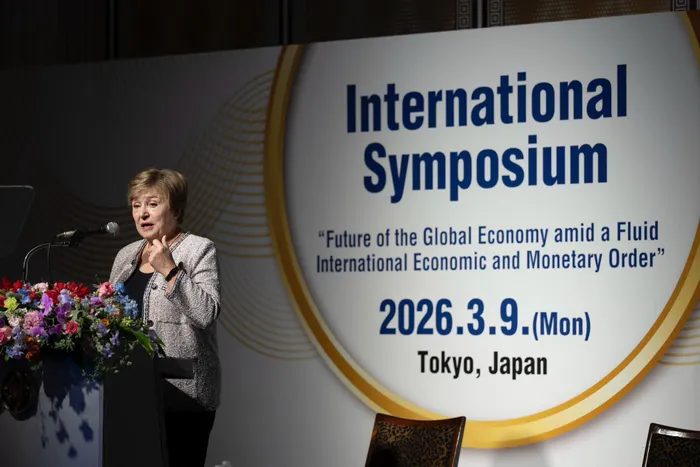
The International Monetary Fund (IMF) managing director, Kristalina Georgieva, speaking at a symposium hosted by Japan Ministry of Finance in Tokyo on Monday.
Image: Supplied
The International Monetary Fund (IMF) managing director, Kristalina Georgieva, has warned policymakers to prepare for unexpected economic shocks and build stronger institutions to navigate an increasingly uncertain global environment.
This comes as important oil and gas facilities have suffered damage and stoppages as a result of the ongoing and intensifying war in the Middle East, which has risen global oil prices drastically above the $100-mark per barrel.
Speaking at a symposium hosted by Japan Ministry of Finance in Tokyo on Monday, Georgieva said the global economy is entering what she described as a “fluid” period characterised by constant disruptions, geopolitical tensions and structural transformation.
Georgieva said if the conflict ends soon as everyone hoped, then before long some new shock will emerge, testing the resilence of all policymakers.
“My advice to policymakers everywhere in this new global environment? Think of the unthinkable and prepare for it,” Georgieva said.
She said governments can no longer assume long periods of stability as the world continues to face overlapping shocks ranging from pandemics and wars to energy disruptions and climate-related events.
During her six-and-a-half years leading the IMF, Georgieva said the global economy has weathered multiple crises including the Covid-19 pandemic, the war in Ukraine and a global cost-of-living crisis.
Despite these challenges, the global economy has shown resilience. The IMF currently forecasts world growth of 3.3% in 2026 and 3.2% in 2027, she said.
However, Georgieva warned that resilience is once again being tested by the latest conflict in the Middle East, which has disrupted global energy supply chains asshipping through the strategically important Strait of Hormuz has dropped by about 90%.
The waterway normally carries about one-fifth of global oil supply and liquefied natural gas trade, making it one of the most critical energy routes in the world.
According to Georgieva, the disruption has pushed energy security to the top of the policy agenda for many countries, particularly in Asia.
Nearly half of Asia’s oil imports and around a quarter of its LNG imports pass through the Strait of Hormuz. The impact is already visible in global energy markets.
Georgieva said oil prices have risen nearly 50% since December, while gas prices have surged in both Asia and Europe. The IMF estimates that sustained increases in oil prices could significantly affect the global economy.
“As a rule of thumb, every 10% increase in oil prices—if persistent through most of this year—results in a 40 basis point increase in global headline inflation and a 0.1 to 0.2% fall in global output,” she said.
The IMF is currently analysing the economic impact of the conflict and will release updated projections in its upcoming World Economic Outlook report.
To help countries cope with such shocks, Georgieva outlined three key priorities for policymakers: strengthening institutions, maintaining financial buffers and improving policy agility.
Strong institutional frameworks—including independent central banks and credible fiscal rules—play a crucial role in helping economies manage risk and support private sector growth, she said.
These frameworks also help governments respond to major structural shifts such as the rapid rise of artificial intelligence and demographic change.
Fiscal space allows governments to support economies during downturns, while strong corporate balance sheets help companies absorb sudden changes in demand or costs.
At the same time, countries must rebuild these buffers during periods of economic stability to ensure they remain available when crises occur.
Finally, Georgieva highlighted the need for greater agility in policymaking, particularly as geopolitical tensions reshape global trade patterns.
She said deeper regional economic integration could help boost growth, especially in Asia where intra-regional trade remains relatively low compared with Europe.
“In an uncertain and fluid world, more countries are needing more of our support,” Georgieva said.
The IMF currently has more than $165bn in outstanding credit to member countries, reflecting growing demand for financial support as nations navigate a volatile global economy.
BUSINESS REPORT