

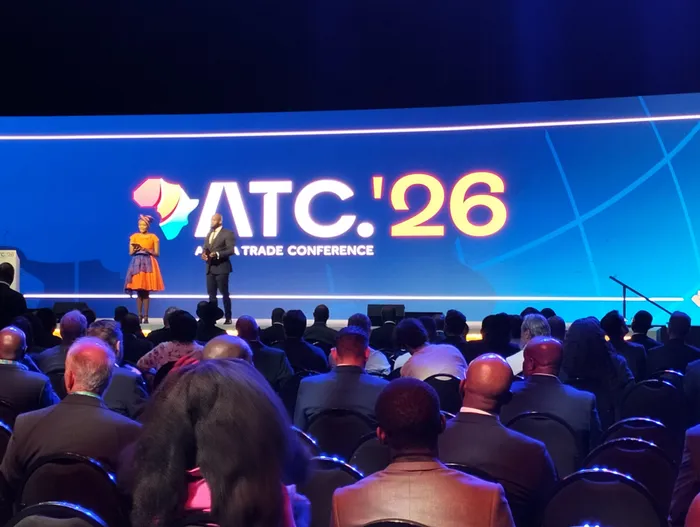
Delegates at the African Trade Conference said greater impetus is needed to further intra-African trade given the uncertainty geopolitical environment, which is creating uncertainties such as on food and energy prices for Africa countries.
Image: Edward West
The building blocks of free inter-continental trade and Africa taking its rightful place on the global trade arena are taking shape, but there remains a great deal of practical work to be done including regulatory harmonisation, trade and logistics infrastructure development, and the establishment of trade financing systems.
This became clear at the African Trade Conference 2026, held in Cape Town on Wednesday. Roosevelt Ogbonna, CEO of Access Bank which hosted the event, stated that since last year's conference, there has been progress in advancing African trade.
There has been the establishment and initiation of value chains across various business sectors. Some African brands are now being exported across continental borders and globally, and several technology platforms developed in Africa are alleviating the friction in payments and logistics systems that previously hindered trade on the continent.
However, he noted that access to trade finance remains a significant challenge. The shortage of infrastructure is causing real delays and costs for every freight shipment within Africa. Additionally, trade is concentrated in only some corridors and markets on the continent. Trade ecosystems were also fragmented between the different countries.
Ogbonna asserted: "Africa can be all that we want it to be. This conference will not end as a talk shop."
Boston Consulting MD & Partner Tolu Oyekan remarked that the ingredients for Africa to take its rightful place in global trade are all present.
The African market comprises 1.5 billion people, and while many other markets are experiencing structural population decline, Africa's population is growing, with a median age of 19.5. The five- year old Africa Continental Free Trade Area is also the world's largest free trade area.
However, while Africa engages in trade, it extracts too little value from it, he said. Currently, 77% of its exports consist of primary commodities, and the ratio of trade to GDP is volatile and low compared to other regions. The continent's share of global trade is very low, at only 3%.
Oyekan pointed out that it is not all doom and gloom though. For instance, there are beginnings of a viable light manufacturing sector in many trade corridors, growth in pharmaceutical production capacity, and initiatives to process some of the export commodities.
Nevertheless, he said, in an environment of escalating geopolitical tensions, currency volatility, climate risk, and increased market volatility, Africa's fragmented markets become very expensive for businesses.
Oyekan said that in this environment, accessibility and predictability in trade matters, as does transparency.
He said that with global trade becoming increasingly unpredictable, the solution lies in deepening intra-African trade and building scale on the continent before tackling the global market. This trade needs to be corridor-driven, he added.
He highlighted some tangible benefits of intra-regional trade, as envisaged by the Africa Continental Free Trad Area, which could lead to a 29% increase in trade and a 7% increase in real per capital incomes by 2035.
Oyekan said that for years, the lack of trade infrastructure was viewed as a limiting factor to increased inter-continental trade. However, he argued that trade could lead infrastructure development—the increased throughput of rising trade provides the scale that makes infrastructure development bankable.
He said Africa is not poor in capital, as there are significant pools of capital in individual and pension savings, as well as in sovereign funds and development finance institutions, that could be utilised for infrastructure development. He said there needs to also be much more access to trade data, and there needed to be trust in public institutions.
Kwabena Ayirebi, MD of Banking Operations at Africa Export-Import Bank, said that intra-African trade accounts for only 15% to 17% of the continent's total trade, whereas in other regions, such as Asia, it is much higher at 59%, and in Europe, it is 62%.
He emphasised that the continent can no longer rely on foreign banks for funding, as these banks invariably prioritise the interests of their own country’s client companies.
Ayirebi mentioned that Africa Export-Import Bank has already created a funding facility focused on boosting intra-African trade, which now constitutes 22% of the bank's funding disbursements.
He said the bank has established an ecosystem spanning 400 banks across 53 countries, and these facilities are being utilised to enhance trade and logistics infrastructure.
He cited as example two recent significant African infrastructure investments: the Dangote Oil Refinery and a $2.9 billion hydroelectric facility that has been financed solely by African banks.
Visit: www.businessreport.co.za