

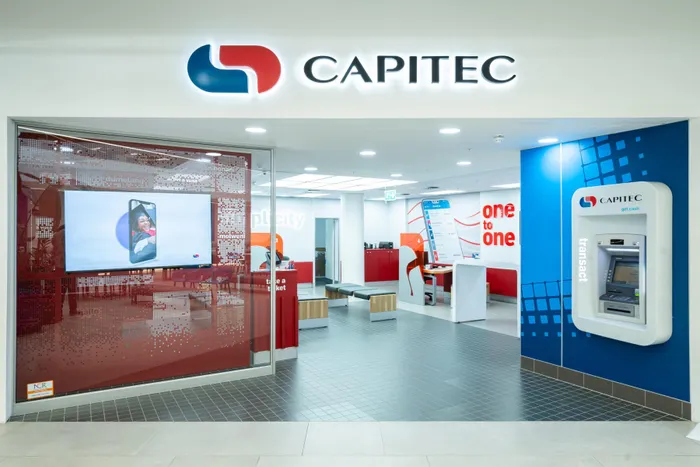
Capitec Bank continues to support its branches in the face of increasing banking digitisation because its clients also want face-to-face contact to be available from their bank says the CEO Graham Lee.
Image: Supplied
Capitec’s annual financial results showcase its rapid growth into a highly contested and relatively new initiative by the bank: business banking.
Business banking gained strong momentum as more entrepreneurs and small businesses responded to their value proposition built on low fees, strong service, and faster credit approvals, CEO Graham Lee said at the release of annual results for the year to February 28.
Capitec first announced its plans to enter the business banking market in 2019. Since then, there has been a wave of new initiatives, such as Tymebank Business launched in 2023, Bank Zero's app-based business banking, and Lulalend expanding from SME lending into full-service digital banking. Other major banks—Standard Bank, FNB, Absa, and Nedbank—have also all enhanced their business banking offerings.
Capitec’s results on Wednesday showed that businesses and entrepreneurs grew 71% to 456,000. Merchant turnover through Capitec card machines reached R98,6 billion, while the scored lending book grew by 118% to R3,1bn, and scored loan disbursements increased by 134% to R3,2bn.
The Entrepreneur Account and Pay-As-You-Trade accounts aim to extend this momentum by giving smaller and underserved businesses simpler banking and more practical access to working capital, said Lee.
He said in an interview the bank is gaining market share in the business banking because Capitec had asked businesses what they wanted from their bank. Capitec was working hard to service these wishes. Businesses wish to have “much more affordable banking,” better service—which Lee said they had made great strides in but needed to improve even more—and be able to provide faster credit.
He said the business banking market was highly competitive, but “customers benefit from more competition.”
During the year, Capitec as a whole— it now actively banks 26 million South Africans—increased headline earnings by 23% to R16,8bn, and return on equity came to 31%. Personal banking contributed 4,1% of group headline earnings, supported by 27% from insurance, 26% from fintech, VAS, and Capitec Connect, and 5% from business banking.
Lee said Capitec’s evolution into a diversified financial services group reflects a strategy to deepen relationships with clients across more parts of their financial lives.
He said consumers started 2026 with a generally better financial outlook and positiion, which was reflected in Capitec’s operations. However, over the past six weeks to two months, given the global geopolitical uncertainties, they had seen early signs of shocks to some of the indicators that typically drive inflation in South Africa.
In the year ahead, the bank would focus on further organic growth and only consider an acquisition if it provided a faster and easier means for the group to reach its growth targets.
Over the past year, digital transaction platforms, personal and business banking services, and insurance offers had matured, broadening the ecosystem and increasing the value delivered to clients, he said.
Value-added services and Capitec Connect grew by 38% to R6,1bn, while net insurance income increased by 38% to R5,2bn. Funeral cover lives assured increased by 13% to 16,6 million, and life cover grew by 129% to 221,000 lives insured, reflecting strong demand for simple, relevant insurance solutions that meet real client needs.
Non-interest income remained 67% of income from operations after credit impairments. Net interest income after credit impairments grew by 18% to R24,1bn as a result of product innovation and prudent credit granting. Over the last financial year, Capitec had returned R1bn to clients through lower fees, reduced pricing, cash-back programs, and rewards.
These savings include R228 million through the simplification and reduction of fees, R213m to businesses through reduced card machine and merchant commission rates, and discounted point-of-sale devices, R61m saved through lower international card fees and zero forex margins, R330m from lower Capitec Connect data prices, R108m in savings through free Connect data and Live Better rewards, and R107m in 1% cash back for every rand spent on a Capitec credit card.
Capitec Connect gave back 3 petabytes of free data, worth R78 million. Capitec Connect also recently launched affordable device sales to all clients through partnerships with Samsung and Apple, delivered nationwide.
Visit:www.businessreport.co.za