

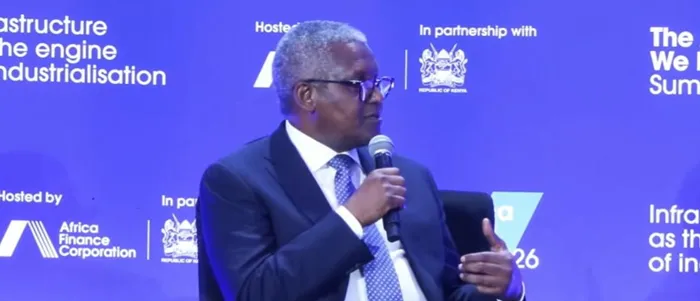
Africa's billionaire industrialist Aliko Dangote speaking at the "Africa We Build Summit" in Nairobi on Thursday.
Image: YouTube screengrab
African business leaders and policymakers have renewed calls for deeper regional integration and stronger domestic financing mechanisms, as billionaire industrialist Aliko Dangote set out bold proposals to accelerate the continent’s development.
Speaking at the "Africa We Build Summit" in Nairobi on Thursday, Dangote, chairman and CEO of the Dangote Group, urged African leaders to remove barriers to movement across borders, arguing that trade and investment cannot flourish without the free flow of people, goods and services.
“Today, with a European passport, you can move faster in Africa than being an African. Which I think we must really stop,” Dangote said.
This is not the first time that Dangote has raised concerns about the burdensome bureaucracy of travelling the continent. Last year, he said he needed 35 visas to travel in Africa on his Nigerian passport, adding that a French passport has more visa-free access in Africa than his.
Dangote on Thursday called on governments to replicate Kenya’s visa-free policy for African nationals, introduced under President William Ruto.
As of January 2024, Kenya has transitioned to a visa-free regime, replacing traditional visas with a mandatory Electronic Travel Authorization (eTA) for all foreign visitors. While no visa is required, travelers must apply for the eTA online at least 72 hours before travel. Some exemptions exist, particularly for East African Community (EAC).
“Why can’t we allow visa-free for all Africans? Please, we need to do that. Because if we don’t really do that, it will be difficult to trade with somebody that you cannot get in and out easily,” Dangote said.
His remarks highlight a growing consensus among African leaders and investors that fragmentation remains one of the biggest obstacles to unlocking the continent’s economic potential.
Despite the creation of the African Continental Free Trade Area, implementation challenges—particularly around mobility—continue to limit intra-African trade.
Without easier travel and streamlined regulations, Dangote argued, even well-capitalized investors face unnecessary hurdles.
His call was echoed and expanded by Samaila Zubairu, president and CEO of the Africa Finance Corporation (AFC), who emphasized that integration must go beyond infrastructure to include financial systems.
“I would like to double down on the appeal for free movement of goods,” Zubairu said. “But we also need reforms to ensure that African capital resides within Africa for Africa’s development.”
Zubairu stressed that while infrastructure investment is critical, the continent cannot achieve sustainable growth without developing its own capital markets. He urged African leaders, including Kenya’s Ruto and Uganda’s Yoweri Museveni, to champion reforms that would enable capital to flow more efficiently within the region.
“We will not develop if we don’t create African capital markets,” he said, adding that the AFC is committed to supporting initiatives that emerge from the summit discussions. “My commitment is to support whatever we agree—not just for today, but to ensure that it happens.”
The dual focus on mobility and capital reflects a broader shift in Africa’s development narrative, from reliance on external funding to building self-sustaining systems driven by local resources and institutions.
Dangote and Zubairu highlighted the disconnect between Africa’s vast economic potential and the structural barriers that continue to hinder growth.
While the continent has made progress in attracting investment and improving infrastructure, persistent challenges such as policy fragmentation, capital flight and limited financial integration remain significant.
Zubairu reinforced this point by linking capital mobility to broader economic transformation. He noted that significant African wealth is still invested abroad, rather than being deployed to finance industries and infrastructure projects on the continent.
The summit, which brought together Heads of State, financiers and business leaders, is part of ongoing efforts to align policy, capital and private sector ambition in driving Africa’s industrialization.
BUSINESS REPORT