

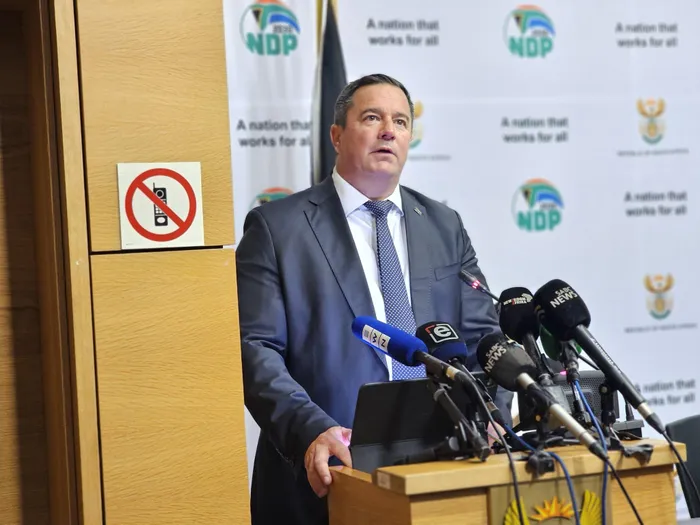
Minister of Agriculture John Steenhuisen hosted a media briefing on Tuesday to provide an update on the current status of FMD and to outline government’s plan to vaccinate 80% of the national herd by December 2026.
Image: Supplied
Livestock farmers will now legally be able to cater to their own biosecurity needs, including treating foot-and-mouth disease (FMD), through the publication in the Government Gazette of the terms of a Routine Vaccination Scheme.
With FMD ravaging livestock throughout the country since late 2025, many cattle farmers and agriculture organisations have criticized the government for not allowing them to vaccinate their own cattle, because the government had begun to roll out its own program and because South Africa initially did not have sufficient vaccine stocks.
Minister of Agriculture John Steenhuisen said on his return from a trip to Latin America on Tuesday, where he worked to obtain a bigger and reliable source of vaccines for the disease, that “while we are busy rolling out the national, fully funded vaccination program, we know our commercial partners need the flexibility to protect their livestock, now.”
“This voluntary scheme is essentially a fast-track option that allows farmers to take the lead in their own biosecurity efforts without first having to wait for the national rollout of vaccines to reach their area,” he said.
This scheme operates as a public–private partnership, enabling owners of cloven-hoofed animals to mitigate the impact of FMD through voluntary vaccination, carried out under the oversight of state veterinary services.
Participating animal owners are required to appoint a private veterinarian or Animal Health Technician, authorised by the Director: Animal Health, to perform the duties set out in the scheme schedule, under the supervision of state veterinary authorities.
Beefmaster Group chairman Louw van Reenen said in a statement that the livestock industry was emerging stronger from the FMD outbreak, even though challenges remain.
“There is improving control of the disease, and if we can get our vaccination status right, over time this should support stronger demand for products like beef and lamb.”
Van Reenen said countries like Argentina and Uruguay have access to US and Europe markets because they meet strict requirements, while South Africa currently does not. “That is a major opportunity for our country, but it will largely depend on an effective vaccination program,” he said.
Steenhuisen said during his visit to Argentina he had visited the laboratories of Biogénesis Bagó, and another 5 million vaccine doses were ready to be exported to South Africa, on top of the 2.5 million doses that have already been distributed in South Africa.
He said agreements were signed with Biogénesis Bagó during the visit to guarantee that the vaccine pipeline remains stable and reliable. This is important because there are currently many outbreaks of FMD in various countries, including in Europe, the Middle East, and the Asia Pacific region, which will push up global demand for the vaccines dramatically.
In addition, following a close study of the regionalisation model used in South America, Steenhuisen said he would use the SADC Agriculture Ministers’ Meeting later this month to call for a similar regional approach as well as the establishment of a regional vaccine bank.
In Brazil, the possibility of a Brazil-South Africa Biosecurity Corridor was discussed during the trip. This involves joint early-warning systems and harmonised risk assessments. Furthermore, the trade imbalance as being addressed “by expediting access to the Brazilian market for South African apples and citrus fruit.”
Meanwhile, Steenhuisen also announced the lifting of the Disease Management Area (DMA) in KwaZulu-Natal. “Since 2021, our agricultural sector in this province has operated under a cloud of restriction, with movement controls designed to protect our national herd. However, as the situation has evolved - so too must our strategy.”
He said that to continue with separate, localised rules for different parts of the same province had become “scientifically and ethically difficult to justify,” because their data showed that the virus is circulating more in the rest of the province than within the DMA.
“Our farmers within the DMA have been economically burdened by these movement restrictions, facing challenges that their neighbours in other districts, and indeed other provinces with equally unstable infections, have not had to face,” said Steenhuisen.
He said that of the 6 million vaccine doses of FMD vaccines procured, 5,229,966 doses had been distributed throughout the country. As of April 23, 2026, three months since the large-scale acquisition of vaccines, over 2.5 million animals had been vaccinated.
BUSINESS REPORT