

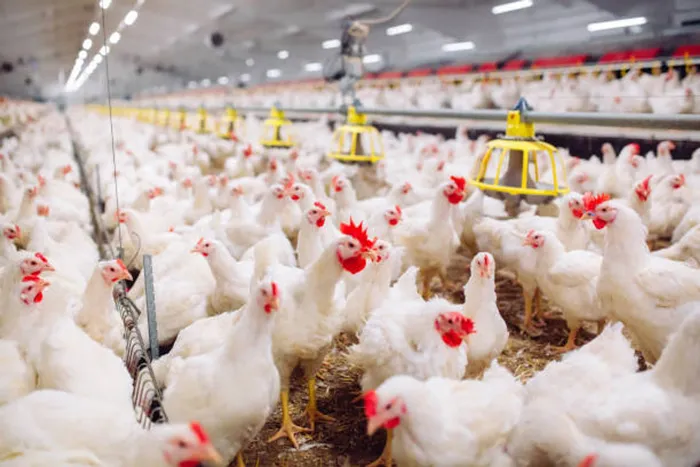
Astral Foods said bird flu remains a risk to the local industry, particularly following higher infection rates in the Northern Hemisphere during their past winter season. Astral has made good progress with its vaccination strategy and abut 30% of its breeding stock will have protection against the disease this coming winter. Farming associations have welcomed news that South Africa issued its first permit to integrated poultry producer Astral for the vaccination of poultry against avian flu
Image: File picture
Astral Foods said strong demand, softer feed prices and better cost management resulted in the JSE-listed integrated poultry producer lifting its interim dividend 427% to 1,160 cents.
The share price gave up some 4% to R227,05 on the JSE Monday afternoon, but the price for the group, which this year celebrated 25 years of being listed on the JSE, is still comfortably ahead of the R186,77 at which it traded a year ago.
However, Astral CEO Gary Arnold said there are a number of factors that will have a bearing on Astral’s near-term business prospects, as well as those of the poultry sector.
Bird flu remained a risk to the local industry, particularly following higher infection rates in the Northern Hemisphere during their past winter season.
However, Astral had made good progress with its vaccination strategy. About 30% of its breeding stock will have protection against the disease this coming winter.
The ongoing conflict in the Middle East has caused international oil prices to surge and, together with a weaker rand, has translated into higher fuel costs. This places further pressure on a consumer base with tightening disposable income amid rising unemployment.
Higher fuel prices, together with a global shortage of fertiliser, would weigh heavily on primary agriculture in South Africa and may negatively affect local crop production for the coming planting season, said Arnold.
“This risk is compounded by the developing El Niño weather phenomenon, and there is a strong likelihood of drought conditions during the South African 2026–27 summer growing season,” said Arnold.
He said any deterioration in local crop production would have negative implications for agricultural supply chains and the broader feed cost environment in the medium to long term.
Nevertheless, South Africa was set for a record grain and oilseed harvest, which had just kicked off for the 2025–26 season. “This will support relatively stable poultry feed input costs over the short term,” said Arnold.
“Astral will continue to optimise broiler production volume opportunities in our business, which will support the demand for chicken and supply the consumer with an affordable and preferred source of protein,” he said.
Group revenue for the six months increased by 11.4% to R11.9 billion, primarily driven by an increase in sales volumes and improved sales realisations in the poultry division. Group operating profit increased significantly off a low base to R1.21bn, underpinned by better margins in the division off lower poultry feed costs, cost management and efficiencies through poultry processing plants.
As a result, the net operating profit margin for the group increased to 10.2%, up from 2.5%.
In the feed division, feed volumes increased by 9.8%, supported by strong internal demand, up 11.1%, with external volumes rising 8%. The increase in internal demand was supported by higher broiler production volumes.
External feed sales mainly reflect higher sales into the table egg sector, as well as higher dairy feed sales.
Revenue for the feed division was in line at R5,3bn, largely attributable to lower feed selling prices, reflecting reduced raw material input costs, particularly for yellow maize.
The poultry division saw a strong turnaround off a very low base, reporting an operating profit of R848 million versus an operating loss of R26m. This was due to broiler production capacity optimisation, with Astral now producing 6.1 million broilers per week. An improvement in overhead cost recoveries was supported by the higher volumes and better efficiencies.
“Group cash flow generation remained strong, supported by the significant improvement in profitability against the comparable period. Our balance sheet is well positioned for capital investments,” said chief financial officer, Johan Geel.
“Astral will continue to optimise broiler production volume opportunities in our business, which will support the demand,” said Arnold.
He said any deterioration in local crop production would have negative implications for agricultural supply chains and the broader feed cost environment in the medium to long term.
Nevertheless, South Africa was set for a record grain and oilseed harvest which had just kicked off for the 2025–26 season. “This will support relatively stable poultry feed input costs over the short term,” said Arnold.
BUSINESS REPORT