

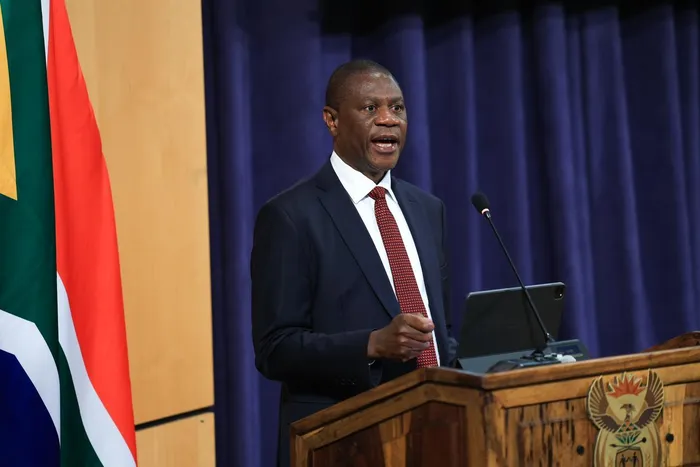
Deputy President Paul Mashatile said regional economic integration in Africa would build economic resilience and growth among African countries..
Image: SA Government X Account
Slow progress on economic integration in Africa is no longer an option as its trade and development continues to fall behind the rest of the world, and a central tenet of that is freedom of movement between its countries for goods, and people.
Delegates who gathered in Cape Town to celebrate 25 years since the launch of the African Union Development Agency (AUDA-NEPAD) said Africa is at a nexus - it otherwise risks falling further behind a world of fast-changing trade, geopolitical and technology development as well as increasing pressures from climate change.
There are also competing interests for global aid - too many projects on the continent rely on aid funding from countries outside Africa.
There is persistent misalignment of interests between African countries that, for instance, led to a 12-year delay in the building of a 250km rail line between Kenya and Somalia, different trade, law and economic systems between African countries that stifle trade and development, and “shameful” xenophobia, as seen recently in South Africa.
Delegates said African countries are also misdirected from their Africa integration agenda by trade corridor funding and interests from other regions, such as the EU, the US and China.
Deputy President Paul Mashatile said that the challenges facing Africa have not changed in the 25 years since being laid bare by former President Thabo Mbeki when he was among those who proposed the development of the AUDA-NEPAD, including poverty, underdevelopment and the global inequality.
Mashatile said recent acts of xenophobic violence in South Africa were shameful, did not reflect government policy, and law enforcement agencies needed to act against it.
He said current levels of trade between African countries, which stand at only 15% of its total trade, are a low percentage compared with other regions, andare insufficient to ensure economic resilience, while the continual reliance on the export of raw commodities from African countries to support country economies represented the export of jobs.
Mashatile said, for instance, that many African countries have the ability to grow their own food, but instead are importers of manufactured food products, and if current trends continue, considering the rising prices of imported foods, there may well be food shortages in African urban areas in the future.
Narda Bekele-Thomas, CEO of the AUDA-NEPAD, said 90% of the institution’s funding is derived from global development funds, and while this was welcome, there are questions about why African countries are not beginning to fund their own development projects.
“When you under-fund your own institution you tell the world you don’t believe in it. You cannot build institutions if you cannot fund it,” she said.
“We are expected to support the development of 8 regional economic communities and 53 countries, but this ownership and membership is not reflected in our budget,” she said.
She said a key aspect of trade and economic integration on the continent was the free movement of skilled people, not just projects, particularly professional and business people, and in this, she also singled out South Africa’s visa system as an example of a country with restrictive visa practices.
She said African professionals and academics were struggling to obtain visas just to hold seminars and meetings in South Africa, never mind work in the country.
“Too much infrastructure is being funded by sovereign and other development agency funding, and we are seeing that it is costing our citizens. African countries, development organisations, financial institutions and the private sector need to invest more on the continent,” she said.
She said infrastructure development and trade integration is taking too long on the continent, and part of the problem is that regulatory and policy misalignments delay projects and cause delays in trade at the borders.
Armien Chad Henricks, AUDA-NEPAD head of infrastructure, governance and partnerships, said while 600 million people did not have access to electricity on the continent, while 300 million who do, only have access to poor electricity supply. Four hundred million Africans do not have access to clean water on the continent, and this figure was much higher if it was access to clean, safe and controllable water resources.
“We need to learn to plan together,” he said.
The AUDA-NEPAD event marked the start of a year-long continent-wide commemoration of the development agency.
The celebration comes after 25 years since President Thabo Mbeki of South Africa and his peers; President Olusegun Obasanjo of Nigeria, President Abdelaziz Bouteflika of Algeria, and President Hosni Mubarak of Egypt, launched NEPAD as Africa’s answer to its own development challenge.
With the establishment of the African Union in 2002, from the Organisation of African Unity (OAU), African leaders positioned NEPAD at the centre of the continent’s development agenda.
Over the 25 years, what began as a declaration of shared intent has become an institution with a measurable record across infrastructure, agriculture, health, climate resilience, gender equality and youth empowerment across all five regions of the continent.
For instance, on trade and connectivity, AUDA-NEPAD's One-Stop Border Post programme has grown from a single crossing at Chirundu between Zambia and Zimbabwe in 2009 to 32 operational posts today, with 85 more in preparation.
On health, the African Medicines Regulatory Harmonisation (AMRH) programme has cut medicine registration timelines in the East African Community from an average of two to three years to under twelve months, ensuring faster access to treatments for HIV, malaria and tuberculosis.
BUSINESS REPORT