

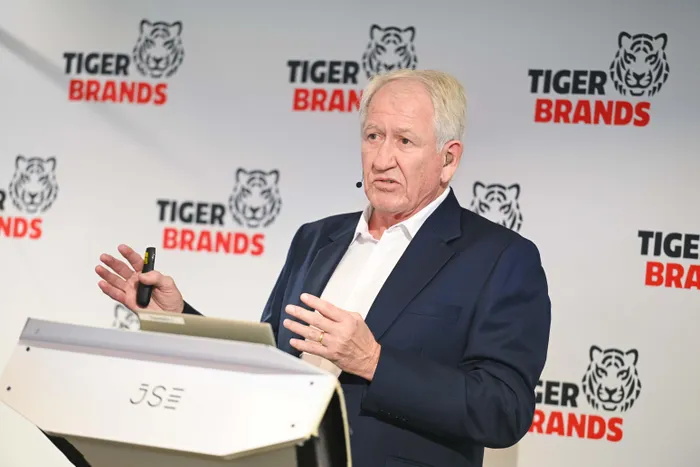
Tiger Brands CEO Tjaart Kruger said the growth achieved in the first half along with continued momentum in delivering the business turnaround is the result of diligent execution of the group strategic and operational levers.
Image: Supplied
Tiger Brands has decided to keep its staple foods business, King Foods, after receiving unsatisfactory offers for the company and after the maker of the King Korn and Ace brands became profitable again.
Not so lucky, however, is Tiger Brands’ 95-year-old Beacon chocolate brand, as the group announced in its results on Monday, for the six months to March 31, that it has reached an agreement to sell its Beacon brand and associated equipment.
However, some of the other branded chocolates and sweets that had been produced by Beacon are being retained by Tiger Brands, including TV Bar, Nosh, Wonder Bar, Black Cat, Jelly Tots, Liquorice Allsorts, and the Jungle Energy Bar.
These brands are profitable and are a “strategic enabler of our ‘snackification’ growth platform,” Tiger’s CEO Tjaard Kruger said in the results report.
The reorganisation of Tiger’s brands is part of a turnaround plan that started in 2024 following years of declining margins, inefficient operations, and fallout from the 2018 listeriosis crisis. The plan involves initiatives to simplify the business, cut costs, and refocus on core food categories.
Also falling under the hammer is Tiger Brands’ 74.38% stake in Chococam, the Cameroonian chocolate and confectionery subsidiary, a disposal first announced in February this year, but which is still awaiting regulatory approval.
Meanwhile, Tiger has paid its shareholders R9.2 billion in share buybacks and special dividends through two years of progress it is making on its turnaround plan.
“These carefully considered capital allocation decisions underscore our deliberate intent to find the optimal balance between driving shareholder returns, optimising our capital structure, and fostering sustainable growth,” said Kruger. The turnaround process began shortly after his appointment in November 2023.
The sale of Tiger’s Randfontein operations, which produces staple foods such as maize meal and wheat flour and other grain products, generated R157 million in non-operational taxed profit for the group during the six-month period.
Kruger said disciplined operational execution and a focus on affordability had underpinned a robust performance for the six months. Food volumes grew strongly, and there was a meaningful improvement in operating income.
This was in spite of ongoing macroeconomic volatility, continued pressure on consumer spending, and a competitive environment.
Overall revenue growth was 1.3% higher at R17.9bn, primarily driven by volume growth of 2.6% and price deflation of 1.3%.
On a like-for-like basis, excluding the impact of discontinued SKUs (Stock Keeping Units) and disposed businesses, normalised volume growth was 4.5%, with price deflation at 1.7%.
Gross margin increased to 32.1% from 29.8% in the prior year, driven by favourable raw material inputs in key categories and initiatives to improve factory efficiency and value engineering savings.
“The South African consumer bears the heaviest burden during challenging economic times,” said Kruger.
All the group business units improved operating income, with the Grains and Culinary segments delivering standout increases of 91.7% and 26.9% respectively.
At the Milling and Baking division, revenue increased by 0.6% to R4.2bn, driven by volume growth of 0.3% and price inflation of 0.3%. Operating income increased 15.3% to R376m, and margins increased to 8.9% versus 7.8% in the prior year.
The Grains segment revenue of R3.5bn was driven by volume growth of 6.9%, offset by price deflation of 10.8% in soft commodities. Operating income increased by 91.7% to R441m, with margins nearly doubling to 12.7% from 6.4%.
This growth was driven by effective pricing strategies, a stronger product mix, logistics optimisation, and improved profitability at King Foods.
The Culinary segment revenue increased by 8.7% to R5.7bn, driven by 6% volume growth and 2.7% price inflation.
In the Snacks, Treats, and Beverages division (STB), revenue of R3.3bn was 1.2% higher, with volume growth of 1.2% driven by candy and ready-to-drink dilutables. Operating income improved 16.1% to R505m, and the operating margin was at 15.5%, versus 13.5% in the prior year.
In the Home and Personal Care division (HPC), revenue fell 9.5% to R1.3bn, driven by volume declines of 10.4% in both Home Care—impacted by wet weather reducing peak pest season demand—and Personal Care, which was impacted by continued competitive intensity.
Kruger said they expect the macroeconomic environment to become more challenging in the second half.
BUSINESS REPORT