

Government is set to clamp down on illegal miners.
Image: Freepik
President Cyril Ramaphosa’s announcement last night that he’s set to deploy the army to deal with illegal mining in Gauteng could well help boost the economy further.
As of early 2026, the country is benefiting from the windfall of a surge in global commodity prices, particularly in gold and platinum group metals. Mining accounts for around 6% of gross domestic product and employs almost half a million people.
When commodity prices go up, the value of exports surges, though logistics and illegal mining often prevent miners from increasing the physical volume.
In November last year, the country had a surplus of R37.7 billion, the widest in nearly four years, due to falling imports (especially components, mineral products, vehicles) and slightly lower but still strong exports (base metals, mineral products).
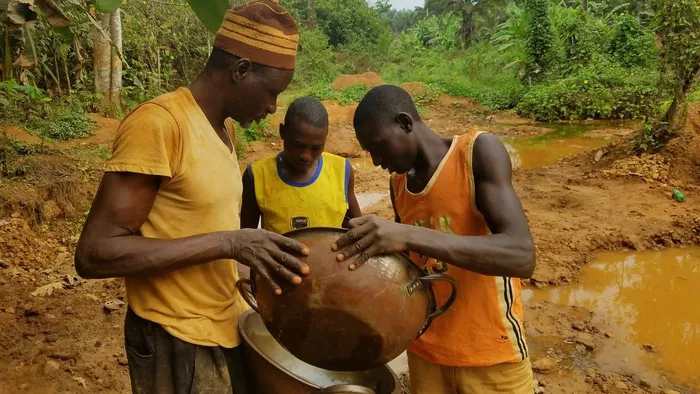
Illegal gold miners in action.
Image: Wikimedia Commons
Investec economist Lara Hodes has noted that mining production rose 2.5% year-on-year at the end of the last quarter of 2025 – the latest figures.
This followed November’s 2.4% year-on-year revised slide. Measured on a quarter-on-quarter seasonally adjusted basis however, output fell by 0.5% in the final quarter of last year, she said recently.
Yet, the country is besieged by the scourge of illegal miners – the so-called zama zamas – who not only put themselves at risk when they enter disused mining tunnels but also rob the country of billions in export money.
Between 5% and 30% of South Africa’s gold output may be mined and traded illegally, according to estimates from industry and regulatory research.
The range is wide, reflecting the difficulty of quantifying a trade that operates largely outside formal oversight.
Even at the lower end, this represents gold worth billions of rand, bypassing taxes, royalties, and reporting mechanisms.
Illegal mining is concentrated in abandoned or under-regulated shafts, particularly in Gauteng, North West, and Free State provinces.
These operations often rely on artisanal and small-scale miners, some working informally or illegally, while others are employed by organised syndicates.
Gold from these sources frequently enters formal supply chains after being laundered through refineries, making it extremely difficult for authorities to track its origin.
Prices of this precious metal remain elevated, increasing the incentive to extract and move gold outside legal channels.
“Gold rose to around $4,960 per ounce on Friday after falling more than 3% in the previous session, as markets navigated elevated volatility,” according to Trading Economics.
The yellow metal recently hit a record high of just more than $5,400 an ounce. PGMs, likewise, have been doing well until a sharp decline at the end of January. Platinum’s early January price was the highest in a decade.
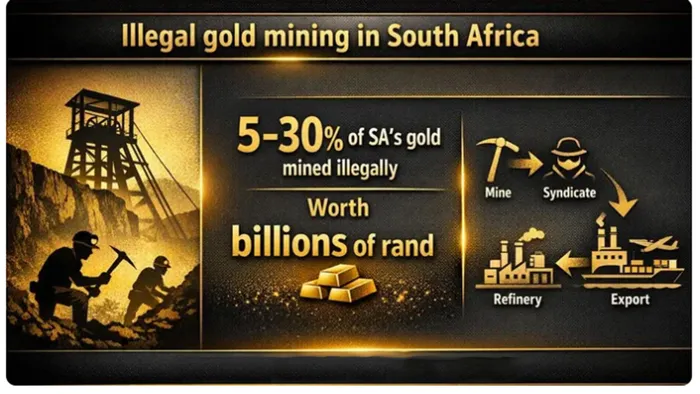
Illegal gold mining is a drain on the economy.
Image: ChatGPT
Ramaphosa, speaking during the State of the Nation Address last night, said the South African National Defence Force would deal with illegal mining in Gauteng.
The president declared organised crime as the most immediate threat to the country's democracy and outlined comprehensive plans to strengthen the fight against criminal networks.
“Our primary focus this year is on stepping up the fight against organised crime and corruption, and we will do so using technology, intelligence and integrated law enforcement,” Ramaphosa said.
Gauteng Premier, Panyaza Lesufi, welcomed this announcement, calling it “a decisive and necessary intervention to confront the growing threat posed by illegal mining activities, which undermine the rule of law, endanger communities, destroy critical infrastructure, and negatively impact the economy of the province”.
Lesufi noted that “illegal mining has become a serious criminal enterprise that threatens the safety of our communities, exploits vulnerable people, and causes extensive environmental damage”.
“We have to act to rid our country of gang violence,” said Ramaphosa.
Mining is also set to become an economic focus through exploration activities such as geological mapping, with a particular focus on rare earth minerals, which are currently in high demand.
Ramaphosa also said that new gold, copper, rare earths, platinum and coal mines are being opened.
IOL BUSINESS