

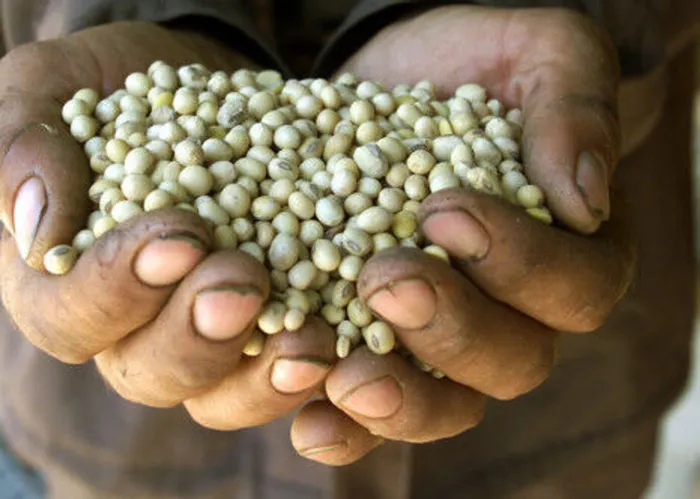
Agricultural Business Chamber of South Africa said that a recent 12% drop in the soybean spot price compared to a year ago may not be good news for the grain farmer but signals good news for feed prices and the poultry sector.
Image: File
A sharp decline in soybean and maize prices is delivering mixed fortunes across South Africa’s agricultural sector, easing feed costs for poultry producers while tightening margins for grain farmers.
According to the Agricultural Business Chamber (Agbiz), soybean spot prices have dropped by around 12% compared to a year ago, while white maize prices have plunged by as much as 39% year-on-year. Yellow maize prices are also under pressure, down roughly 28% over the same period.
Agbiz chief economist Wandile Sihlobo said the price decline comes amid a period of strong agricultural activity.
“In the northern regions of our country, farmers are beginning to harvest soybeans and other summer grains and oilseeds,” he said.
Since the start of the current marketing season in March, farmers have delivered over 245,000 tons of soybeans to commercial silos. Despite a projected harvest of 2.7 million tons — about 4% lower than last year due to weaker yields in some regions — output remains well above the long-term average.
Sihlobo noted that this level of production will likely keep South Africa in a net export position, while simultaneously placing downward pressure on domestic prices.
“A harvest of 2.7 million tons is well above the long-term average and will keep South Africa in a net exporting position,” he said.
“For example, the soybean spot price currently trades around 6,763 per tonne, which is down 12% from a year ago. Indeed, the presence of large global soybean supplies also contributes to these lower domestic prices.”
While lower prices are unwelcome news for soybean producers, they are providing a significant boost to the livestock and poultry industries, where feed costs make up the bulk of production expenses.accounts for over half of input costs in yellow and soybeans.
Sihlobo said yellow maize prices are also under pressure, down 28% from a year ago, due to ample supplies.
“So, we are at a time of favourable feed prices for the poultry producers.”
Izaak Breitenbach, CEO of the South African Poultry Association, said soybean meal is a critical component in broiler diets, accounting for about 23% of feed composition but roughly half of feed costs per ton.
“The soybean price is thus very important in final feed price determination,” Breitenbach said.
He added that the drop in maize and soybean spot prices is good news for feed prices.
“Good news for sure, it will put the industry in a position to supply affordable chicken meat to our consumers as we have done for many years.”
Breitenbach concluded that feed cost makes up approximately 65-70% of the cost of growing a broiler, and therefore feed cost is important in poultry production.
“For us to supply affordable chicken to our consumers, we would try to minimise the cost of feed as far as possible.”
However, the outlook is less favourable for grain producers.
Dawee Maree, head of agriculture information and marketing at FNB, warned that declining crop prices are likely to weigh on farmer profitability.
“The fundamentals and market conditions will always dictate. That is why a proper hedging strategy is always important for grain farmers,” Maree said.
“However, the biggest challenge at this stage is the increase in input costs (diesel and fertilisers) as a result of the Middle East conflict. That increase, coupled with the low prices, will force farmers to make certain (probably difficult) decisions come planting time in Oct-Dec.”
Maree concluded that on the other side of the scale, the drop in grain prices is positive news for intensive livestock producers (poultry, dairy, and feedlots).
“This should result in lower feed costs for these producers, taking into account feed costs are normally more than 70% of their input costs.”
BUSINESS REPORT