

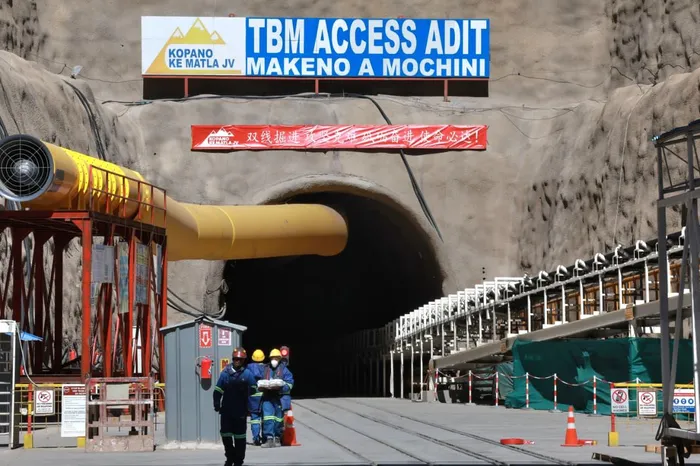
The newly launched TBM, an engineering feat measuring 423 metres in length with a 5.38-metre cutterhead, will excavate deep beneath mountainous terrain, in some sections operating under rock cover exceeding 1,000 metres.
Image: GCIS
The second phase of the Lesotho Highlands Water Project has entered a critical new stage, with the official launch of a second tunnel boring machine (TBM) marking accelerated progress on one of Africa’s most ambitious cross-border infrastructure projects.
Minister of Water and Sanitation, Pemmy Majodina, and Lesotho’s Minister of Natural Resources, Mohlomi Moleko, on Monday unveiled the Polihali TBM in Mokhotlong, Lesotho, a milestone that underscores the R9.2 billion project’s shift from preparation to full-scale underground construction.
Phase II of the project is designed to significantly boost water supply to Gauteng while simultaneously strengthening Lesotho’s energy capacity through the planned Oxbow Hydropower Scheme.
At its core is the construction of the 38.5-kilometre Polihali Transfer Tunnel, which will channel water from the Polihali Reservoir to the Katse Reservoir.
The newly launched TBM, an engineering feat measuring 423 metres in length with a 5.38-metre cutterhead, will excavate deep beneath mountainous terrain, in some sections operating under rock cover exceeding 1,000 metres.
Majodina described the machine as more than just equipment, calling it a “fully integrated underground factory” that represents a decisive step toward long-term water security.
“As the TBM advances, it brings us closer to the dream of a water-secure Gauteng, which is the economic hub of the country and population growing rapidly despite being the smallest province in the country,” Majodina said.
Work on the tunnel is already well underway. A TBM launched from the Katse side in January 2025 has excavated more than 600 metres, while the Polihali machine, which began operations in January 2026, has already advanced hundreds of metres. Both machines are boring toward a meeting point beneath mountain ranges rising above 3,000 metres.
The Lesotho Highlands Development Authority confirmed that the twin TBM approach is complemented by drill-and-blast methods in more complex geological sections. This hybrid construction model is expected to optimise both speed and cost efficiency across the project.
Once complete, the tunnel will dramatically increase water transfer capacity from 780 million cubic metres to 1,270 million cubic metres per year, reinforcing Gauteng’s water supply at a time when demand continues to rise.
In parallel, energy generation at the Muela Hydropower Station is expected to increase by around 30%, supporting Lesotho’s drive toward greater energy independence.
“This is a step-change in regional resilience — for both the Kingdom of Lesotho and the Republic of South Africa,” Majodina said.
Beyond its technical scale, the project is also delivering substantial socio-economic gains. Thousands of jobs have already been created, with a strong focus on local participation.
More than 2,400 Basotho workers are currently employed, while over 1,100 individuals have received skills training, with hundreds gaining formal certification. Local economic participation has exceeded M600 million, with procurement programmes supporting regional businesses, including black-owned enterprises.
Majodina said these efforts are central to ensuring that the project delivers tangible benefits to communities in Lesotho.
She said progress on the Polihali Dam, set to become Africa’s largest concrete-faced rockfill dam upon completion, is also advancing steadily. Over 7.7 million cubic metres of rockfill have already been placed, representing more than half of the total embankment volume. Construction continues at a pace exceeding 20,000 cubic metres per day.
“At the downstream end, this tunnel will connect to the Katse reservoir through a highly controlled underwater breakthrough — the “lake tap.” A moment that will demand absolute precision in alignment and pressure control,” Majodina said.
This comes as the government is in the final stages of establishing a National Water Resource Infrastructure Agency (NWRIA) to effectively manage and mobilise funding for the country's water infrastructure.
In his State of the Nation Address, President Cyril Ramaphosa promised a Water Action Plan designed to address immediate (short-term) municipal failures, as well as medium and long-term infrastructure improvements.
An investment of R150bn was identified in 2026 to fix the problem, including the establishment of the NWRIA to manage the construction and maintenance of water systems.
Meanwhile, Moleko highlighted the broader significance of the project, noting that it builds on more than four decades of collaboration between the two countries.
"This milestone positions the construction programme in the correct sequence, bringing greater certainty to the 2029 water delivery date to South Africa, while marking another significant step towards achieving energy independence and reducing reliance on imported energy," he said.
BUSINESS REPORT