

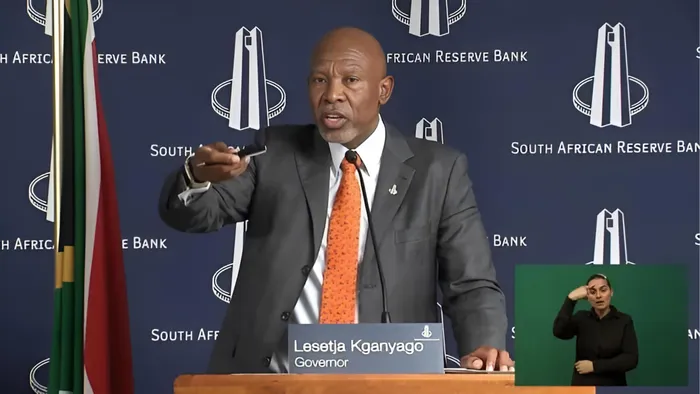
The recent Constitutional Court ruling on the Phala Phala farm scandal has intensified scrutiny on the South African Reserve Bank's actions. This article explores the implications of the court's decision and the ongoing controversy surrounding President Cyril Ramaphosa's alleged misconduct.
Image: IOL | File
The recent judgment of the Constitutional Court on the Phala Phala farm scandal has once again brought the South African Reserve Bank (Sarb) firmly into the spotlight over the handling of the matter.
The court upheld a court challenge by the EFF and the ATM when it set aside the vote of the National Assembly, taken in December 2022, when it declined to refer the report of the Independent Panel to an Impeachment Committee.
It declared the parliamentary rule, which deals with the removal of the president, inconsistent with the Constitution and provided a read-in provision pending an amendment.
All the controversy stems from an unreported robbery at President Cyril Ramaphosa’s Phala Phala farm three years ago.
The Phala Phala report tracked a series of events around the payment of a “holding deposit” in millions of foreign currency for some of the president’s prized buffalo, but the money was rather fortuitously “stolen” before the president needed to declare it to the Sarb and SA Revenue Services.
The matter has been a serious point of contention for opposing political parties and lobby groups, with many accusing Sarb of protecting the president instead of freezing Ramaphosa's bank accounts and taking further action against him.
It had raised questions about the institution’s commitment to ensuring the integrity of the financial system.
Sarb has published limited findings two years ago of its investigation into the Phala Phala matter, where it was seemingly set aside on a technicality.
The central bank had said it found that, based on the facts available, there was no violation of the country’s exchange control laws because there was no “perfected transaction” to require a declaration on the part of the farm.
Sarb governor, Lesetja Kganyago said at the time that the central bank treated its mandate seriously, as he answered to Ministers of Parliament two years ago.
“We were satisfied that our team acted professionally and without fear or favour. Our responsibility was to focus on the possible exchange of money and we focused on the laws that we administer. We are not responsible for the port of entry, that would be Sars (SA Revenue Service).
“Sars has already pronounced the declaration of this money. We do not have the power that customs officials have, it is the responsibility of them,” the governor said while answering probes by MPs in Parliament.
“We were not investigating a crime, we were investigating exchange controls,” he further said.
The bank’s findings on the matter was, “On the facts available to it, the SARB finds that there was no perfected transaction and thus the SARB cannot conclude that there was any contravention of the exchange control regulations (the applicable regulation is regulation 6(1)) by Ntaba Nyoni Estates CC (the entity involved) or, for that matter, by the president. That is because the SARB has concluded that the transaction in question was subject to conditions precedent which were not fulfilled, and therefore there was no legal entitlement, within the meaning of regulation (6)(1), on the part of Ntaba Nyoni Estates CC, to the foreign currency.”
Kganyago said the mere possession of foreign currency was not what was regulated in terms of the exchange control regulations.
“Any cash upon entry into the country needs to be declared to Sars,” Kganyago further added.
The uncomfortable question therefore remains - did the South African Reserve Bank investigate Phala Phala as broadly as the financial integrity, constitutional accountability, and public trust implications demanded or only as narrowly as its immediate regulatory threshold technically required?
The Congress of South African Trade Unions (Cosatu) said on Monday that it noted Ramaphosa’s intention to exercise his legal rights to take the Section 89 Panel Report upon Review.
"Whilst the Report and its allegations are a matter of great concern to all, it is important that space be provided to Parliament to fulfill its responsibilities in full, including as directed by the Constitutional Court. We expect all Members of Parliament, across party lines, to uphold the spirit and letter of the Constitution at all times, in particular in how it processes these serious matters of state. Now is not the time to play to the public gallery, irrespective of the pending local elections and politicians’ desperation for social media likes and media headlines. This is more so during these uncertain and sensitive times, both global and domestic," Cosatu stated.
The trade union further stated, "Whilst none would wish for these messy headlines, especially when the nation is grappling with high unemployment, weak economic growth, rising costs of living, entrenched poverty and inequality, endemic crime and corruption, and embattled public and municipal services. We nonetheless take pride that ours is a robust constitutional democracy where all are subjected to oversight by Parliament, scrutiny by the judiciary and ultimately the public’s verdict. This was built and achieved in no small part by the liberation movement led by the Tripartite Alliance. We must at all times defend these fundamental tenets of our nation."
Follow Business Report on Facebook, X and on LinkedIn for the latest Business and tech news.