

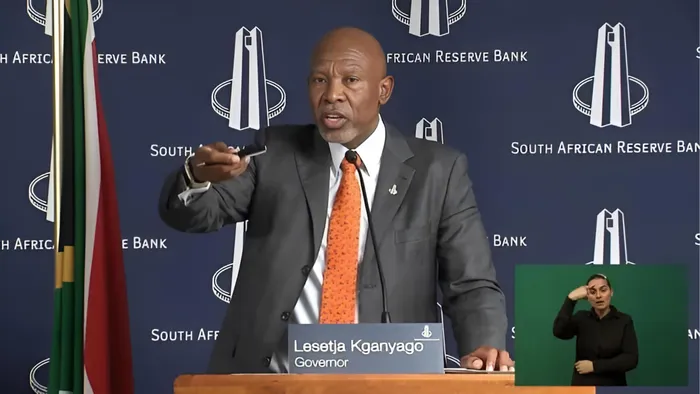
A new Bureau for Economic Research (BER) report has sparked concern that Middle East tensions and rising fuel costs could result in an interest rate hike later this month.
Image: IOL | File
A new Bureau for Economic Research (BER) report has raised concerns that escalating tensions in the Middle East and rising fuel prices could push the South African Reserve Bank (Sarb) towards an interest rate hike later this month.
The warning comes ahead of the Monetary Policy Committee (MPC) meeting on May 28, where policymakers are expected to weigh growing inflation risks against South Africa’s fragile economic recovery.
Lisette IJssel de Scheppe, chief economist at BER, said the inflation outlook had deteriorated significantly in recent months after initially appearing more stable at the start of the year.
“Inflation was easing, interest rates were expected to fall, and the global economy seemed to be digesting all the tariff and trade drama,” De Scheppe said.
However, she said the story has now become more complicated.
“The world has changed again, and with it the assumptions underpinning that relatively neat outlook, especially when it comes to interest rates. A few months ago, the question was how quickly interest rates would fall. Now it is whether they may rise again.”
De Scheppe said that the disruption to global energy markets has pushed oil prices higher, lifted fuel costs, and introduced a renewed inflation hump just when we thought the path to 3% was going to be swift and painless.
She said that even with some cushioning, inflation is now set to move higher in the near term.
“For a small, open economy like South Africa, that feeds through the economy quickly - via the fuel pump, the exchange rate, and ultimately, into broader prices,” she said.
“A forecast of around 4% for headline inflation in 2026, with some months edging closer to 5%, looks reasonable even if the Iran conflict is resolved relatively quickly, with higher outcomes increasingly likely the longer it drags on.”
De Scheppe said that the Sarb has earned a reputation for acting decisively when inflation threatens to drift.
“That credibility is valuable - it allows the Bank to look through temporary shocks - but it also means it cannot afford to ignore signs that inflation pressures may become more persistent.”
She added that the expectation was that the bank could look through this shock.
“But several weeks in, with oil prices still elevated and disruption in the Strait of Hormuz ongoing, that window is closing quickly. Which is why the prospect of a rate hike at the May MPC meeting suddenly feels very real,” she said.
De Scheppe said that a small, early adjustment of 25 basis points, followed by more only if needed, would be aimed less at the current fuel shock, which higher interest rates cannot fix, and more at preventing second-round effects from taking hold.”
“Higher interest rates, even modest ones, will add pressure to already stretched households and raise borrowing costs for firms at a time when demand is still fragile,” added de Scheppe.
Professor Raymond Parsons, a North-West University Business School economist, said that at its previous meeting the MPC already indicated that headline inflation would exceed its 3% inflation target in the months ahead.
“At the same time, prior to the global energy impact, inflation had declined to about 3% earlier this year. At its next meeting on May 28, the MPC will therefore need to decide, on the data then available, whether there are already ‘second round effects’ emerging from the expected higher headline inflation.”
Parsons added that on present evidence, it might be argued that the MPC can afford to ‘wait and see’ for now.
“In addition, the global reaction from most other central banks, which like the Sarb enjoy high credibility, is that they will not yet rush into interest rate hikes that may unnecessarily damage growth and employment,” Parsons said.
“In this highly uncertain outlook, the jury is therefore presently still out on whether the MPC should raise rates now.”
Professor Waldo Krugell, an economist at North-West University, said that the fuel price increases are definitely going to feed into inflation and lead to a rate hike, but there's still some uncertainty over the size of this impact.
“We know that fuel costs make up a very specific part of the CPI basket. So a 15% increase in the price of petrol is weighted with a 3.8% weight in the basket and that then adds to the headline inflation rate.”
Krugell added that the fuel price increase will definitely push up inflation.
“Any second-round inflation effect on other prices will not yet be visible. I think that the Sarb has the inflation-fighting credibility that they can wait one more meeting and see if the war ends and oil prices come down by the time of the July meeting.”
BUSINESS REPORT