

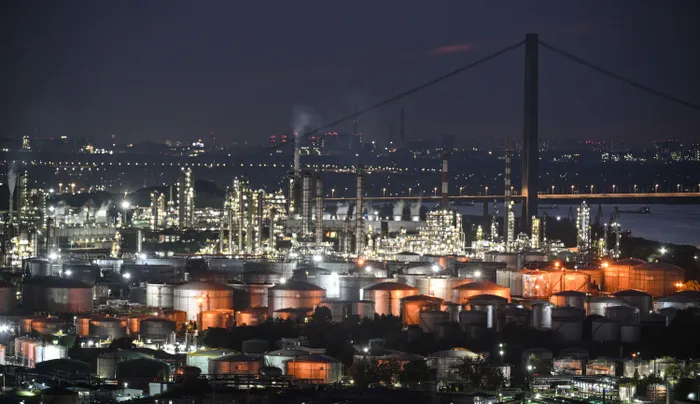
South Africans may face further fuel price hikes and rising interest rates if Brent crude remains above $100 a barrel amid ongoing tensions in the Middle East.
Image: Hector Retamal / AFP
Ongoing tensions in the Middle East and continued disruption around the Strait of Hormuz are keeping global oil prices elevated, with economists warning that South Africans could soon feel the effects through higher fuel costs, rising inflation, and additional interest rate hikes.
According to Annabel Bishop, commercial cargo traffic moving through the Strait of Hormuz has dropped dramatically in recent weeks as uncertainty surrounding the conflict between Iran and the United States continues.
“Commercial cargo vessels crossing through the Strait of Hormuz have declined from over one hundred and twenty a day to around five a day, with some days seeing zero and others closer to ten,” Bishop said.
The Strait of Hormuz is one of the world’s most strategically important shipping routes for global oil and energy supplies. The disruption has contributed to Brent crude oil prices remaining above US$100 a barrel since late April.
“The oil price has been substantially elevated on the stalemate in the Middle East war, at over US$100 per barrel since the 22nd of April as talks between Iran and the US stalled, and Iran maintains its threat of holding sovereignty over the Strait of Hormuz, elevating oil futures,” Bishop explained.
Financial markets are increasingly pricing in the possibility that maritime traffic through the strait may not normalise this year.
“Financial markets only see around a 75% probability of the Strait open by January next year, which would put significant pressure on oil and petroleum product supply, as well as that of oil feedstocks,” Bishop said.
The impact could be particularly significant for South Africa as higher global oil prices filter through to local fuel costs and inflation.
3Bishop warned that if Brent crude remains above US$100 per barrel for the rest of 2026, inflationary pressures could intensify considerably.
“Currently, CPI inflation is expected to average near 4.0% year on year this year, but the oil price persistently above $100 per barrel would push it towards 5.0% year on year,” she said.
This could also alter the country’s interest rate outlook.
“We expect one 25 basis point interest rate hike in July, but sustained elevated oil prices could turn that into at least two 25 basis point increases this year,” Bishop said.
Higher borrowing costs and rising import expenses are also expected to weigh on economic growth.
“In addition, GDP growth would drop towards 1.0% year on year from our forecast 1.5% year on year as the cost of imports escalates,” Bishop said.
South African motorists are already facing the prospect of another fuel price increase in June.
“South Africa’s petrol price is now set to rise by 25 cents per litre in June, but adding in the planned change in the fuel levy means June’s petrol price hike would be closer to R2.00 per litre instead,” Bishop added.
She cautioned, however, that international petroleum prices remain highly volatile and could still shift materially before month end.
The Central Energy Fund’s fuel price recoveries continue to fluctuate daily depending on developments linked to shipping activity in the Strait of Hormuz.
Bishop noted that the average rand oil price for May currently stands at R1 750 per litre, higher than April’s average of R1 701 per litre, although the pace of increases has slowed compared with earlier spikes seen this year.
Meanwhile, global demand conditions are also beginning to weaken as higher prices place pressure on consumers and businesses.
According to the International Energy Agency, world oil demand is forecast to contract, with weaker economic conditions and demand saving measures contributing to slower consumption.
The agency also noted that oil supply from Gulf countries has declined due to the disruption around the Strait of Hormuz, although increased production from other regions is offering partial relief.
Bishop said diesel prices have moderated slightly this month as lower demand has reduced pressure on international gasoil prices, but warned that further volatility remains likely.
As South Africa heads into its key agricultural planting season later this year, concerns are also emerging around the impact elevated fuel and fertiliser input costs could have on food production and broader inflationary pressures.
While global oil prices have fluctuated sharply over the years, Bishop noted that South Africans have steadily experienced the impact through rising fuel prices.
According to Statistics South Africa, petrol prices have risen from just 21 cents per litre in 1976 to R26.52 per litre currently, reflecting decades of oil market shocks, currency weakness, and global supply disruptions.
Follow Business Report on Facebook, X and on LinkedIn for the latest Business and tech news.