

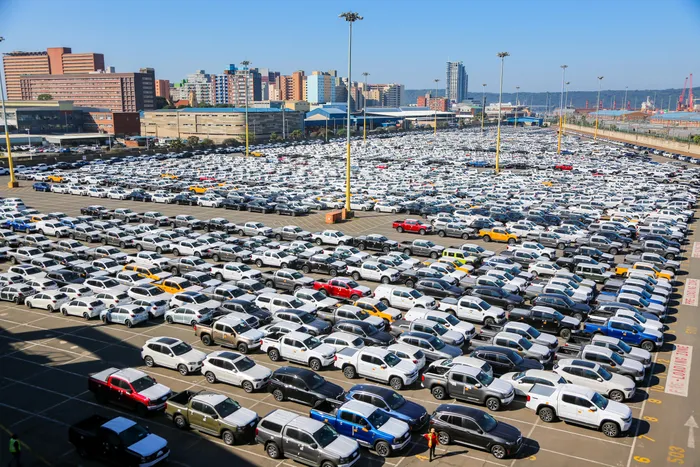
A new report by the Bureau for Economic Research (BER) on Tuesday indicated that exports of automotives have increased significantly from India and China in recent years.
Image: Supplied
A new report by the Bureau for Economic Research (BER) has highlighted how rapidly rising vehicle imports from China and India are reshaping South Africa’s automotive market, intensifying pressure on local manufacturers while giving increasingly cash-strapped consumers access to more affordable vehicles.
The report, authored by economist Rose Murunzi, found that lower-priced vehicles from the two Asian economies have significantly expanded consumer choice in a market where affordability has become a dominant concern.
According to the report, lower priced vehicles from both markets have expanded consumer choice and improved affordability in an economy where households have become increasingly price-sensitive.
The report noted that South Africa currently accounts for only 0.64% of global vehicle production, ranking 21st globally, with ambitions to increase that share to 1% by 2035.
By comparison, India accounts for roughly 6.4% of global vehicle production, ranking fourth worldwide, while China dominates the global market with an estimated 33.7% share.
Murunzi said that import penetration has increased. And while India has long been an important supplier of affordable passenger vehicles to South Africa, Chinese brands have expanded particularly rapidly in recent years, increasing their share of the domestic market.
“At the same time, the industry continues to operate within long-standing structural constraints, including infrastructure inefficiencies and high logistics costs, and within an export-oriented policy framework that has historically supported production scale, investment, and manufacturing employment,” she said.
Murunzi said the scale advantage enjoyed by both China and India, supported by extensive state backing and deep supplier networks, has allowed manufacturers in those countries to produce vehicles at significantly lower costs than many global competitors.
“This scale differential for both markets directly translates into cost advantages, enabling them to undercut global competitors while maintaining margins,” Murunzi said.
“Since the pandemic, global production has diverged: China’s output surged to 27 million vehicles in 2022 (up 5% from 2019), while India also expanded strongly, and the US recovered to near pre-pandemic levels; however, Germany and Japan remained below 2019 output.”
The report found that India has remained South Africa’s largest export destination for passenger vehicles for more than a decade, underlining the increasingly integrated automotive trade relationship between the two countries.
“This sustained trade relationship highlights the growing integration of the two countries within the automotive value chain, particularly in the supply of affordable passenger vehicles to the South African market,” Murunzi said.
At the same time, Chinese vehicle brands have rapidly expanded their footprint in the domestic market.
Chinese automakers have gained notable market share in recent years, with Chery entering South Africa’s top 10 vehicle brands in 2024 and ranking eighth, while GWM climbed from ninth place in 2023 to sixth in 2025.
Traditional players such as Nissan and Renault have subsequently dropped out of the country’s top 10 vehicle rankings.
“In 2025, South Africa recorded a total automotive trade deficit of R66.5 billion,” Murunzi said.
“However, the country's automotive trade deficit with Asia alone amounted to R143.5bn, highlighting the automotive sector’s heavy reliance on Asian vehicle and component imports and lack of exports to the region.”
Thailand remains a major supplier of original equipment components required to support domestic assembly activities, while China and India are increasingly supplying affordable, technology-rich passenger vehicles dominating the local market.
“Rising imports, therefore, play a dual role in the sector. On the one hand, imported vehicles and components support domestic demand and local assembly activities,” she said.
“On the other hand, increasing import dependence widens the automotive trade deficit and intensifies competitive pressure on domestic manufacturers, particularly in the local vehicle market.”
Domestic vehicle sales declined by 16.5% between 2015 and 2024 before partially recovering in 2025, although sales remained below 2015 levels.
Over the same period, imports rose by 19.1%, increasing their share of total vehicle sales.
“This rise in import penetration suggests that domestic producers have been unable to compete on price or product offerings in key segments, particularly in the entry- and mid-range categories where demand is most elastic,” Murunzi said.
The report further noted that South Africa’s automotive sector continues to face deep structural constraints, including logistics inefficiencies, infrastructure bottlenecks and elevated transport costs that undermine competitiveness.
Despite these challenges, the sector remains central to South Africa’s industrial strategy, employment base and export earnings.
The BER said maintaining the long-term sustainability of the industry would require improving domestic competitiveness while balancing consumer demand for affordable vehicles with the need to protect local manufacturing capacity.
BUSINESS REPORT