

Business leaders, technology experts and youth advocates say South Africa’s unemployment crisis requires urgent collaboration, digital infrastructure investment and AI driven reskilling to prepare young people for the future of work.
Image: Supplied.
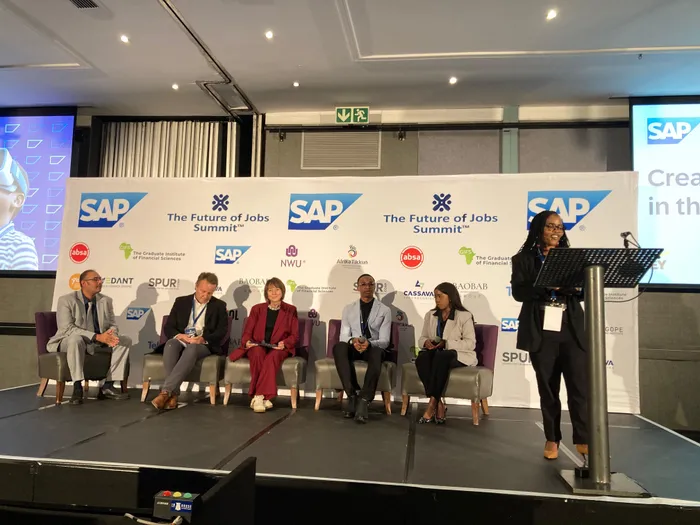
As South Africa grapples with an unemployment crisis the 2026 Future of Jobs Summit held at the Maslow Hotel in Sandton on Thursday provided a detailed road map on how government and businesses in South Africa can come together to put an actionable plan in place to create jobs and prepare the future workface in gaining employment.
During panel discussions held at the Summit, it was revealed that the worsening unemployment crisis and the rapid rise of artificial intelligence (AI) are forcing business leaders, policymakers and youth advocates to confront an urgent reality: traditional approaches to job creation are no longer enough.
With youth unemployment among people aged 15 to 34 sitting at 45.8%, experts said the country must rethink how it prepares young people for a rapidly changing labour market increasingly shaped by technology, automation and digital skills.
Speaking during discussions focused on the future of work and employability in Africa, business leaders and youth development advocates stressed that collaboration between corporates, government and civil society will be critical to creating sustainable employment pathways.
Amanda Gibbs, Chief Executive Officer of the African SAP User Group, one of the panelists at discussions held during the Summit said connecting young people to opportunities and networks is one of the biggest challenges facing the country.
“Skills become more powerful when young people are able to connect to people who can teach them and upskill them,” said Gibbs.

Amanda Gibbs, Chief Executive Officer of the African SAP User Group
Image: Supplied.
She explained that many young South Africans face fear and uncertainty when trying to enter the workforce, particularly as AI transforms industries and career paths.
“There is so much fear in trying to find a job. It is all of us that need to do something different,” she said. “Connecting skills with opportunities is what we need to look at and AI is a fantastic tool to help you with creating and opening up that conversation.”
Gibbs added that behind the unemployment statistics are real people and communities struggling to find stability and opportunity.
“Behind these figures there are faces, names and stories,” she said.
They further argued that while AI is often viewed as a threat to employment, it also presents significant opportunities for those willing to adapt and learn new skills.
Refilwe Motseta, SAP Young Professionals Graduate (YPP), Global Government Affairs & CSR Intern at SAP, said fears around AI replacing jobs often stem from resistance to change.
“The notion of AI taking jobs comes from the notion of not willing to learn,” Motseta said. “We need to learn and adopt as it can assist in daily work lives.”
She encouraged young people to invest in understanding AI and digital tools in order to remain competitive.
“We should be investing in learning more about AI and to remain up to date,” she said.
During a panel discussion under the banner: Creating Jobs in the Age of AI, Dr Suvel Ramgovind, a senior solution advisor and AI specialist at SAP said organisations and individuals alike need to embrace a mindset shift around reskilling.
“If we do not come to terms that we need to adapt and reskill, people who are willing will not be left behind,” Sevel said.
The discussions also highlighted the widening digital and skills gap facing corporate South Africa.

Dr Suvel Ramgovind, a senior solution advisor and AI specialist at SAP
Image: Supplied.
Sean Berrington , EY Africa’s Tech Consulting Leader and Tech Alliances Leader said many technology firms and banks are already facing ageing skills gaps and increasing demand for digital talent.
“Most tech and banks have an ageing skills gap,” Shaun said. “It requires people to think differently and work together.”
He added that stronger collaboration between businesses is needed to scale meaningful employment interventions.

Sean Berrington , EY Africa’s Tech Consulting Leader and Tech Alliances Leader
Image: Supplied.
“Forums such as these are exceptional. We need more corporates in the room with more commitments made,” he said.
The role of infrastructure in enabling long term job creation also emerged as a major theme.
Melvyn Lubega, Head of the Digital Service Unit in the Presidency and chairperson at the Baobab Group, argued that sustainable job creation depends on building strong digital infrastructure rather than relying solely on companies to create jobs directly.
“Job creation does not come from companies. It comes from infrastructure,” Lubega said.
He pointed to countries such as India, where investment in digital infrastructure unlocked innovation and large scale economic participation.
“South Africa has good foundations, a strong banking sector, strong institutions and incredible talent,” he said. “But everyone is working in their own silos and we need to come together and collaborate.”
Executives from Absa Group also stressed that Africa’s future workforce will need to adapt rapidly as industries evolve.
KG Bako, Managing Executive: TalentManagement and Transitions at Absa Group, said Africa’s future growth story depends on decisions being made now around skills development and employability.
“The decisions we make every day shape the continent,” Bako said. “We need to build the skills of the future and create sustainable jobs.”
According to the World Economic Forum, roughly 60% of Africa’s workforce will need reskilling in the coming years as technology reshapes industries and business models.
Marc Lubner, Chairperson and Afrika Tikkun Group CEO, warned that the speed of change is leaving many young people underprepared for the realities of modern work.
“The change that is taking place is chaotic and we are not necessarily equipping young individuals for what is out there,” Mark said.
He argued that businesses, government and civil society organisations need to work more closely together to understand the realities facing young communities.
“Civil society lives on the streets. They have a deep understanding of what the young community wants,” he said.
Follow Business Report on Facebook, X and on LinkedIn for the latest Business and tech news.