

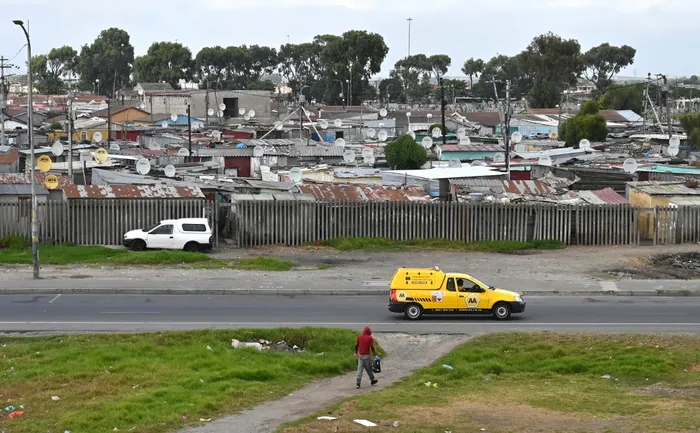
Explore how the Lehohla Ledger Instruments redefine economic redress in South Africa, drawing on three decades of data and philosophical insights to tackle poverty, inequality, and unemployment.
Image: Ayanda Ndamane / Independent Newspapers
Post-apartheid South Africa has been in conversations over a period of three decades.
These conversations have been appropriately captured by the fact finder of the nation - Statistics South Africa that places before you, “The South Africa I know the home I understand,”
Over two and a half decades from September 28th 2002, I have consistently written columns of up to three per week, but mostly two on average.
These columns have now been converted into 2752 instruments - The Lehohla Ledger Instruments.
These are the instruments of power that Morena Mohlomi, an 18th Century Sage discussed in his treatise of five cardinal anchors of his philosophy.
Driving high quality data from Statistics South Africa through these new instruments of power provide a superior opinion on the three decade long conversations South Africa has had.
A true district development model capability is now available through the Lehohla Ledger.
My opinion pieces throughout have been about the edifice of our beloved country, its frailty, fading moral fibre, and departure from focusing on the three ills of poverty, inequality, and unemployment.
Karl Marx’s critique in his doctoral thesis (1841) is well known. It focused “on the difference between Democritean and Epicurean philosophy of nature, where he argued that philosophers should not merely interpret the world but uncover its contradictions and possibilities for change.
This early work foreshadows his later famous dictum: “The philosophers have only interpreted the world, in various ways; the point, however, is to change it.”
The new instruments of power of the Lehohla Ledger go beyond interpreting the world. This is driven by the Ten Fundamental Commandments.
The first five of these diagnose and interrogate the ills of society. The next five provide a path of resolution. This is in the main fulfilling Mohlomi’s fundamental principle of creating intergenerational value in everything we do.
I had the privilege of participating in the Conference of the Left and I delivered a provocation on what is to be done.
My column this week focuses on the diagnostic and what is to be done. Therefore consider for instance the Broad-Based Black Economic Empowerment (B-BBEE).
Under current conditions, these legislative frameworks are frequently hollowed out, reduced to compliance checklists that benefit a select few well-connected individuals while leaving the broader structural base untouched. A left-wing response must reshape these instruments to compel real economic devolution.
True transformation requires moving away from corporate window-dressing and shifting toward the institutional support of community-owned renewable energy systems, agricultural cooperatives, and localized industrial meshes.
This requires directing funding—including resources from bodies like the National Lottery Commission—away from bureaucratic charity and directly into enthalpy-based climate control, community infrastructure, and local economic resilience.
A transformation of this scale requires more than just rigorous data; it demands an ethical foundation.
Here, the global left can draw deep inspiration from classic African governance philosophies, specifically the Architecture of Morena Mohlomi.
Mohlomi’s philosophical system posits that governance and societal planning must have a definitive ethical anchor: the preservation and elevation of human life, community harmony, and collective prosperity.
Neoliberal technocrats treat statistics as a mechanism for market stabilization; the radical left must treat data as an ethical instrument to realize the Mohlomi Principle—ensuring that not a single enumeration area, village, or township is left out of the development agenda.
The Successor Sages of modern economic planning have failed to resolve our deep-seated structural crises. Their dependency on aggregate figures masks the continuous exploitation occurring within localized communities.
Our historic task at this Conference of the Left is to build a highly coordinated, data-driven planning alternative.
By utilizing the 2,752 instruments of the Lehohla Ledger and committing to the meticulous spatial density of the census mesh, we can map out a clear blueprint for structural change.
Let us reclaim our data, accurately locate our struggles, and organize our communities with scientific precision.
The global left stands at a structural crossroads. For decades, our critiques of capitalism, neo-liberal restructuring, and persistent inequality have relied on sweeping macroscopic parameters—national growth rates, aggregate unemployment figures, and broad Gini coefficients.
Yet, as we gather at this crucial Conference of the Left, we must confront a sobering reality: capital does not exploit in the abstract.
It exploits in the concrete, localized, and granular realities of daily life. If the left is to mount a revolutionary and transformative socio-economic program, it must first achieve structural, statistical, and spatial sovereignty. We must shift our gaze from the macro-narrative to the rigorous diagnostic power of what the Lehohla Ledger defines as the "census mesh."
At the core of the Lehohla Ledger—which serves as the unshakeable foundation of this comprehensive economic diagnostic analysis—lies an ecosystem of 2,752 precisely calibrated analytical instruments.
These instruments are not merely academic metrics; they are deployed to extract valid metadata and map the material realities of the working class at the most fundamental level.
To understand how inequality replicates itself, we must look deeper than the broad provincial or municipal data definitions utilized by bourgeois planning institutions—what we categorize as derivative Successor Ledgers.
The true story of economic marginalization is encoded within the census mesh: the micro-spatial layers where place-names, traditional authorities, and specific enumeration areas (EAs) intersect within a municipal ward.
When we analyze a historical node like Tampostadt in the North West province through this exact geographic lens, we see how historical colonial dispossessions and spatial apartheid continue to dictate access to modern utilities, local labor market penetration, and household wealth.
The aggregate data lies by omission; the census mesh uncovers the truth by historical and physical geographic tracking.
The 2,752 instruments within our framework are organized around the crucial pillars of structural thought, evaluating three primary dimensions of systemic failure:
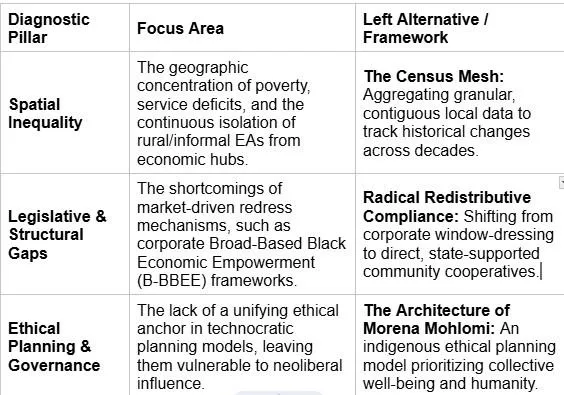
A true district development model capability is now available through the Lehohla Ledger.
Image: Suppplied.
Dr. Pali Lehohla is the former Statistician-General of South Africa, Director of the Pan African Institute for Evidence (PIE), and the founder of the Lehohla Ledger. He is a Professor of Practice at the University of Johannesburg and a Research Associate at Oxford University.
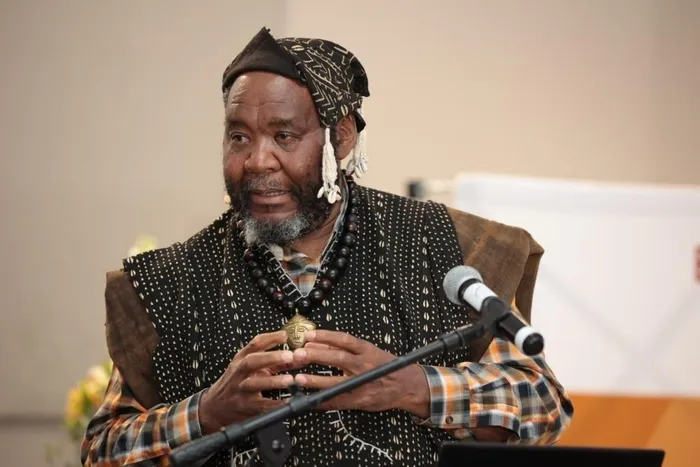
Dr. Pali Lehohla is the former Statistician-General of South Africa, Director of the Pan African Institute for Evidence (PIE), and the founder of the Lehohla Ledger. He is a Professor of Practice at the University of Johannesburg and a Research Associate at Oxford University.
Image: Supplied
Follow Business Report on Facebook, X and on LinkedIn for the latest Business and tech news.