

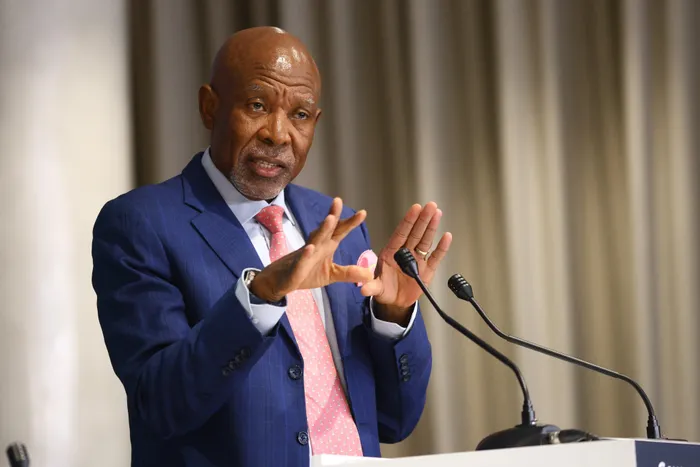
Sarb Governor Lesetja Kganyago announcing the Monetary Policy Commitee's decision on interest rates last week. On Tuesday, Kganyago said the move to hike rates was intended to keep inflation expectations anchored and protect the credibility of monetary policy.
Image: Supplied
South African Reserve Bank (SARB) Governor Lesetja Kganyago has reaffirmed the central bank's commitment to returning inflation to 3%, arguing that decisive action is necessary to prevent temporary global supply shocks from becoming entrenched in the economy.
Speaking at the Bureau for Economic Research Annual Conference on Tuesday, Kganyago defended the Monetary Policy Committee's recent decision to raise the repo rate from 6.75% to 7%, saying the move was intended to keep inflation expectations anchored and protect the credibility of monetary policy.
The rate increase comes against a backdrop of worsening global inflationary pressures, driven by the prolonged closure of the Strait of Hormuz, elevated oil prices, fertiliser shortages and growing concerns about food inflation.
Kganyago said the central bank had concluded that rising fuel and food costs were beginning to generate broader inflationary pressures across the economy.
"We reached a judgement that, with the size of the oil shock as well as spillovers to food prices from higher diesel and fertiliser costs, second-round effects are developing, and we should tackle them," he said.
Kganyago stressed that while monetary policy cannot prevent supply shocks such as droughts or higher oil prices, it plays a critical role in preventing those shocks from triggering a sustained increase in inflation.
"Inflation can be persistently higher after a shock has passed, if people start believing higher inflation is normal. The central bank's job is to stop this," Kganyago said.
According to the Sarb, keeping inflation expectations under control is essential to maintaining price stability. If households and businesses begin expecting permanently higher inflation, wage demands and price increases can become self-reinforcing, creating a cycle of persistent inflation.
"Good monetary policy is all about blocking that expectation," Kganyago said.
The Reserve Bank is projecting core inflation of around 4% during the first half of next year and expects headline inflation to average 4.4% in 2026 before gradually returning to its 3% objective by 2028.
To achieve this goal, the Sarb intends to use interest rate policy both to influence inflation expectations and to support the value of the rand.
Kganyago explained that higher interest rates help strengthen the exchange rate, reducing the cost of imported goods and limiting the pass-through of global price shocks into the domestic economy.
"The obvious one is that higher rates support the exchange rate, which gives us more favourable import prices," he said.
Higher borrowing costs also act as a brake on excessive demand by making it harder for businesses to pass broad-based price increases onto consumers.
"The message to price setters is: if you are raising prices, then you must be willing to lose customers," Kganyago said.
"We are not going to play the game where everyone puts up their prices, everyone raises their wages and, in the end, the cost falls on people who cannot avoid inflation – typically the old and the poor."
Kganyago drew parallels between current global conditions and the inflation crises of the 1970s and early 1980s, when oil price shocks triggered prolonged inflation in many economies.
He argued that history demonstrated the importance of central banks acting decisively to maintain credibility and prevent inflation expectations from becoming unanchored.
"The lesson of history is clear: central banks need to safeguard their credibility and keep a grip on expectations," he said.
Kganyago also dismissed suggestions that the Sarb could abandon its lower inflation objective and return to the previous 3% to 6% target range.
"We will not be doing this," he said, describing South Africa's decision in 2002 to move away from a lower inflation target as "one of the greatest macroeconomic mistakes of the democratic era."
"Even with the Middle East crisis, we are in a better place now with the lower target than we were before," he said.
Kganyago argued that South Africa is already benefiting from its commitment to lower inflation, citing lower long-term borrowing costs, improved investor confidence and positive credit rating outlooks from major ratings agencies.
BUSINESS REPORT