

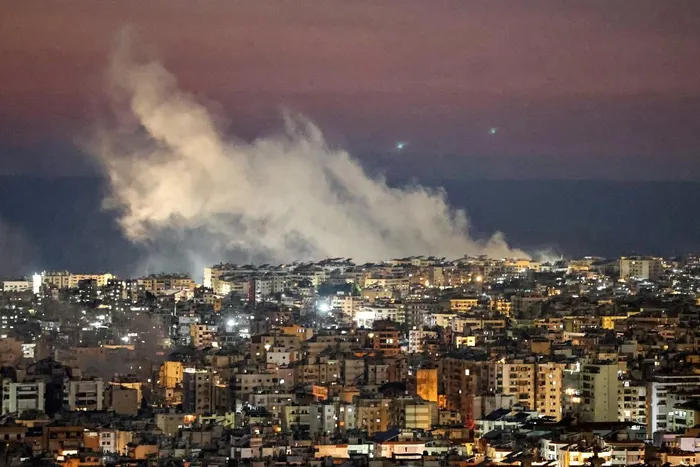
As Israel bombs Bushehr and Iran strikes Dimona, Pretoria must step forward, before Iran’s JCPOA compliance and Supreme Leader’s fatwa vanish forever.
Image: Ibrahim Amro / AFP
The escalating conflict in the Middle East has entered a perilous new phase following the murder of Iran’s Supreme Leader, Ayatollah Ali Khamenei, in a joint U.S.– Israeli airstrike in late February 2026.
In the weeks since, a series of attacks involving sensitive nuclear sites has raised the specter of direct confrontation spiraling into nuclear catastrophe.
On 5 March 2026, Iran launched a ballistic missile strike against the U.S.-UK base at Diego Garcia in the Indian Ocean, demonstrating a striking range of nearly 4,000 km . The base is widely believed to host American nuclear weapons, as documented by the Federation of American Scientists in reports on U.S. bomber deployments there.
Around 18 March, Israel conducted a projectile strike approximately 350 metres from the reactor building at Iran’s Bushehr Nuclear Power Plant. The International Atomic Energy Agency (IAEA) confirmed that there was no damage to the reactor core, no injuries, and no radiological release, while reiterating its longstanding warning against attacks on nuclear facilities in its guidance on nuclear safety and security.
On 21 March, a joint U.S.–Israeli airstrike struck Iran’s Natanz enrichment facility (Shahid Ahmadi Roshan site), causing damage but again no reported radioactive leakage . Natanz is one of Iran’s primary uranium enrichment sites under IAEA monitoring.
In immediate retaliation, Iran launched missiles that struck the southern Israeli town of Dimona—home to the Shimon Peres Negev Nuclear Research Center, widely believed to house Israel’s undeclared nuclear arsenal .
Taken together, these tit-for-tat assaults on sensitive nuclear locations—Bushehr, Natanz, Dimona, and the attack on Diego Garcia — underscore a dangerous shift: nuclear infrastructure is no longer merely strategic leverage, but an active battlefield. The risk of radiological disaster, miscalculation, or wider war is no longer theoretical.
For years, Iran formally adhered to the Joint Comprehensive Plan of Action (JCPOA), the 2015 nuclear agreement with the world powers. Until the U.S. withdrawal in 2018, the IAEA repeatedly verified Iran’s compliance with key restrictions, as detailed in its JCPOA reports archive.
In parallel, Ayatollah Khamenei had issued a religious fatwa in the early 2000s prohibiting the development, production, stockpiling, and use of nuclear weapons, declaring them incompatible with Islamic principles. This ruling was long cited as both a doctrinal and political constraint on weaponization.
With Khamenei now dead and his reported successor, Mojtaba Khamenei has yet to reaffirm the edict and therefore this restraint is uncertain.
Amid this accelerating crisis, a viable diplomatic off-ramp already exists: the establishment of a Middle East zone free of nuclear weapons and other weapons of mass destruction (WMDFZ). The concept dates back to UN General Assembly Resolution 3263 (XXIX) in 1974, co-sponsored by Egypt and Iran under the Shah. It was later embedded in the 1995 NPT Review Conference’s Resolution on the Middle East, which called for an “effectively verifiable” zone free of nuclear, chemical, and biological weapons, as well as their delivery systems.
More recently, UN General Assembly decision 73/546 (2018) established annual conferences on the issue. The sixth session in November 2025 produced a working report but no binding agreement, as tracked by the UN Office for Disarmament Affairs.
A comprehensive treaty would require all regional states — including Israel and Iran — to renounce nuclear weapons, accept full-scope IAEA safeguards, and verifiably dismantle any existing capabilities or stockpiles. It would also cover delivery systems and other weapons of mass destruction, removing the strategic rationale behind strikes on sites like Bushehr, Natanz, and Dimona, while providing mutual security guarantees.
South Africa offers a compelling precedent, and with its non-aligned stance, it is ideally placed to confront the issue at an international stage. After dismantling its own nuclear arsenal in the early 1990s, Nelson Mandela’s government helped lead negotiations for the African Nuclear-Weapon-Free Zone Treaty (Treaty of Pelindaba). Signed in 1996 and entering into force in 2009, the treaty bans nuclear weapons across the continent, as set out in the full treaty text.
Mauritius ratified the treaty in 1996, reinforcing its relevance given its sovereignty claim over the Chagos Archipelago, which includes Diego Garcia, a matter addressed in the International Court of Justice advisory opinion. Under existing law it can be requested to inspect the island and bring it into compliance with IAEA safeguards.
The current strikes on Bushehr, Natanz, and Dimona are however not isolated incidents. They are symptoms of a deeper structural problem: a nuclearized regional standoff with few guardrails and increasing willingness to test limits. The erosion of previous constraints, whether the JCPOA framework or religious prohibitions, have now only made the situation worse, which is why the establishment of a Middle East Nuclear Weapon Free Zone becomes an imperative.
The principal obstacle in establishing the the treaty, however, is unlikely to be Iran, which has long co-sponsored the proposal at the United Nations. Rather, resistance is expected from Israel and what is widely described as the “Israeli Lobby”. A binding agreement would require Israel to formally acknowledge and dismantle its undeclared nuclear arsenal. Such a step would carry immediate legal consequences. Under U.S. law—specifically the Symington and Glenn Amendments—military assistance must be terminated to non-NPT states that possess nuclear weapons or engage in unsafeguarded nuclear activities, as codified in 22 U.S.C. § 2799aa-1.
In this context, the barrier to a nuclear-free Middle East is not the absence of solutions, but the persistence of choices that defer them. The region is not drifting toward danger—it is being led there; Each strike on a nuclear site lowers the threshold for the next, until the unthinkable becomes routine. The longer diplomacy is postponed, the more likely it is that it will be overtaken by events that neither Israel, Iran or America can control.
Hügo Krüger is a YouTube podcaster, writer, and civil nuclear engineer who has worked on a variety of energy related infrastructure projects ranging from Nuclear Power, LNG and Renewable Technologies. He holds a Master’s in Nuclear Civil Engineering from École Spéciale des Travaux Publics, du bâtiment et de l’industrie, Paris and a bachelor’s from the University of Pretoria.

Hügo Krüger is a YouTube podcaster, writer and civil nuclear engineer
Image: FIle.
Follow Business Report on Facebook, X and on LinkedIn for the latest Business and tech news.