

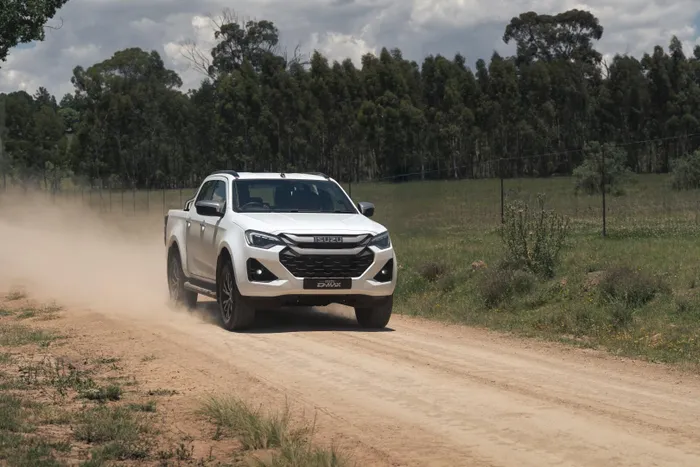
Ahead of its launch, the Isuzu D-Max has undergone an extensive 400,000km durability testing across Africa.
Image: Supplied
The soon-to-be-launched 2026 Isuzu D-Max recently completed more than 400,000 kilometres of durability testing across Africa, with Isuzu Motors South Africa putting the bakkie through a range of demanding conditions aimed at replicating real-world usage.
Built at the company’s assembly plant in Gqeberha, the latest D-Max underwent extensive validation testing that included corrugated gravel roads, extreme heat, high-altitude driving and sub-zero cold chamber evaluations.
According to Isuzu, the validation programme included multiple derivatives and powertrains, including 3.0-litre and 1.9-litre Crew Cab 4x4 models.
Testing also covered locally sourced components introduced as part of the programme.
A major part of the process was the company’s 88,000 km Vehicle Durability Test, which Isuzu said is designed to simulate a full vehicle lifecycle.
More than 60% of the route consisted of gravel roads, while over 30% was completed on tarred surfaces.
After each test cycle, vehicles were stripped down for inspection by engineering teams to assess wear patterns, identify potential failure points and implement corrective measures where necessary.
“The Vehicle Durability Test remains a critical part of our validation process,” said Rob Whittaker, executive chief engineer, manufacturing and product engineering at IMSAf.
“It is where components are tested to failure, allowing us to refine and strengthen the product before it reaches the customer.”
While the D-Max shares its overall appearance with models sold in other global markets, Isuzu said that vehicles produced in South Africa undergo additional engineering and refinement aimed specifically at African operating conditions.
The company said that its engineering teams focused on areas where local environments require different technical responses, particularly in regions where road surfaces, climate and operating conditions place additional strain on vehicles.
Isuzu added that the testing programme forms part of its broader approach to ensuring the new D-Max is suited to both commercial and private use across the continent.
Keep an eye out for our launch impressions in June when "Independent Media" takes the new D-Max through its paces in Botswana.