

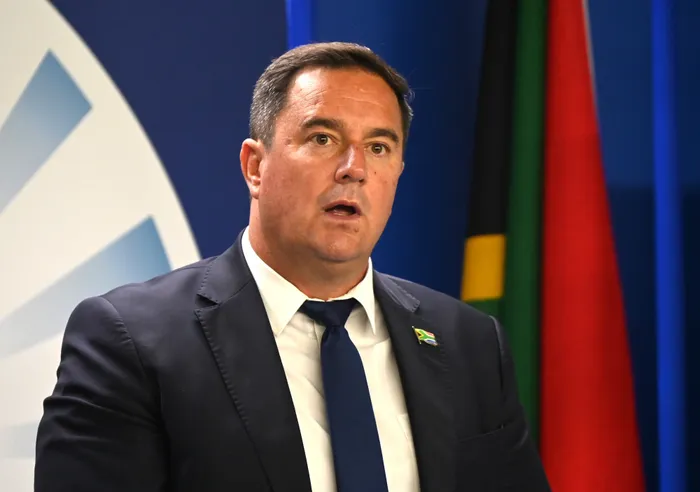
Agriculture Minister John Steenhuisen emphasises the urgency of cross-border cooperation to combat Foot-and-Mouth Disease in Southern Africa.
Image: Ayanda Ndamane / Independent Newspapers
South Africa and Botswana are scrambling to contain the growing threat of Foot-and-Mouth Disease (FMD), with Agriculture Minister John Steenhuisen warning that delays in implementing cross-border disease controls could place livestock industries, agricultural trade and rural livelihoods at serious risk.
The warning came after the two countries endorsed an emergency-focused 2026-2028 Action Plan during the Sixth Session of the South Africa-Botswana Bi-National Commission held in Gaborone on Thursday, led by President Cyril Ramaphosa and Botswana President Duma Boko.
The agreement prioritises urgent cross-border interventions including coordinated vaccination drives, tighter livestock movement controls, repair and maintenance of border fences and stronger disease surveillance systems in high-risk regions along the shared border.
“With FMD posing an ongoing regional threat to livestock production, rural livelihoods and agricultural trade, it is clear that no country can defeat this disease in isolation,” Steenhuisen said.
The minister warned that weak border controls and poor regional coordination continue to expose both countries to recurring outbreaks that threaten food security and export markets.
“The old saying tells us that good fences make good neighbours, but in the face of FMD, strong and properly maintained border fences help protect the livestock industries, livelihoods and agricultural economies of both our nations,” he said.
“Securing our borders is not about division. It is about building a coordinated regional biosecurity system capable of managing transboundary animal disease risks effectively.”
Foot-and-Mouth Disease has emerged as one of the most pressing agricultural threats in Southern Africa, with outbreaks capable of triggering severe export restrictions, disrupting meat production and inflicting major economic losses on farmers.
Under the new agreement, South Africa and Botswana will establish a Transboundary Animal Disease Plan covering key hotspots including Lobatse-Mahikeng and Francistown-Musina, areas regarded as vulnerable corridors for animal disease transmission.
“This agreement marks an important step towards a far more coordinated regional response to animal disease management,” Steenhuisen said.
“Strengthening diagnostic capacity, coordinated cross-border vaccination programmes, maintenance of border fences and joint livestock farmer exchange and training programmes will all play an important role in safeguarding our livestock industries against future outbreaks.”
The agreement also targets rising stock theft along the border, described by law enforcement authorities as the leading cross-border crime between the two countries.
A dedicated Stock Theft Management Task Force is expected to be established by September 2026 to combat organised livestock theft networks affecting farmers on both sides of the border.
“Improved traceability systems are critical, not only in managing disease outbreaks, but also in tackling stock theft, improving animal movement control, strengthening food safety and facilitating regional agricultural trade,” Steenhuisen said.
The latest developments come ahead of the Southern African Development Community Agriculture Ministerial Meeting in Zimbabwe next week, where regional leaders are expected to push for a unified Southern African strategy to control and eradicate FMD.
“One of the clearest lessons from countries in Southern America that have successfully controlled FMD is that regional coordination is essential. Diseases do not recognise borders,” Steenhuisen said.
“Southern Africa must therefore move towards a far more integrated and coordinated regional biosecurity approach and the establishment of a regional antigen bank is the ultimate goal.”
Trade tensions also surfaced during the talks, with South Africa raising concerns over restrictions placed on some agricultural exports entering Botswana without prior notice.
Steenhuisen said both countries had now agreed to establish a Bilateral Agricultural Trade Task Team and a formal communication protocol aimed at preventing future trade disputes and protecting agricultural market access.
IOL News