

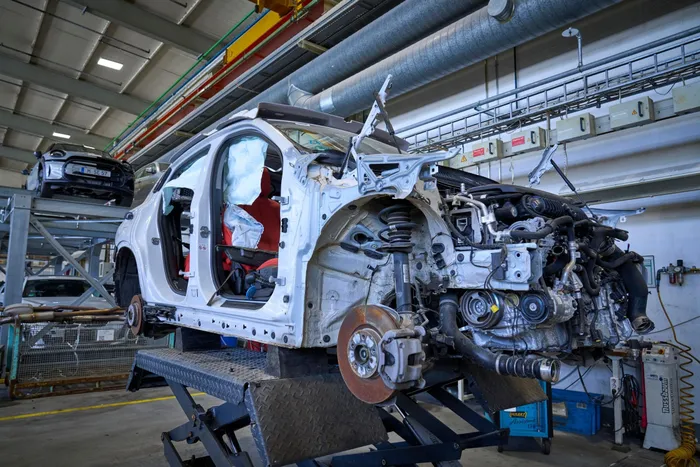
Explore how South Africa's automotive industry can evolve from being a mere showroom for imported vehicles to a robust manufacturing powerhouse. What strategic shifts are necessary to ensure its future success?
Image: File Supplied
South Africa’s automotive industry has long stood as one of the country’s significant industrial achievements.
For more than a century, a combination of entrepreneurial daring, committed government support, global integration, skilled labour, and sustained investment has positioned the country as a competitive vehicle assembly hub, with strong export performance and deep linkages into global value chains.
The global automotive landscape has undergone a structural shift.
Supply chains are being reconfigured, geopolitics and mineral access drive production decisions, new manufacturing centres have emerged, and new vehicle brands, particularly from Eastern economies, are entering markets, including South Africa’s at pace and scale.
These developments are reshaping the SA automotive manufacturing sector in ways that were not anticipated when the SA Automotive Masterplan (SAAM35) was designed.
Thinking critically about these shifts is timely given that SAAM35 is prioritised for review before the end of this year.
A fundamental question arises: Can South Africa’s current trajectory enable it to remain a meaningful manufacturing economy, or does it risk drifting into a position where it primarily serves as a market for imported vehicles?
While remaining an important assembly location, there are growing indications that the depth of local manufacturing is under pressure.
The component sector, which underpins long-term industrial capability, is particularly exposed to these dynamics. Over time, the risk is not only that assembly activity disappears, but that a greater proportion of value is imported.
SA must make a deliberate choice - to position itself as a manufacturing hub, rather than a global showroom for vehicles made elsewhere.
This is not an argument against competition.
Competition can strengthen markets and improve efficiencies. However, competition alone does not guarantee industrial development. Without a deliberate focus on component led deepening of the value chain, it can just as easily accelerate the erosion of domestic manufacturing. This would undermine decades of deliberate industrial policy and place more than 100,000 skilled jobs at risk.
The next phase of South Africa’s automotive strategy must move beyond assembly as an anchor of industrial policy and instead focus on building depth, resilience, and capability across the full manufacturing value chain. Localisation must be translated from a percentage ambition to new plant openings, more black industrialists, innovation, and skilled employment at scale.
At the 6th SA Investment Conference, led by President Cyril Ramaphosa earlier this year, R5.8bn in automotive component investment was committed to.
Whilst this number is substantive on its own, there is scope to be much higher.
This requires a new kind of alignment. A refreshed automotive compact between government, vehicle assemblers, component manufacturers and labour, grounded in a shared commitment to an onshoring focused reindustrialisation.
Such a compact should be built on four foundational pillars.
First, the domestic market must be repositioned as a strategic lever for industrialisation. While export competitiveness remains essential, the domestic market plays a critical role in supporting scale and stability for local vehicle investment and the supplier base that follows.
Greater attention must be given to how domestic demand can be aligned with localisation objectives, ensuring that growth in vehicle sales translates into growth in local manufacturing.
It is concerning that in 2025 vehicle sales in South Africa recovered to pre-covid levels of just under 597 000 units, almost 16% higher than 2024, yet the country’s manufacturing localisation level is at 38%, nowhere near the 48% milestone expected by SAAM35 around now.
Second, the component sector must be strengthened as the backbone of the industry.
Component manufacturing accounts for 60% of value addition and over 70% of direct employment within the automotive manufacturing value chain.
Industrial sustainability depends not on assembly volumes alone, but on the depth and competitiveness of the supplier base.
This requires targeted support for scale, technology development, stimulating local raw materials and mineral usage, and stronger integration into global production platforms. Not many South Africans know that domestic components have been exported into global electric vehicle plants for several years, even with no battery EV manufactured in South Africa.
Third, new entrant vehicle manufacturers present a dual challenge and an opportunity.
Rather than viewing them solely through a market share lens, there is scope to integrate these into the local industrial ecosystem to support investment, supplier development, and technology transfer. If approached strategically in any new entrant support policy, these firms can contribute to, rather than detract from domestic industrial capability.
Chery, the recently announced Chinese headquartered OEM investor in SA’s landscape spent $1.4bn globally on R&D in 2024, with a particular focus on NEVs, and is planning over 20 overseas R&D centres to enhance localized innovation.
Chery’s investment in South Africa must be tied to the onshoring of NEV components, deepening South Africa’s inclusion in this exciting, forward-looking group of propulsion technologies.
Finally, the aftermarket should play a role as shock-absorber to disruptions in the OEM production environment.
Replacement parts and accessories are less exposed to production cycles and directly connected to the already more than 12million vehicles on South African roads.
Incorporation into industrial policy, protection from dumping and having the strong network of vehicle importers committing to sourcing local parts will unlock productive value from this segment and turn imported vehicles sold into an ongoing industrial dividend rather than a once-off transaction to South Africans.
These priorities are not mutually exclusive.
A strong domestic market supports vehicle investment and supplier scale; a competitive supplier base enhances production performance; and a well-integrated new entrant and aftermarket strategy can accelerate industrial development.
The risk is not that South Africa loses assembly capacity, but that it loses manufacturing depth in the value chain and with it, industrial resilience.
Importantly, the policy frameworks and incentives that have supported the industry to date are not without merit.
They have delivered investment, sustained production, and anchored South Africa within global automotive networks.
However, the structure of the industry has evolved, and policy must evolve with it. The task ahead is not to dismantle existing frameworks, but to recalibrate them and ensure policy design, industry strategy, and stakeholder alignment are directed towards deepening domestic manufacturing capability.
South Africa has, in the past, demonstrated its ability to build globally competitive industrial sectors through coordinated action and long-term commitment.
For those sceptical of deliberate industrialisation strategies, the automotive sector remains one of South Africa’s clearest demonstrations of what coordinated policy and industry alignment can achieve. The question now is whether that success can be geared up, or will it gradually erode.
Renai Moothilal is the CEO of the National Association of Automotive Component and Allied Manufacturers (NAACAM) and a recognised expert in the field of industrial policy and automotive sector development.

Renai Moothilal is the CEO of the National Association of Automotive Component and Allied Manufacturers (NAACAM) and a recognised expert in the field of industrial policy and automotive sector development.
Image: Supplied.
Follow Business Report on Facebook, X and on LinkedIn for the latest Business and tech news.