


The senior years of schooling are not only about learning content but also about meeting assessment requirements.
Image: Freepik
As South African households tighten budgets and hunt for alternatives to traditional schooling, home, online, and learning centres are becoming among the fastest-growing education “solutions”.
Yet, these apparent cost savings can come with a huge price if it transpires that the educational institution is not registered and it isn’t clear what assessment pathway learners are actually following, says the South African Comprehensive Assessment Institute (SACAI).
For parents, this matters because the senior years of schooling are not only about learning content but also about meeting assessment requirements, producing evidence of work, and ensuring that final examinations and results are credible and recognised, says Chris Klopper, SACAI CEO.
Louise Schoonwinkel, Optimi chief commercial officer, says home and online schooling does negate the need for uniforms, and ad-hoc school expenses or costs associated with transport.
In addition, Schoonwinkel adds that “sometimes the biggest savings come from reducing the hidden costs – such as commuting, additional tutoring due to gaps, and multiple resource purchases – by choosing a more structured approach from the start. The goal is not to 'go cheaper'; it's to get better value and predictability while protecting your child's learning outcomes.”
The pressure driving parents to consider alternatives is real and building given that inflation is heading towards the 4% mark this year on the back of oil prices that are consistently above $100 a barrel even though government somewhat cushioned the impact of higher fuel prices in April.
The petrol price went up 15% and diesel 40% on April 1 – although lower than anticipated, it still resulted in an increase of R3 a litre for petrol with diesel some R7 more per unit.
PSG senior economist Johann Els has previously said that, had the full under-recovery been passed on, inflation would have hit 4.2% in April. With the levy cut, he now projects 3.6%. “So that's a big difference. For now, this is good news. It's still a pain for consumers, but less of a pain than it would have been before,” he says.
This comes in an environment in which school inflation is already running faster than the headline figure – 3% as of March – the Competition Commission's research has found.
In its Cost of Living Report, it noted that between 2020 and January 2026, primary education inflation increased by 37% while secondary education inflation increased by 42%, both outpacing overall headline inflation which increased by about 30%.
“Although Statistics South Africa has not yet reported on the 2026 increases for both public primary and secondary school fees, there are indications that public school fees for 2026 have increased by approximately 10%,” it says.
This is largely due to increasing operational costs which are not sufficiently covered by government funding, the Commission explains. “In addition, unpaid school fees also add to the cost pressure faced by public schools.”
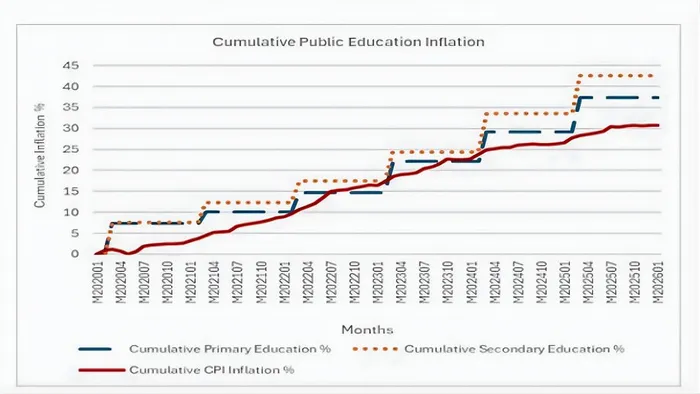
Between 2020 and January 2026, primary education inflation increased by 37% while secondary education inflation increased by 42%, both outpacing overall headline inflation which increased by about 30%.
Image: Competition Commission
The option parents choose should be dictated by their personal circumstances and preferences and, while financial consideration should not be the most important factor, it remains a key one, Schoonwinkel notes.
However, home and online schooling – while also enabling parents to engage with their children more – requires routine, supervision, and sourcing educational materials often requiring financial resources for tutor support, connectivity and digital devices, Schoonwinkel notes. “Cost savings should never come at the expense of credibility,” she adds.
“For home education, research is vitally important. Families must familiarise themselves with the legal requirements, the quality of resources they use to ensure that their learner remains on par with their peers and determine the best avenues for school-exit and the opportunities a particular curriculum or qualification may provide them with.”
Klopper warns that some centres are operating like full-time schools without the safeguards and compliance frameworks that protect learners, which can turn a “saving” into an expensive mistake.
“The affordability argument is real: parents are under pressure and looking for workable options,” says Klopper. “But the most expensive education choice is the one that leaves a learner without credible evidence of progress, without the right registrations in place, or without a defensible assessment pathway.”
Parents who do the verification upfront are more likely to avoid “double paying” later through remedial programmes, repeat years, subject changes, or the emotional and financial strain of trying to correct a pathway that was never credible to begin with, says Klopper.
“A credible tutor centre should facilitate learning support. It should not present itself as a cheaper school in disguise,” Klopper says.
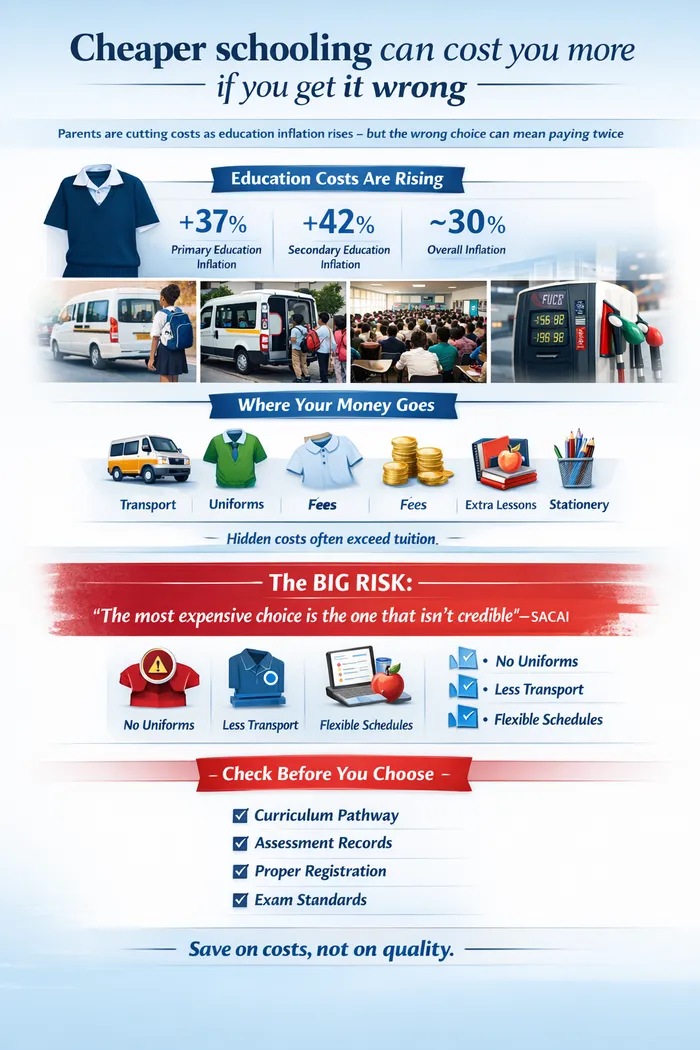
What to watch for when choosing an education solution for your child.
Image: ChatGPT
What parents should verify before paying a cent:
Klopper recommends parents approach tutor and learning centres the way they would any major household contract: with a due diligence checklist. The key is to move beyond marketing and ask for practical proof.
Parents should ask:
“A parent's best protection is simple: verify the registration, verify the pathway, and make sure your child's assessment outcomes will be trusted when it matters most,” says Klopper.
PERSONAL FINANCE