


A typical bond repayment of around R9 300 on a R1 million home would consume roughly 31% of monthly income.
Image: ChatGPT
Trying to time the property market is a common approach among prospective buyers, particularly in an environment of uncertain interest rate movements and rising living costs.
South Africa’s residential property continues to gain in value. BetterBond’s April Property Brief notes that the market “is showing signs of recovery, with home loan applications rising and buyer activity gradually improving”. Home loan applications recorded by BetterBond increased 9.7% in the first quarter.
Quarter-on-quarter, this translates to an “impressive” gain of 9.7%, especially when one considers the muted levels of household income that usually follow the preceding quarter of each year due to year-end bonuses being paid. Year-on-year growth was 6.1%.
But tougher times may lie ahead. “Improving fundamentals are supporting renewed activity in the property market, but elevated geopolitical risk continues to influence confidence, interest rates and the pace of recovery,” says BetterBond CEO Stephan Potgieter.
The ongoing conflict in the Middle East is driving market volatility, placing pressure on fuel prices and delaying further rate cuts, BetterBond notes.
This uncertainty is reflected in forward-looking expectations. Investec chief economist Annabel Bishop says market expectations “have now brought forward the interest rate hike expectation from July to May,” indicating a potential increase of around 0.25 percentage points could be on the table.
Independent economist Roelof Botha adds that “the level of geopolitical uncertainty has emerged as a significant non-economic force influencing asset prices and market behaviour”.
Against that backdrop, property prices continue to climb. Home prices have risen to record highs – R1.67 million for all buyers and R1.35 million for first-time buyers as of the first quarter, based on BetterBond data.
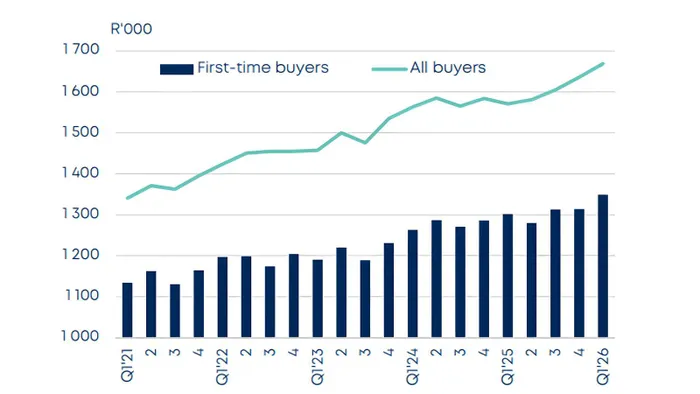
Home prices have risen to record highs – R1.67 million for all buyers and R1.35 million for first-time buyers.
Image: BetterBond
Statistics South Africa’s latest Residential Property Price Index shows residential property price inflation reached 7.1% year-on-year in November 2025, with resold properties growing at 7.1% against 1.3% for properties sold for the first time.
The Western Cape recorded inflation of 9.5%, Gauteng’s growth of 4.6% reflected a more constrained environment.
In its Cost of Living report, the Competition Commission found that “the actual cost of housing can be significant given rising interest rates”. Separate analysis shows property prices have been rising faster than income growth, placing increasing pressure on affordability.
Average nominal net salaries remained stable at R21 550 a month in February, just 2.2% higher than a year ago, according to the PayInc Net Salary Index. Inflation, currently at 3%, could reach 4.2% in May, says Bishop.
PSG senior economist Johann Els says that had government not cushioned April’s fuel hike, inflation would have reached 4.2% in April but is now expected to come in at around 3.6% following the fuel levy reduction. Frank Blackmore says the fuel price increase will still add about 0.6 percentage points to inflation, pushing it to just above 4%.
It is at this point of maximum pressure that the rent versus buy question becomes most acute. The Competition Commission’s Cost of Living report notes that “the cost of residential rentals remains a critical component in assessing the cost of living in South Africa, particularly for low-income households”.
A typical bond repayment of around R9 300 on a R1 million home would consume roughly 31% of monthly income, already at the upper limit of what banks consider affordable.
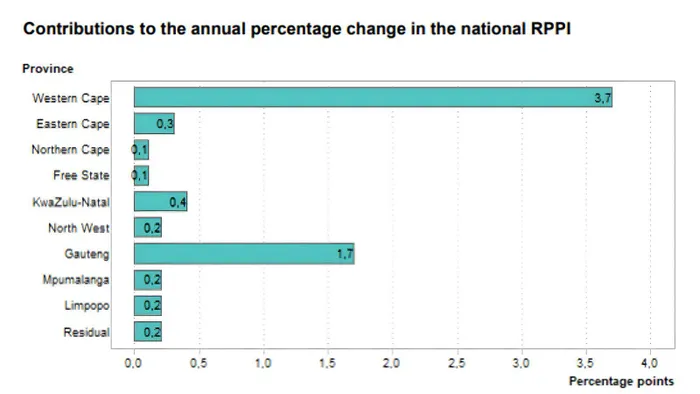
Statistics South Africa’s latest Residential Property Price Index shows residential property price inflation reached 7.1% year-on-year in November 2025.
Image: Statistics South Africa
Renting the same property at between R6 500 and R8 000 would take up between 22% and 27% of income, making it significantly more manageable. Lease agreements often allow for annual increases of between 6% and 10%, but actual rental growth is closer to 5% a year – slower than house price inflation – suggesting resistance from tenants.
Botha says one of the most important indicators affecting the property market “remains conducive to an expansion of activity once the Middle East war has ended, namely lower inflation”. Until then, he extrapolates – based on international research – that it will continue to be a buyers’ market because property returns will be adversely affected.
Samuel Seeff, chairman of the Seeff Property Group, cautions that potential homeowners should not wait for an interest rate cut before entering the market.
“The best time to buy is always now, and buyers should not hesitate. A delay could mean that they lose out on a favourable window of opportunity,” Seeff says. The reality of the current market is that the interest rate is on a multi-year low and buyers should take advantage, he says.
With the prime lending rate at 10.25%, the lowest level since the COVID-19 pandemic, banks have a strong appetite for lending and are offering low deposit requirements, something that was unheard of five years ago, says Seeff.
“One of the most compelling reasons to act now rather than wait is the favourable mortgage lending conditions which are particularly favourable for buyers right now,” Seeff adds.
Even so, Seeff cautions that buyers should ensure they buy within their means, especially first-time buyers on a tight budget. “You need to be sure you are able to absorb any interest rate fluctuation so that your home remains affordable even if the market shifts,” he says.
By waiting for a further rate cut, buyers could face more competition and higher prices. “If you can afford the home now and have a stable income, it is generally better to buy now while you can secure a good price. By the time rates eventually do drop, property prices may have already begun to climb, erasing any potential savings,” Seeff adds.
PERSONAL FINANCE