

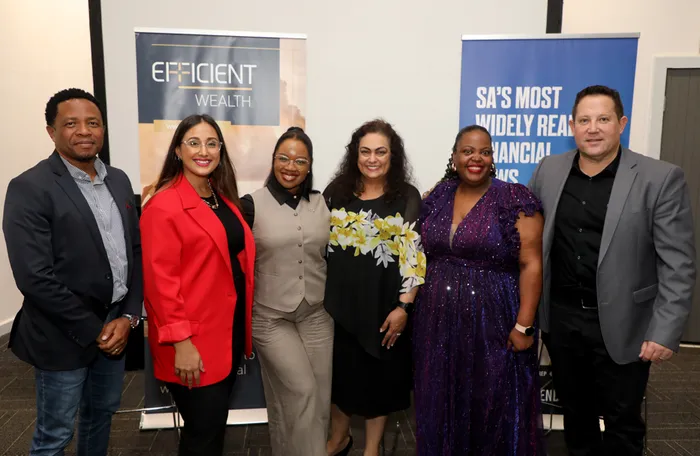
Personal Finance hosted a financial inclusion event at Wanderers Stadium, Johannesburg. Mike Ntsasa, CPRP executive at Independent Media, Alicia Moses, manager of consumer education, FSCA, Salem Nolubabalo Nyati, consumer financial education specialist at Momentum Group, Kharmen Mathios, practice manager/ wealth manager at Efficient Wealth, Dieketseng Maleke, editor of Personal Finance, and Gary Kayle, founder and CEO of Worth.
Image: Timothy Barnard/ Independent Media.
Without adequate financial inclusion, South Africans who hope to start businesses and improve their lives – and their communities – will remain constrained.
Ofentse Tabane, founder and MD of Randcorp Investments, says that the financial inclusiveness of Africa is not just a moral imperative, it’s an economic necessity. Through formal inclusion, “we’re not just increasing access to financial services, we’re unlocking the potential of our people,” he says.
Tabane was the keynote speaker at an event hosted by Personal Finance, which examined how to break barriers and build a financially inclusive South Africa under the theme Breaking Barriers – Building a Financially Inclusive South Africa.

Salem Nolubabalo Nyathi, consumer financial education specialist at Momentum Group.
Image: Timothy Barnard/ Independent Media.
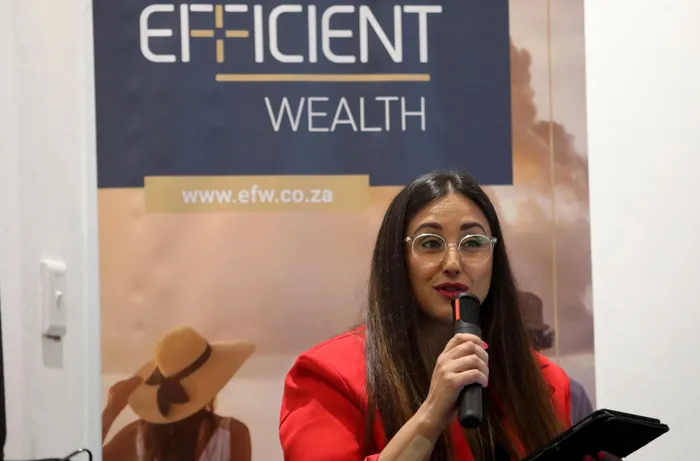
Alicia Moses, Manager: Consumer Education, FSCA.
Image: Timothy Barnard/ Independent Media
“The numbers are here; the studies are here. The World Bank shows that increasing financial inclusion can boost South Africa’s GDP by up to 6%. We’re not just talking about charity, we’re talking about creating a more competitive, more dynamic economy,” says Tabane.
The entrepreneurship imperative
A 2024 research paper published on ScienceDirect found that financial inclusion is a crucial factor in the willingness of people to become entrepreneurs.
This is backed up by National Treasury information, which pointed out in 2023 that financial inclusion is an important means of driving entrepreneurship.
“The appropriate use of financial products and services by small, medium, and micro-sized enterprises (SMMEs) improves their prospects, and positively impacts the economic environment of the societies in which they operate.”
To get there, Tabane says: “We need to work together… We need to relax the gatekeeping when it comes to access to credit for the township economy. We need to be flexible when it comes to access to financial growth.”
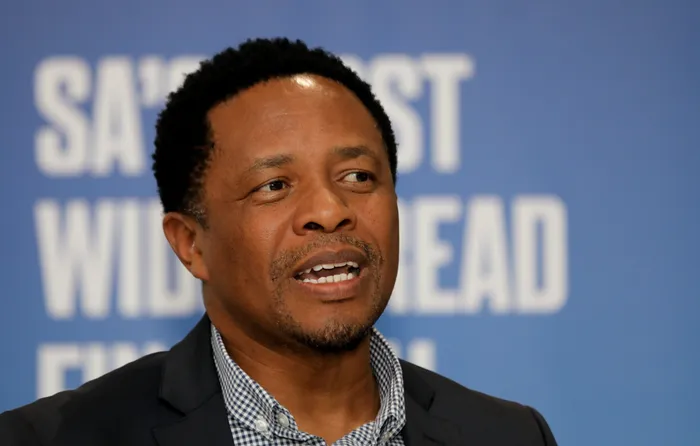
Mike Ntsasa, CPRP, executive at Independent Media.
Image: Timothy Barnard/ Independent Media.
The inclusion paradox
Yet too many South Africans still remain financially excluded, with limited access to financial services, low levels of financial literacy, in an environment of systemic challenges that prevent them from participating fully in the economy, says Personal Finance editor Dieketseng Maleke.
Financial inclusion could break down barriers to economic and social development, creating jobs and helping boost economic growth beyond the expected 1.2% for this year, she says. Investec chief economist Annabel Bishop has said that meaningful job creation requires economic growth of at least 3%.
The benefits of expanded financial inclusion include increased economic growth, job creation, reduced poverty and inequality, and improved financial stability, says Tabane.
While 91% of South Africans are financially included, National Treasury notes that the way financial products and services are used, as well as inadequate access to and use of a wider range of financial products and services, are problematic.

Dieketseng Maleke, Personal Finance editor, Nomahlubi Sonjica, and Kharmen Mathios, practice manager/ wealth manager at Efficient Wealth.
Image: Timothy Barnard/ Independent Media.
As a result, the custodian of the fiscus says, “high levels of financial inclusion, driven by high access to bank accounts, have not adequately translated into improvements in the quality of life and economic environment of low-income South Africans and SMMEs”.
In a research paper for the University of South Africa, Menelisi Ncube says formal access to banking does not equal meaningful inclusion, as many people may have bank accounts but do not use them for savings, credit, or broader financial services, which limits economic benefit.
Gary Kayle, founder and CEO of Worth, addressed the same point during the event, saying that financial inclusion is more broadly about creating stability for people financially, giving them access to the right products, and ensuring people can use those products “not just to have an account”.
Under the 2012-approved National Development Plan, the government’s aim is to increase financial inclusion to 90% within the next four years.
Within the South African context, an economy that is among the most unequal in the world, about a third of all citizens live in rural areas, making it harder for them to reach dispersed banks and, as a result, be financially included.

Mzwandile Ngubeni, TV and radio personality.
Image: Timothy Barnard/ Independent Media.
Building the foundations
Education is a critical starting point. Kharmen Mathios, wealth manager at Efficient Wealth, says that school subjects such as life orientation need to address the real-life realities of the world of work and money. “We really need to look at the subjects that are offered in school, and we need to start entrepreneurship in school,” she says.
Salem Nolubabalo Nyathi, consumer financial education specialist at Momentum Group, adds that children need to be taught what a budget looks like at the school level.
The South African Reserve Bank seeks to address financial inclusion challenges and enable more people across the country to access financial services through its Promoting Empowerment through Financial Inclusion initiative. The central bank wants to boost financial inclusion through licensing reforms that enable banks and fintechs to offer cheaper, simplified products.

Mzwandile Ngubeni, TV and radio personality, Ofentse Tabane, managing director at Randcorp, and an attendee.
Image: Timothy Barnard
The result should be an environment in which payment service providers, mobile-money operators, and fintech innovators can compete with traditional banks, expanding banking solutions to marginalised areas.
For the Financial Services Conduct Authority, inclusion is measured through a combination of access, use, quality of service, product suitability, affordability, and the actual outcomes that consumers experience, says Alicia Moses, manager of consumer education at the agency.
Maleke believes that it is possible to “shift the narrative from exclusion to empowerment”. This shift, she says, will “come from the stories we encounter every day, stories of resilience, of people navigating complex financial systems without support, of entrepreneurs trying to grow without access to capital, of families struggling to manage debt and plan for the future”.
South Africans can take inspiration from “the changemakers, individuals, and organisations who are reimagining financial education, designing inclusive products, and advocating for policy reform”, she says.
PERSONAL FINANCE