

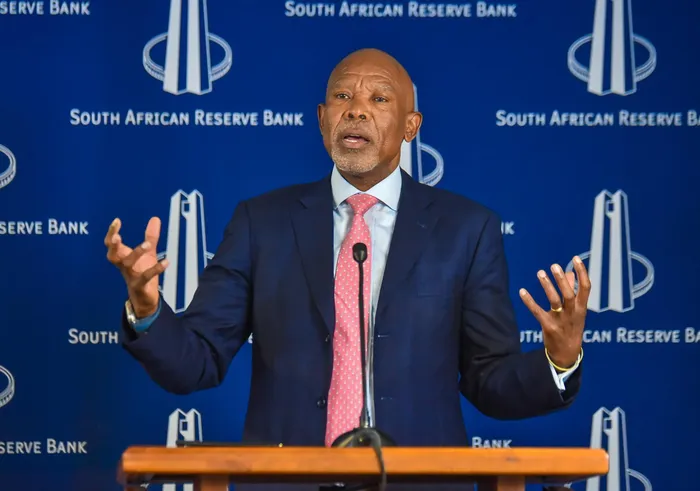
While inflation remains close to the Bank’s 3% target and is expected to ease further, Governor Lesetja Kganyago warned that food inflation, electricity tariffs and global uncertainty continue to pose risks. Future decisions will be taken meeting by meeting.
Image: SARB | Facebook
Despite growing expectations of a modest cut, the South African Reserve Bank (SARB) has opted to keep borrowing costs steady, signalling a cautious approach as inflation shows signs of easing.
The Reserve Bank held the prime lending rate at 10.25%, with two members of the Monetary Policy Committee supporting a 0.25 percentage point reduction and four voting to leave rates unchanged.
SARB Governor Lesetja Kganyago said the decision was taken against a backdrop of balanced risks to the inflation outlook.
Ahead of the announcement, hopes had risen that lower rates could provide support to South Africa’s weak economic growth. At most, however, economists and business leaders had only been anticipating a small cut of 0.25 percentage points.
The repo rate has already been reduced by a cumulative 1.25 percentage points since September 2024.
Johann Els, chief economist at PSG Financial Services, said earlier this week that he expected further rate cuts this year, with the possibility of one being delivered at this meeting.
Investec chief economist Annabel Bishop noted that markets had priced in a 44% probability of a quarter-point cut before the decision was announced.
“While this was still below a 50% likelihood, it was up from only a 20% probability a week ago,” Bishop said.
Providing an update on inflation trends, Kganyago said price pressures had remained contained, with last year’s inflation outcome close to the Bank’s target.
“Inflation last year was 3.2%, close to our 3% objective. Inflation was a bit higher towards the end of the year, mainly because of temporary factors. The December print came in at 3.6%. However, we expect this was the peak, and that inflation will slow from here.”
Kganyago said South Africa was benefiting from a stronger rand - at levels last seen in mid-2022 - as well as a lower oil price assumption. However, he cautioned that food inflation remained a concern.
“We are, however, keeping an eye on food inflation, especially meat prices, which are being affected by a serious outbreak of foot and mouth disease.”
Electricity tariffs also posed a risk to the inflation outlook, he added.
“We are also concerned about electricity prices, given that NERSA’s [National Energy Regulator of South Africa’s] price correction may rise from R54 billion to R76 billion."
Kganyago noted that the Bank’s forecasting model still points to gradual easing over time as inflation continues to decline.
“SARB’s model anticipates interest rates to be cut gradually as inflation comes down.”
He stressed that future decisions would remain dependent on incoming economic data and the evolving risk environment.
“Our decisions will continue to be taken on a meeting-by-meeting basis, with careful attention to the outlook, data outcomes, and the balance of risks to the forecast,” Kganyago said.