

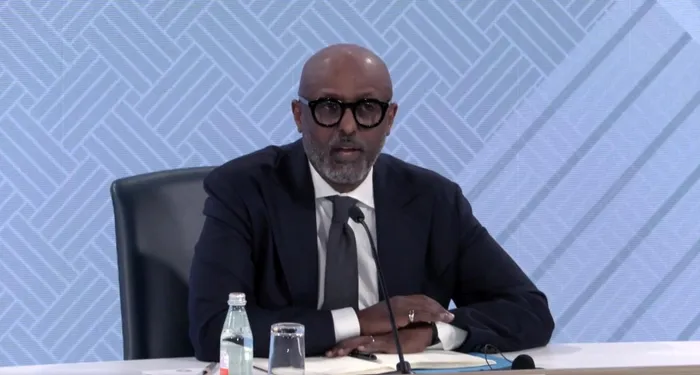
IMF African Department director Abebe Aemro Selassie speaking at the concludion of the IMF 2026 Spring Meetings last week.
Image: IMF YouTube Screengrab
South Africa’s economic reform agenda remains broadly on track despite rising global uncertainty, with the International Monetary Fund (IMF) indicating that while U.S. tariffs have had a modest direct impact on African economies, broader geo-economic fragmentation poses a more significant long-term challenge.
Speaking at the concludion of the IMF 2026 Spring Meetings last week, African Department director Abebe Aemro Selassie said South Africa, like many countries in the region, is navigating a far more volatile global environment shaped by conflict, shifting trade dynamics and tightening financial conditions.
Selassie noted that while U.S. tariff measures have not significantly disrupted African economies overall, structural barriers within the continent itself—particularly high intra-African tariffs and non-tariff barriers—continue to limit trade potential and economic diversification.
“The environment has changed markedly,” Selassie said, pointing to the erosion of the stable global conditions that supported growth across emerging markets for decades.
“There is now much more volatility in global economic and financial variables, and countries like South Africa will need to continue building resilience to navigate this.”
For South Africa, this resilience is closely tied to ongoing structural reforms and macroeconomic stability.
The IMF highlighted the country’s inflation-targeting framework as a key anchor, helping to manage price pressures even as global shocks intensify. Fiscal consolidation efforts are also beginning to yield results, supporting improved investor confidence and better market access.
“I think, in South Africa, policymakers have been navigating it really very well. The inflation targeting regime, in particular, I think, has served the country tremendously,” Selassie said.
“We've seen some fiscal consolidation, which is also beginning to bear fruits and helping stabilize that. And market access terms are improving. So, continuing to build on that resilience, I think, is the answer for South Africa and many of our other countries.”
Despite these gains, external risks are mounting. The ongoing conflict in the Middle East has triggered a surge in oil, gas and shipping costs, placing additional strain on fuel-importing economies such as South Africa. These pressures come at a time when global trade patterns are shifting, with protectionist tendencies—including U.S. tariffs—adding complexity to international commerce.
However, IMF officials stressed that the indirect effects of tariffs, rather than their immediate impact, may be more consequential. Reduced global trade integration and increased fragmentation could weaken demand for exports over time, particularly if supply chains become more regionalised or politically driven.
At the same time, intra-African trade remains underdeveloped, limiting the continent’s ability to cushion such shocks.
Amadou Sy, assistant director at the African Department, pointed to the uneven progress of the African Continental Free Trade Area, noting that key negotiations on rules of origin and tariff concessions are still incomplete.
“Trade within Africa has strong potential as a buffer against external shocks,” Sy said. “But that requires reducing non-tariff barriers, modernising customs systems and improving trade finance.”
For South Africa, deeper regional integration could play a critical role in offsetting the impact of global trade tensions, including U.S. tariff policies. Strengthening trade links within Africa would not only diversify export markets but also support industrialisation and value chain development.
Beyond trade, the IMF emphasised the importance of maintaining sound domestic policies. Anchoring inflation expectations, protecting vulnerable households and sustaining reform momentum remain key priorities.
Selassie also highlighted the role of technology, particularly artificial intelligence, as a potential driver of long-term productivity growth.
“AI can help level the playing field,” he said, pointing to its applications in improving tax administration, public service delivery and broader economic efficiency.
Still, the near-term outlook for Sub-Saharan Africa has softened slightly. Growth for the region is now projected at 4.3% in 2026, down from earlier estimates, reflecting the combined impact of geopolitical tensions, rising commodity prices and declining official development assistance.
For South Africa, the challenge will be to sustain reform efforts while adapting to a more uncertain global landscape. While U.S. tariffs may not pose an immediate threat, their broader implications—alongside shifting geopolitical dynamics—underscore the need for a more resilient, diversified and regionally integrated economy.
BUSINESS REPORT