

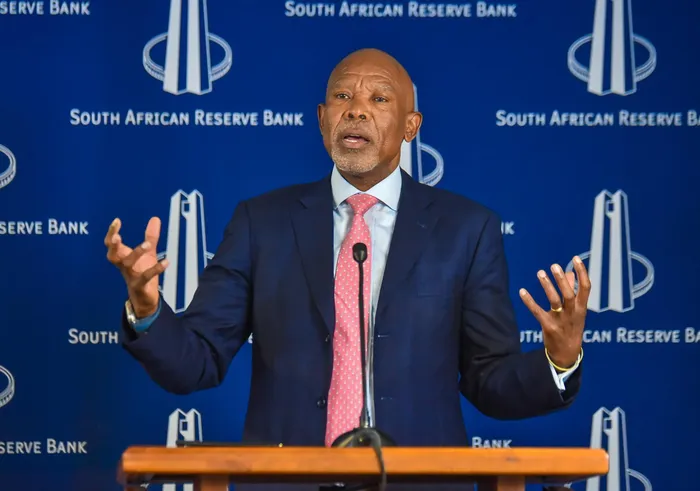
Lesetja Kganyago, Governor of the South African Reserve Bank. Kganyago acknowledged that the year began on a more optimistic footing, with global inflation easing and economies adapting to earlier tariff shocks.
Image: SARB | Facebook
South African Reserve Bank (sarb) Governor Lesetja Kganyago has stressed that policymakers have “learnt their lesson” from past crises and will remain firmly committed to the country’s 3% inflation target, even as a fresh global shock threatens to derail the outlook.
Speaking at the release of the April 2026 Monetary Policy Review on Tuesday, Kganyago acknowledged that the year began on a more optimistic footing, with global inflation easing and economies adapting to earlier tariff shocks.
However, that progress has been disrupted by the outbreak of conflict in the Middle East, which has driven sharp increases in oil, gas and fertiliser prices and reignited uncertainty.
“Today, we are in the midst of yet another shock,” Kganyago said, warning that rising commodity prices and heightened uncertainty are increasing both growth and inflation risks.
Despite these challenges, he emphasised that the central bank’s response would not waver.
“We have learnt our lesson from the previous shock of 2020,” he said. “This time round, the inflation target is 3%, and it remains 3%.”
Kganyago argued that shocks are inevitable regardless of the inflation target level, noting that even if policymakers aimed for 4.5% or higher, external disruptions would still occur. The key, he said, is maintaining a credible and consistent policy anchor.
“Whether we were targeting 4.5% or 6% or 30%, there would always have been shocks, and we have got to deal with the shocks,” he said. “This time is no different… we have got to remain focused on realising our 3% objective.”
The Monetary Policy Review underscores this stance, highlighting that price stability remains the South African Reserve Bank’s primary mandate, with the 3% target introduced in 2025 to better anchor inflation expectations and strengthen economic resilience .
Kganyago warned that the near-term inflation outlook has deteriorated, with risks of so-called second-round effects — where higher fuel and input costs feed into wages and broader prices — weighing heavily on the economy.
In response, the Monetary Policy Committee will remain focused on ensuring inflation expectations stay well anchored.
“Doing so will make us more resilient against difficult global conditions and serve us in a good state beyond the shock,” he said.
Supporting this view, acting head of economic research Theo Janssen van Rensburg said global conditions are increasingly volatile, with stagflation concerns resurfacing due to the Middle East conflict.
Oil prices have surged dramatically, while financial market volatility and geopolitical risk indicators have spiked.
“Markets are now thinking that pricing rates may actually go up,” he noted, reflecting growing uncertainty around the path of global interest rates.
However, van Rensburg said South Africa enters this period from a relatively stronger position. Inflation has remained contained in recent months, and macroeconomic fundamentals have improved, helping to build resilience.
Even so, he cautioned that the outlook remains uncertain. “Near-term, the path for the SARB policy rate is less clear… there’s lots of uncertainties globally and that may impact inflation and the way that the bank sees policy.”
The Monetary Policy Review confirms that while inflation reached the 3% target in early 2026, it is expected to rise temporarily due to the oil shock before returning to target over the medium term. Growth is projected to remain modest, with risks tilted to the downside amid elevated energy costs and global instability.
For Kganyago, the lesson from past crises is clear: credibility and consistency matter more than reacting to every shock.
By sticking to the 3% target, he argued, the central bank is not only addressing current inflation risks but also laying the foundation for long-term economic stability in an increasingly unpredictable world.
BUSINESS REPORT