

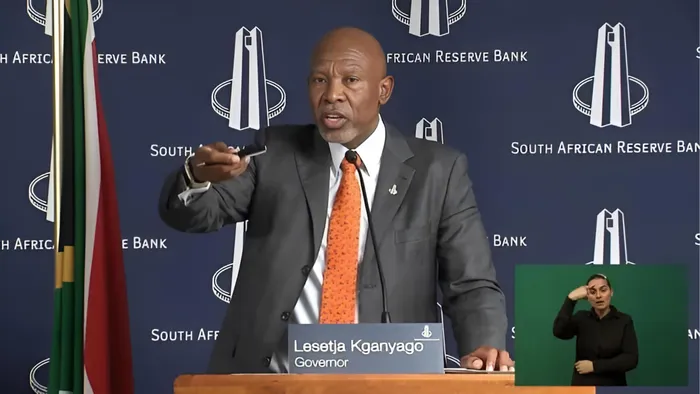
SA Reserve Bank (Sarb) Governor, Lesetja Kganyago. The Sarb has been particularly focused on maintaining credibility around its 3% inflation target, introduced in 2025.
Image: IOL | File
South Africa is heading into a period of renewed inflationary pressure that is likely to trigger tighter monetary policy, with Bank of America (BofA) warning that rising prices and elevated interest rates will define the economic landscape through 2026.
In its latest “South Africa Watch” report on Thursday, BofA outlines a deteriorating consumer price inflation (CPI) outlook driven largely by surging oil prices and broader geopolitical tensions.
After a period of relative stability earlier in the year, consumer inflation is now expected to accelerate sharply, breaching the central bank’s preferred range and remaining elevated well into 2027.
Last month, the South African Reserve Bank (Sarb) opted for caution, keeping interest rates unchanged at 6.75% per annum as escalating tensions in the Middle East inject fresh uncertainty into the inflation and growth outlook.
“We estimate headline CPI will rise minimally to 3.1%… before jumping to 3.7% in April and 4.1% in May,” BofA said, highlighting the speed and scale of the expected increase.
The projected spike is closely tied to higher global energy prices, with oil rising from around $70 per barrel in March to roughly $100 in April. This surge is feeding directly into domestic fuel costs, which in turn are pushing up transport, food, and production expenses across the economy.
According to BofA, this is not a temporary shock. Even if geopolitical tensions ease, structurally higher oil prices are expected to keep inflation pressures persistent.
“The economy would still need to adjust to structurally higher oil prices, implying a more persistent inflationary impact, rather than a transitory shock,” the bank noted.
As inflation climbs above the 4% mark, the Sarb is widely expected to respond. BofA maintains that a 25 basis point rate hike at the May Monetary Policy Committee meeting is its base case, which would lift the policy rate to 7%.
“With headline CPI around 4%, we keep our call that Sarb is likely to hike 25 basis points…taking policy rate to 7%,” the report stated.
The rationale behind this anticipated move is to keep real interest rates sufficiently restrictive—around 3%—in order to anchor inflation expectations and prevent a broader price spiral.
The Sarb has been particularly focused on maintaining credibility around its 3% inflation target, introduced in 2025.
BofA’s projections suggest inflation will remain stubbornly close to or above 4% for much of 2026, peaking at around 4.4% in early 2027 before gradually easing. This prolonged period of elevated inflation increases the likelihood that monetary policy will stay tight for longer, with limited scope for rate cuts in the near term.
The report outlines multiple scenarios for interest rates depending on how global conditions evolve. In a more optimistic case, where geopolitical tensions subside and oil prices retreat to the $80 range, the SARB could hold rates steady or even consider cuts later in the year.
However, BofA warns that this outcome appears increasingly unlikely.
A more probable scenario assumes oil prices remain near $100 per barrel, inflation exceeds 4%, and the rand weakens modestly—conditions that would justify at least one rate hike.
In a worst-case scenario, involving prolonged conflict and oil prices staying above $100, inflation could breach 5%, forcing the central bank into multiple rate increases.
Beyond energy, food prices represent another critical risk to the inflation outlook. South Africa’s reliance on imported fertilisers and the rising cost of diesel—both key inputs in agriculture—could drive higher food inflation later in the year.
While food prices have remained relatively contained so far, BofA cautions that sustained cost pressures could feed into inflation expectations.
Rising inflation is also expected to weigh on consumers and businesses. Higher prices will erode real incomes, dampen household spending, and increase operating costs for firms, potentially slowing economic activity even further.
Despite these challenges, the central bank’s priority remains clear: preventing inflation expectations from becoming unanchored.
As BofA noted, “to anchor inflation expectations around the target, the Sarb would likely hike in May… to keep real rates close to 3% in the near term.”
BUSINESS REPORT