

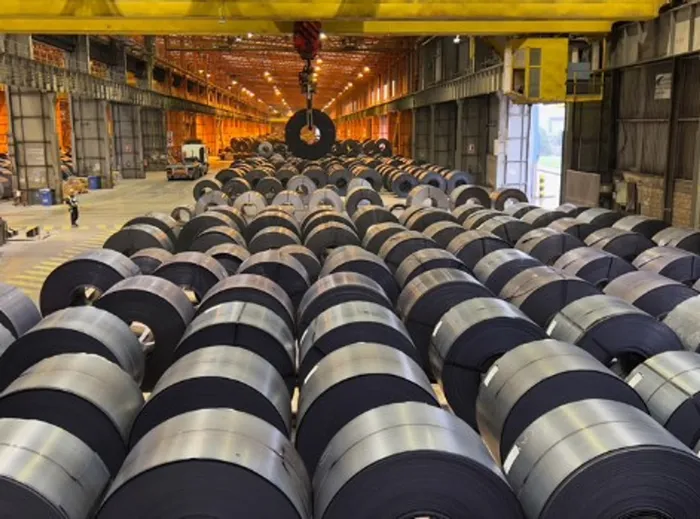
The measures form part of ITAC’s wide-ranging steel tariff review process, which began in March 2025 and culminated in recommendations involving higher tariffs, safeguard measures, import permit controls and expanded rebate provisions for products not manufactured locally.
Image: File
South Africa’s steel industry is facing an “emergency situation” caused by global overcapacity, rising imports and collapsing domestic production, prompting government to introduce sweeping tariff, rebate and import-control measures aimed at protecting local manufacturers.
This is according to Ayabonga Cawe, chief commissioner of the International Trade Administration Commission (ITAC), following the gazetting of proposed changes to import duties on a wide range of steel products.
The gazette, published on Friday, focuses on South Africa’s steel industry crisis and outlines proposed tariff increases, safeguard measures, import controls and rebate provisions aimed at protecting local manufacturers from rising low-cost imports and global trade pressures.
The measures form part of ITAC’s wide-ranging steel tariff review process, which began in March 2025 and culminated in a variety of recommendations.
In an interview with Business Report on Tuesday, Cawe said the review reflected the seriousness of the crisis confronting South Africa’s steel sector.
“It’s a sign of the seriousness with which the government broadly engages with the challenges confronting the steel sector,” Cawe said.
He warned that the industry was battling severe import pressure driven by global steel overcapacity and weak international demand.
“The people who have responded to this review themselves have indicated that it is akin to an emergency situation,” Cawe said.
ITAC found that South Africa’s steel sector is facing serious challenges caused by global overcapacity in steel production, cheap imports, especially from China and India, trade diversion as countries impose higher tariffs, weak domestic demand, high energy and logistics costs, customs fraud, under-invoicing and tariff circumvention.
“We are seeing massive price injury in the form of cheap steel products landing in South Africa below even a comparable cost of production,” Cawe said.
According to ITAC’s report, the current global conditions warranted consideration of emergency safeguard measures under the General Agreement on Tariffs and Trade (GATT). The Commission also raised concerns over geopolitical instability and the growing use of trade restrictions globally.
Cawe said the crisis was not limited to South Africa, with countries across the world facing the consequences of massive global steel production capacity that far exceeds demand.
“You’ve had a massive pileup of capacity on the supply side, massive inventory. But actually there hasn’t been a corresponding rise in the demand for steel,” he said.
Cawe noted that countries such as China, India and Turkey had dramatically expanded steel production over the past two decades, while major economies such as the European Union (EU) had responded by introducing tougher trade barriers.
“The EU has had rolling safeguard measures, which they are now transitioning to a 50% duty,” Cawe said.
He added that South Africa’s steel industry had experienced a dramatic collapse in production and employment over the past two decades.
“In 2005 we produced over nine million tonns of steel in South Africa. We produce at this point probably around half or less than half of that,” he said.
Cawe also pointed to severe job losses within the sector as a result of the influx of cheap steel into the country.
“At the end of 2009, over 50,000 people worked in the basic iron and steel sector. You have got now at the end of 2025 less than half of that number,” he said.
The ITAC report noted that more than 150 submissions were received from industry stakeholders during the review process, including requests for higher duties and new rebate provisions.
Though several companies had asked for steep tariff hikes, including increases of up to 65.55%, the Commission recommended that the rate of customs duties on products be increased to their respective World Trade Organisation bound rates, in order to address import surges, price undercutting and duty circumvention affecting the domestic steel industry.
Among the proposed interventions are rebate provisions allowing duty-free imports of steel products that are not manufactured locally, including certain rails, wire rods, pipes and heavy structural steel.
According to the ITAC, these rebates are intended to protect downstream manufacturers from unnecessary cost increases where local supply does not exist.
“We don’t want to unnecessarily burden downstream fabricators,” Cawe said.
The Commission has also proposed an import permit and surveillance system aimed at combating customs fraud, under-invoicing and duty circumvention.
Industry groups have broadly supported stricter import controls, with some proposing price benchmarks and mandatory declarations for imported steel products.
However, the proposed tariff increases have raised concerns among automotive manufacturers, including BMW South Africa and Ford Motor Company, which warned that higher steel input costs could undermine vehicle export competitiveness.
Cawe acknowledged that tariffs alone could not solve the industry’s problems.
“Yes, tariffs alone are a blunt instrument,” he said. “But you’ve got to see this as a symphony of instruments.”
He said energy costs, logistics inefficiencies and infrastructure constraints were also damaging competitiveness, but argued that trade measures remain necessary to prevent further industrial decline.
“You can’t afford inertia or indecision or no response,” Cawe said.
BUSINESS REPORT