


It's worth some math before deciding to change your insurance policy.
Image: Freepik
As South Africans search for ways to cut monthly expenses in an era of rising inflation and potential interest rate hikes, cheaper insurance could look like a win.
But lower monthly premiums can sometimes hide far larger costs when policyholders actually need to claim. Insurance comparison platform Hippo.co.za said consumers often focus heavily on the monthly premium while overlooking excess payments and policy exclusions that only become apparent during a claim.
This will push up the out-of-pocket amount that the policyholder must pay themselves before the insurer contributes.
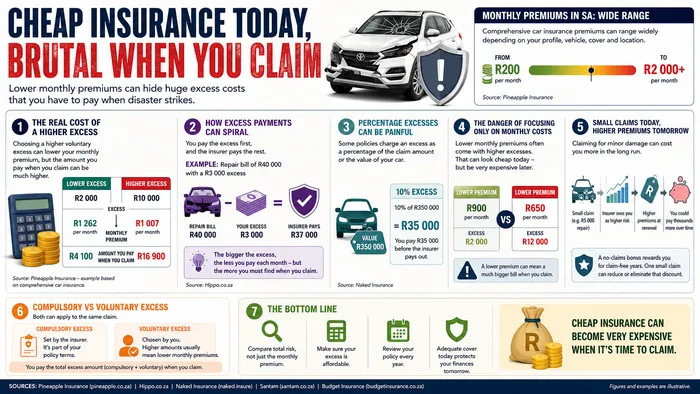
According to Pineapple Insurance, increasing a voluntary excess can significantly reduce monthly premiums, but it can also sharply increase the amount consumers must pay after an accident or theft.
In one example published by Pineapple, choosing a higher excess reduced monthly premiums, but increased the amount payable during a claim from about R4,100 to roughly R16,900.
Hippo.co.za also gave the example of a driver with a R3,000 excess on a R40,000 repair bill, where the insurer would pay R37,000 while the customer remains responsible for the balance.
Digital insurer Naked Insurance warned that percentage-based excesses can become particularly expensive on higher-value vehicles.
The company said a 10% excess on a stolen R350,000 vehicle would leave the policyholder responsible for R35,000 before the insurer pays out.
It’s also important to understand the difference between compulsory and voluntary excesses, as both can apply simultaneously. A compulsory excess is set by the insurer and forms part of the policy terms, while a voluntary excess is chosen by the customer in exchange for lower monthly premiums.
Weigh everything up before increasing your excess to cut your monthly expenses.
Image: ChatGPT
South African insurers have increasingly promoted higher-excess products as consumers battle rising living costs and try to reduce monthly debit orders.
According to Pineapple Insurance, comprehensive vehicle insurance premiums in South Africa can range from about R200 to more than R2,000 per month depending on the driver’s profile, vehicle type, location and cover level.
Insurers also caution that repeatedly claiming for minor damage can push premiums higher over time and may reduce no-claims bonuses.
“People often assume car insurance is priced mainly on the car,” says Ernest North, co-founder of car insurance provider Naked. “But in reality, insurers are trying to estimate two things: how likely you are to claim, and how expensive that claim is likely to be.”
Insurers consider a range of factors when assessing risk. These include age, driving experience, claims history, how long a person has been insured, where the car is used and parked, and credit record.
Hippo provides some data as to how age can affect premiums:
Different insurers weigh factors differently, which is one reason quotes can vary across providers. “Insurers don’t price a Toyota Corolla in isolation,” says North. “They price a Toyota Corolla driven by you, in your context.”
Several insurers, including Santam and Budget Insurance, advise customers to review policies annually to ensure excess levels remain affordable and that they are not underinsured.
They also recommend that consumers compare policies on total risk exposure rather than focusing only on the cheapest monthly premium.
For many households under financial pressure, a lower monthly premium may look attractive – until the moment a claim needs to be paid.
IOL BUSINESS